Why do card processors treat VPN and proxy services as high-risk, and how can they take card payments?
A consumer VPN and a residential proxy network side by side as a card processor sees them, the gap in Visa's fraud evidence rules, and the records worth keeping.
Press the card to run an example sale.
Card processors treat VPN and proxy services as high-risk because the product hides where a buyer is, which is what fraudsters rent it for, and because a privacy seller struggles to prove who paid when a fraud dispute arrives. Such a seller can still take cards through a platform that accepts restricted categories, a high-risk merchant account, or a card checkout paid to its own wallet.
The two products are not judged alike, though. This article puts a consumer VPN and a residential proxy network side by side as a processor sees them, explains the evidence gap in Visa's fraud rules, and lists the records worth keeping when each plan period is an invoice the customer pays.
What the published rules actually say
No card network rule read for this article names VPNs or proxies; the restrictions come from individual payment companies. Paddle, a merchant of record for software, lists "VPN and Proxies (Restricted Category)" on its acceptable use page and says that for restricted offerings "Paddle must do enhanced due diligence". Restricted means extra checks rather than an outright ban: Paddle says its team "will reach out to you for additional information if it is needed". Stripe's list of prohibited and restricted businesses does not mention VPNs, proxies or anonymizers.
The idea that the card networks ban VPNs, which turned up in one of the AI answers tested for this article, traces back to 2013. That year Paysafecard told TorrentFreak it would not work with VPN services because "you cannot trace where the information is coming from". Asked by TorrentFreak about VPN bans, a Mastercard spokesperson said: "We don't currently have a policy that unilaterally prohibits VPNs or anonymizers." What processors do have is a general wariness of businesses whose disputes are hard to answer, covered in what makes a business high-risk to card processors.
A VPN and a residential proxy, side by side
A VPN and a residential proxy both change the address a website sees, but they come from different places and turn up in different warnings. The table compares them on the points a processor's risk team reads.
| Question a processor asks | Consumer VPN | Residential proxy network |
|---|---|---|
| Whose address does the buyer's traffic use? | The VPN provider's own servers | Home and small-business connections, "typically located elsewhere in the world" (FBI) |
| Did the owner of that address agree? | The provider owns or rents it | Sometimes; the FBI says some owners do "not provide consent" and are unaware |
| Named in a 2026 law enforcement warning? | Free VPNs, as one way devices get enrolled in proxy networks | Yes, as "a standard tool criminals use to look like ordinary users online" |
| Can the buyer pick a city? | Only where the provider has servers | "Down to the city and state", per the FBI |
The last row is the one that matters to fraud teams. The FBI's public service announcement of 12 March 2026 describes criminals who obtain "a residential proxy IP address in the same city as the victim" to log in to a stolen bank account, so "the victim's bank is less likely to flag the activity as suspicious". It also advises businesses to "block IP addresses that are known to be associated with residential proxy networks", so the fraud tools a processor runs are built to distrust the very traffic a proxy network sells. The proxies page covers how that plays out for sellers.
Google's threat intelligence team added scale on 28 January 2026. In "a single seven day period in January 2026", it observed "over 550 individual threat groups" using addresses from one network, IPIDEA, and found that providers' claims to source addresses ethically "are often incorrect or overstated". A proxy seller that can show where its addresses come from answers that doubt; one that can't inherits it.
Why a privacy product struggles to win a fraud dispute
When a cardholder says "I never made this purchase", Visa lets the seller's side rebut it with Compelling Evidence 3.0, and a privacy product weakens one of the items that rebuttal accepts. Under Visa's rules of 24 October 2026, a card-absent fraud dispute is invalid if the same card was used in "2 previous Transactions that the Issuer did not report as Fraud Activity", processed between 120 and 365 days before the dispute, and the device ID or fingerprint, or the IP address, plus one more element (such as the login ID or delivery address) matches across them. The full rule is set out in what friendly fraud is and what a merchant can do.
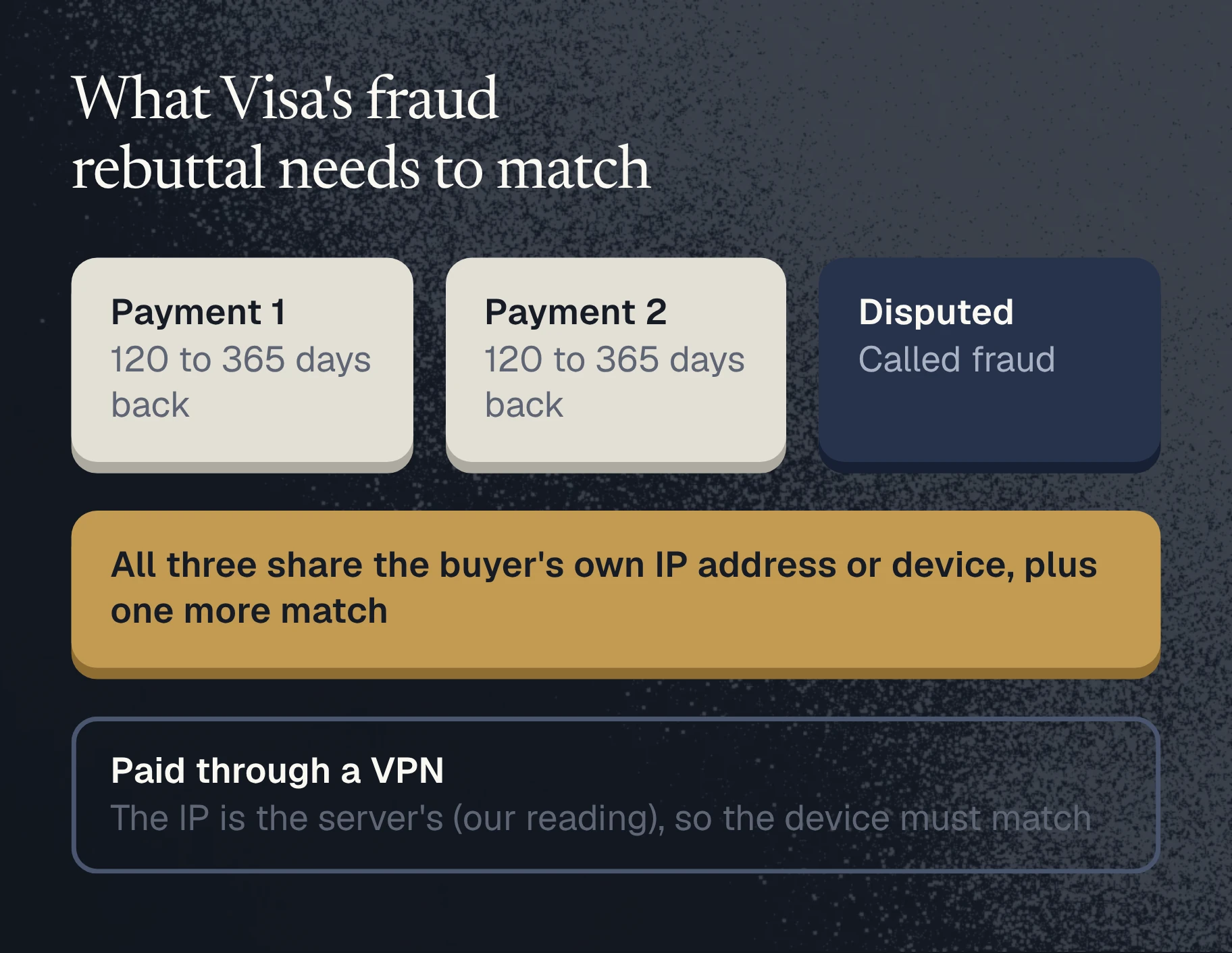
The rule is specific about the address: it "must be the Cardholder's public IP address", in clear text. Visa's text doesn't mention VPNs, so what follows is this article's reading of it, not Visa's. A customer who buys a VPN plan while connected to the VPN arrives from the provider's server, not their own connection, so the address on the disputed payment is unlikely to be theirs or to match the earlier ones. A device ID or fingerprint is unaffected by the VPN and can still match, with the login ID as the second element, but only if the seller recorded them at the time, and a provider that promises to keep no logs may have chosen not to.
What to keep when each plan period is an invoice
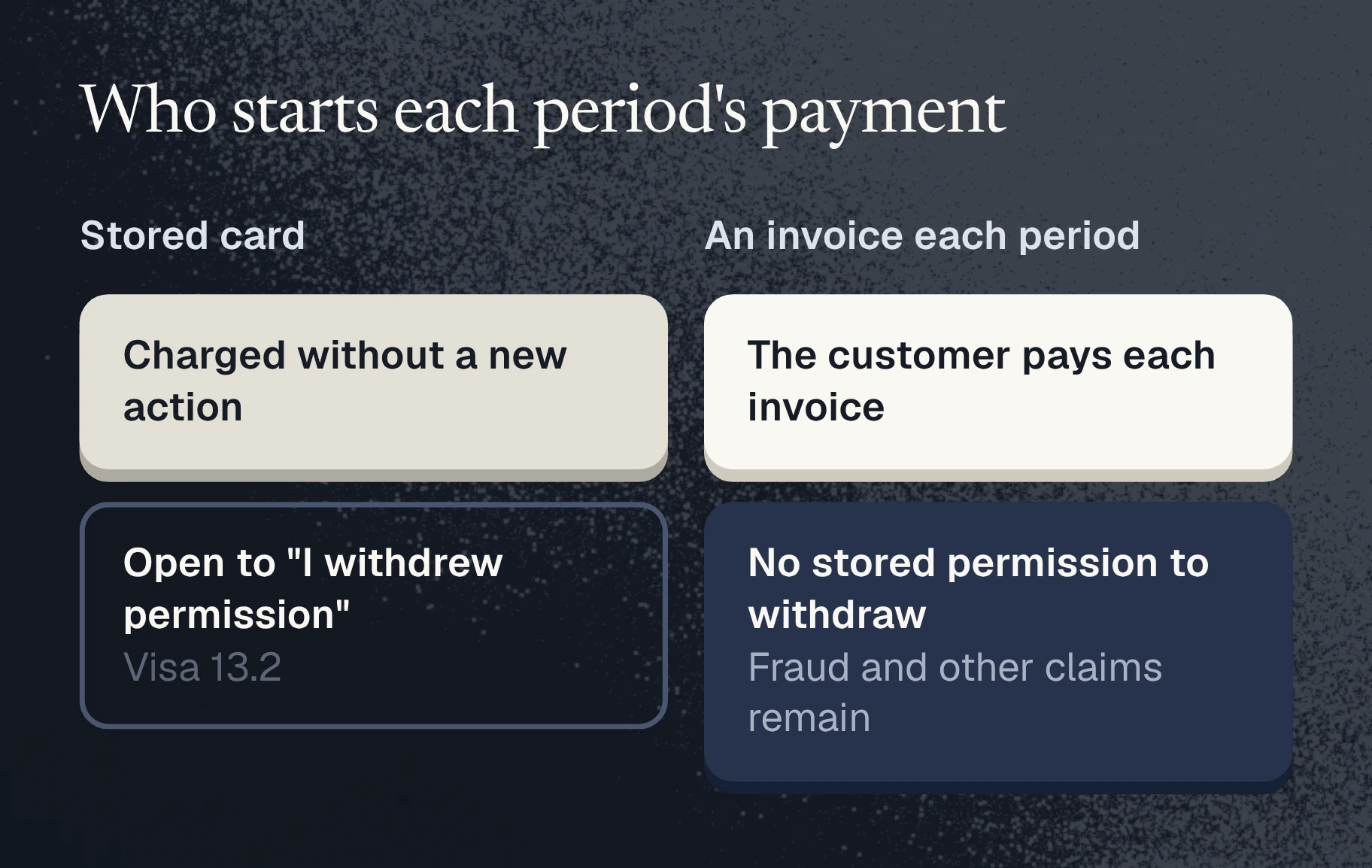
Selling plans as invoices the customer pays changes which disputes are possible. Visa's Condition 13.2 covers a cardholder who "withdrew permission to charge the Payment Credential for a Recurring Transaction"; with subscriptions billed by invoice, no permission is stored, because each period's payment is one the customer starts. Fraud, "not received" and misrepresentation disputes remain, and the records below answer them.
| Record | Answers which complaint | Where it comes from |
|---|---|---|
| The invoice and its receipt, with the period it covers | "I didn't agree to this amount" | The invoice tool |
| The plan's terms, as shown on the sign-up page | "I wasn't told it would bill again" | A saved copy of the page at the time |
| Account creation, first connection and later logins | "I never made this purchase" | The seller's own service, at a level its privacy policy allows |
| When access was delivered, and to which account | "I never received it" | The seller's own service |
| The cancellation date and the access that ran until then | "I cancelled and was still billed" | The subscription record |
A privacy seller can keep account events without keeping traffic: the login records in the third row say an account was used, not what it did. How much of that a no-logs promise allows is a decision for each seller to make before a dispute, not during one.
How a VPN or proxy seller can take card payments
There are three card routes, each with a limit worth knowing before choosing.
- A merchant of record platform that accepts restricted categories. Paddle lists VPNs and proxies as restricted, so expect enhanced due diligence first. The platform charges the card and handles the disputes, and its fraud rules decide which buyers get through.
- A high-risk merchant account. The seller is the merchant, so its own dispute ratio is watched; Visa's line is 150 basis points with at least 1,500 disputes and fraud reports a month in the US, Canada, Europe and Asia Pacific, per its VAMP fact sheet.
- A card checkout paid to the seller's own wallet. An independent, licensed on-ramp provider charges the card on its own page, and the sale settles to a wallet the seller controls.
Railbed is the third kind: card checkout for online merchants that mainstream processors turn away, with no underwriting and no application to pass. Sign-up needs an email, your website and a payout wallet, and sales settle to that wallet, almost always as USDC on Polygon, with nothing held back. Plans can be sold as subscriptions, where "Railbed never stores a card, so nothing is charged automatically" and an unpaid plan is canceled after 3, 7, 14, 30 or 60 days, or kept past due, as you choose. Subscriptions add no fee of their own; each payment carries the provider's fee and spread, a 1% network fee, and the Railbed fee, from 0.9%.
Good to know. Card disputes "are raised with, and handled by, the on-ramp provider that charged the buyer's card", and Railbed is not a party to them; "a provider may contact you, decline future payments from a buyer or region, or take other action under its own terms", which is when the records above matter. Providers decide whether to ask a buyer for ID, and Smart Routing ranks the providers least likely to ask first; whether buyers need ID to pay covers what that means for privacy-minded customers. A card can still be declined on the provider's page. Give access from the payment and subscription events Railbed sends your server, as the fulfilment guide describes, never from the buyer's return to your site. The VPN page covers plan setup for that trade.
Sell a VPN or proxy plan billed by invoice
Create a subscription plan with its sign-up page in Test mode, pay its first invoice with simulated money, and see the receipt and subscription page your customer gets.
Create an accountRead the subscriptions guide