Chargeback alerts compared: Ethoca, Verifi CDRN, RDR and Order Insight, and what each one stops
Ethoca, Verifi CDRN, RDR and Order Insight side by side: the cards each covers, how fast you must act, whether the dispute still counts, and what each costs.

Press the card to run an example sale.
Chargeback alerts give a merchant a short window to refund or explain a disputed sale before it becomes a chargeback. Ethoca Alerts and Verifi's CDRN send a notice you act on, Visa's RDR refunds by your own rules, and Order Insight and Consumer Clarity show the buyer's bank your order details. Neither network's public pages give a price.
Chargeback alerts compared: who runs them and what each one stops
The five services below come from the two card networks' own companies: Ethoca belongs to Mastercard and Verifi to Visa. The table is built from Mastercard's Ethoca Alerts developer pages, Mastercard's Consumer Clarity for Merchants overview, Verifi's Resolve disputes and Prevent disputes pages, and Verifi's RDR rules FAQ, all read in November 2026. What a pre-dispute alert is, next to a refund and a chargeback, is covered in chargeback vs refund vs dispute vs pre-dispute alert.
| Service | Run by, cards covered | What you do, and how fast | Still counted? |
|---|---|---|---|
| Ethoca Alerts | Mastercard; participating issuers on Mastercard, Visa, Amex, Discover | Stop the order and refund; final outcome within 24 hours (best practice) | Not as a dispute if refunded in time |
| Verifi CDRN | Visa; Visa and non-Visa issuers in Verifi's network | Refund within 72 hours | Not by Visa, if resolved before the chargeback |
| Verifi RDR | Visa; Visa issuers that turn it on | Nothing per case: your rules accept or decline instantly | No, by Visa's own FAQ |
| Verifi Order Insight | Visa | Keep order data available; the bank shows it to the buyer | Not if the buyer drops it; Compelling Evidence 3.0 blocks remove the fraud report too |
| Ethoca Consumer Clarity | Mastercard | Answer the bank's order lookup in real time from your own endpoint | Not if the buyer drops it |
The "Still counted?" column has one exception for every row that refunds: if the cardholder told the bank the purchase was fraud, Visa's issuer files a fraud report, and Visa's fact sheet only excludes "TC 40 fraud qualified for Compelling Evidence 3.0". A refund through an alert doesn't take that report away. The ratios themselves are in what chargeback ratio gets a merchant account shut down.
How each service works, case by case
Each service fits a different kind of claim and a different amount of work on your side. Here is what each one asks of you, in the networks' own words.
Ethoca Alerts
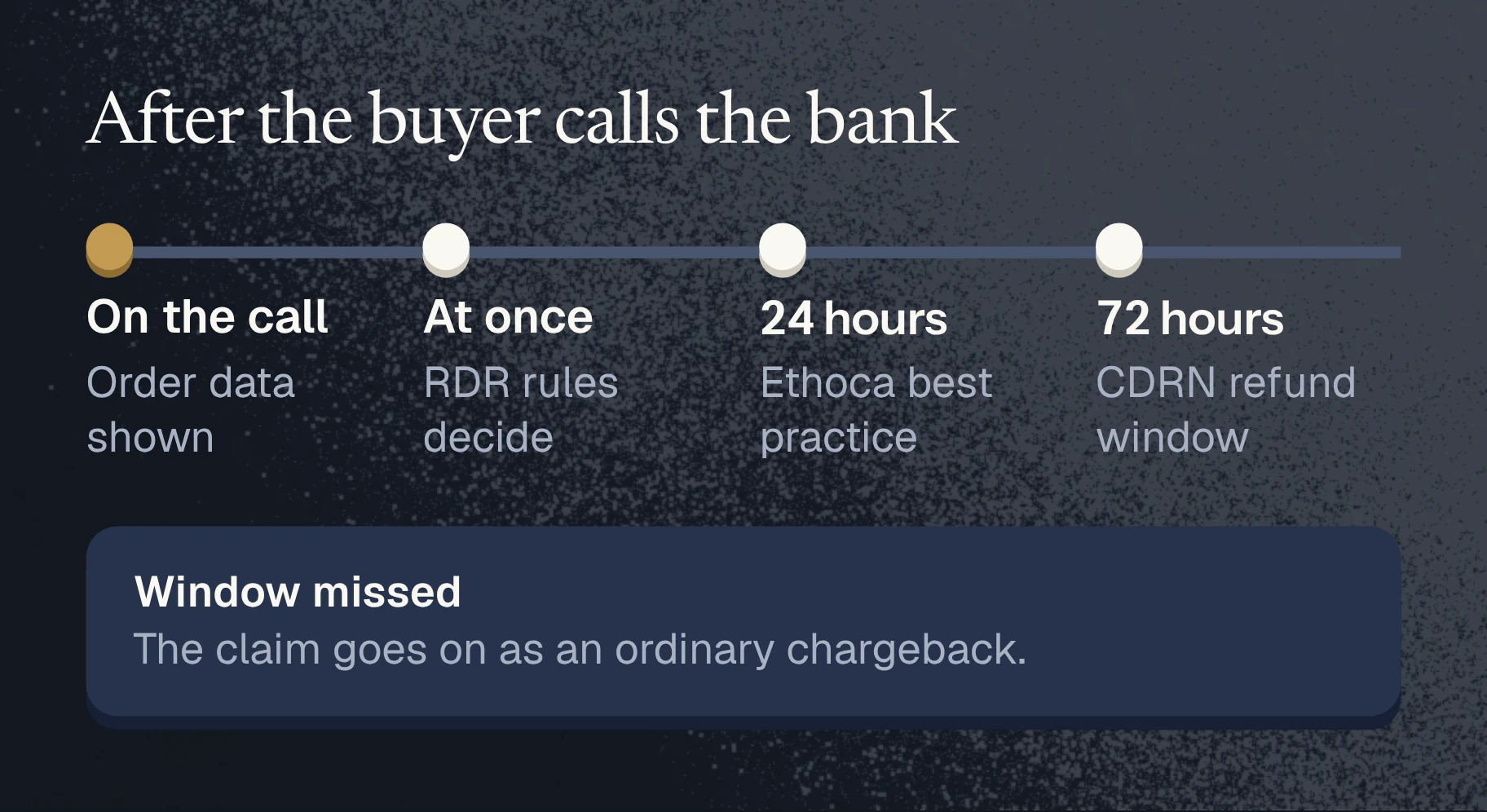
Ethoca Alerts is Mastercard's notice service for fraud and dispute claims. Mastercard describes it as delivering "near real-time fraud and customer dispute alerts from participating card issuers", in two kinds: fraud alerts and dispute alerts. The steps on its product page are: "Issuer notifies Ethoca of a confirmed fraud or dispute. Ethoca transmits an alert to the merchant. Merchant stops fulfillment and refunds the customer to avoid a chargeback. Ethoca transmits alert outcome to the issuer."
Speed matters. Mastercard's support FAQ says "Best practice is to respond with a final outcome within 24 hours of receiving the alert to maximize the chance of stopping the chargeback", and that "the first final-state outcome you submit is the one sent to the issuer". Mastercard is also clear about what it isn't: "Is Ethoca Alerts a chargeback management system? No."
Verifi CDRN
CDRN is Verifi's alert service for refunds you decide one by one. Verifi's page says "Merchants have 72 hours to initiate a cardholder credit to resolve Visa and non-Visa transaction disputes before a chargeback is filed", through a network that includes Mastercard, Discover and American Express issuers. Verifi says sellers use RDR for Visa and "CDRN for non-Visa issuers and direct-to-Verifi issuers", and that the same transaction can't come through both.
Verifi RDR
Rapid Dispute Resolution is the automatic one. Visa's own rules define it as "a pre-dispute resolution service that provides the ability for Merchants and Payment Facilitators to automate the acceptance of liability for a disputed Transaction" (Visa Core Rules, 24 October 2026). You set rules, by reason or amount, and a matching case is credited at once. Verifi's FAQ answers the ratio question directly: "RDR disputes and pre-disputes will not count against the dispute ratio." A case your rules decline goes on as a chargeback. Stripe's docs add a limit: RDR only resolves disputes for "the full amount of the original transaction" when it "hasn't been refunded".
Order Insight and Compelling Evidence 3.0
Order Insight is Verifi's data service: it "helps merchants stop friendly fraud with automatic data transmission that prevents inquiries from triggering chargebacks". When a buyer opens their banking app or calls about a charge, the bank sees your order details, a digital receipt in the app and "enhanced transaction detail" for call-center staff. Its deflection feature "leverages the Visa Compelling Evidence 3.0 rule to deflect disputes before a chargeback is issued", which "effectively blocks confirmed first-party-misuse on Visa card-not-present fraud disputes". Stripe's docs describe the test as two earlier sales with matching IP addresses and a matching email or delivery address, after which "the issuer must block the dispute". Visa's own rule names the login ID, full delivery address, device ID or fingerprint and IP address as the data that can match; the full conditions are in how to win a chargeback.
Consumer Clarity and First-Party Trust
Consumer Clarity is Ethoca's equivalent for Mastercard. Mastercard says it "brokers order information between merchants and issuers in real time", using "a merchant-hosted integration model": you run an endpoint that answers the bank's lookup. The same service carries First-Party Trust, for a Mastercard 4837 fraud claim: Mastercard's engine looks at the buyer's earlier transactions to decide "whether liability shifts from the merchant to the issuer or remains with the merchant".
What they cost, and where no price is published
No network price exists to compare. Verifi's pages, Mastercard's Ethoca and Consumer Clarity pages, and Visa's public rules list no fee for any of these services, as of November 2026. Prices come from whoever enrolls you: your processor or a reseller. One well-known processor, Stripe, publishes its own:
| Service through Stripe | Stripe's published price (US) |
|---|---|
| Order data lookups (Order Insight, Consumer Clarity) | Included |
| Visa resolution (RDR) | $15.00 each |
| Visa Compelling Evidence 3.0 block | $15.00 each |
| Mastercard resolution (Ethoca Alerts) | $29.00 each |
| A dispute received, for comparison | $15.00 each |
Two more costs aren't on any price list. A resolved alert is a refund, so you give up the sale. And Verifi notes that acquirers "may levy fees" based on their own risk measures "regardless of a seller meeting Visa's dispute ratio target".
An example $120.00 annual plan, four ways
What each route costs is clearer on one sale. Say a customer buys an example annual plan for $120.00, doesn't recognize the charge on their statement and calls their bank. Using Stripe's published prices above:
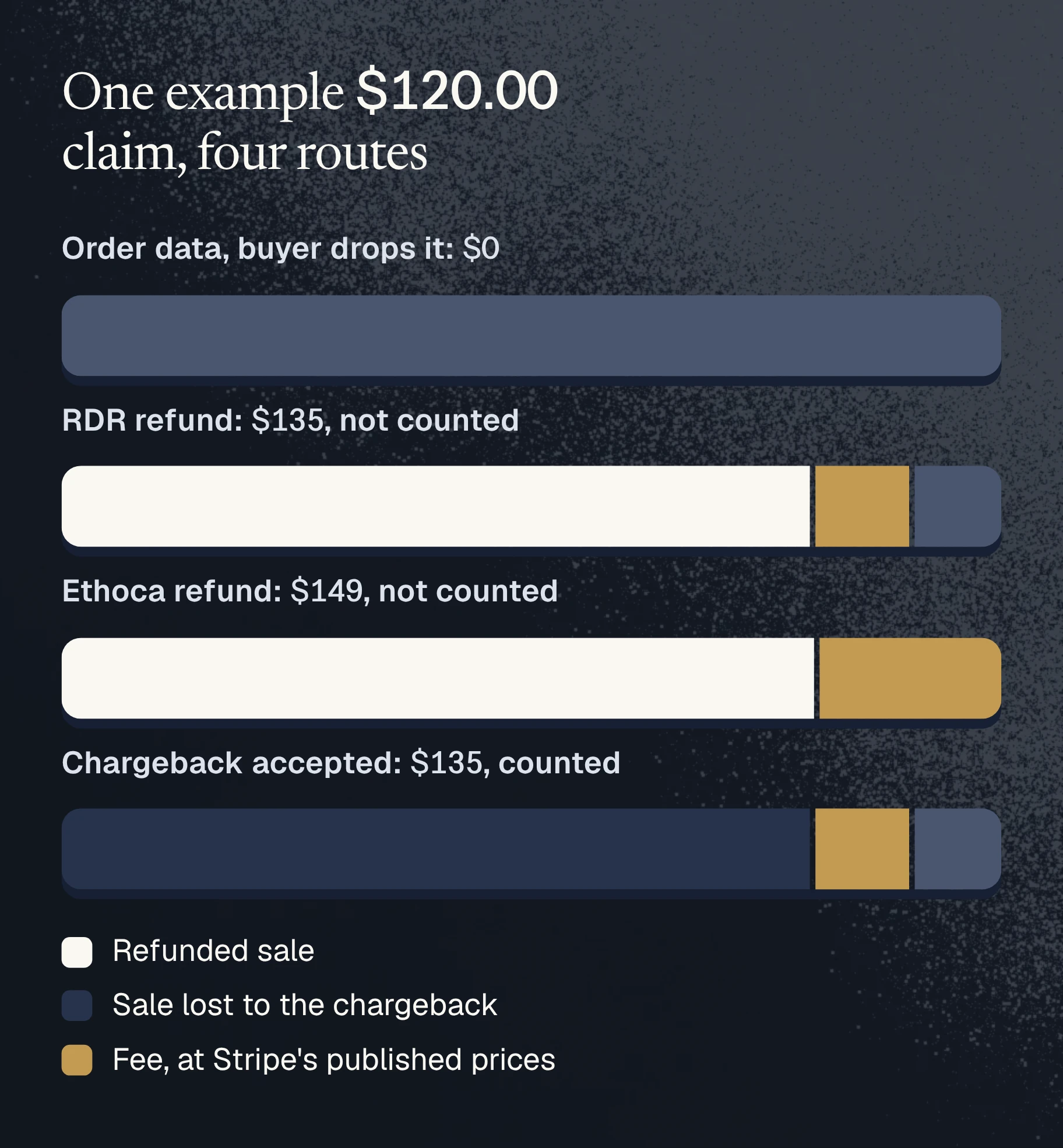
- Order data. The bank shows the plan's name, date and the buyer's email. The buyer recognizes it and drops the call. Cost: nothing extra; the lookup is included.
- RDR (Visa card). Your rule accepts it. You refund $120.00 and pay $15.00: $135.00 in all, not counted as a dispute.
- Ethoca Alerts (Mastercard). You refund within the day. $120.00 plus $29.00: $149.00, not counted as a chargeback.
- No service. A chargeback is filed and you accept it: $120.00 plus the $15.00 dispute received fee, $135.00, and it's in the count. Fighting and losing adds the $15.00 dispute countered fee.
If the buyer had said "I didn't make this purchase", the RDR route would still leave Visa's fraud report in the count, while an Order Insight block under Compelling Evidence 3.0 ($15.00 at Stripe, with the sale kept) would remove both.
Which one to start with
The right service follows your card mix and your dispute reasons. Look at last quarter's disputes by network and by reason code, then:
- Many "don't recognize this" claims from real customers: start with order data (Order Insight, Consumer Clarity). It's the only route that keeps the sale.
- Repeat customers on Visa filing fraud claims: Order Insight with Compelling Evidence 3.0, which needs two earlier undisputed sales on the same card with matching device or IP data and one more match.
- Many small Visa claims you would refund anyway: RDR with amount rules, so no one handles them by hand.
- Mostly Mastercard, or mixed brands: Ethoca Alerts or CDRN, with someone ready to answer within a day.
Prevention that stops the bank call happening at all still beats any of these; how to prevent chargebacks maps which tactic stops which claim.
Why Railbed fits a merchant weighing alert costs
With Railbed, an independent, licensed card provider charges the buyer's card and the sale settles to a wallet you control. Card disputes "are raised with, and handled by, the on-ramp provider that charged the buyer's card", in Railbed's terms, and "Railbed is not a party to those disputes". Settled sales can't be pulled back from your wallet; card disputes go to the provider that charged the card. Nothing is held back from your sales: no setup fee, no monthly fee, no reserve.
What helps a buyer recognize a charge is still yours to do. The provider's name is on the statement, so Railbed's developer guide says to name it "near your buy button or in your order email, so buyers recognize the charge". The customer portal, off by default, lets a customer sign in with an emailed code and see their orders and receipts.
Good to know:
- Railbed is not a party to card disputes, and a payment status in Railbed is not a dispute-management service. A provider may contact you about one.
- The card provider decides whether to ask a buyer for ID; Smart Routing ranks the providers least likely to ask first.
- There's no refund button. To refund a buyer, you send the funds back yourself.
- The fee is from 0.9%, plus a 1% network fee and the card provider's own fee.
Take cards with disputes handled by the card provider
Sign up with an email, your website and a payout wallet. Settled sales can't be pulled back from your wallet; card disputes go to the provider that charged the card.
Create an accountRead how it works