Visa and Mastercard chargeback reason codes in plain words
The Visa and Mastercard chargeback reason codes in the current rulebooks, with what the buyer claims and the record that answers each.
Press the card to run an example sale.
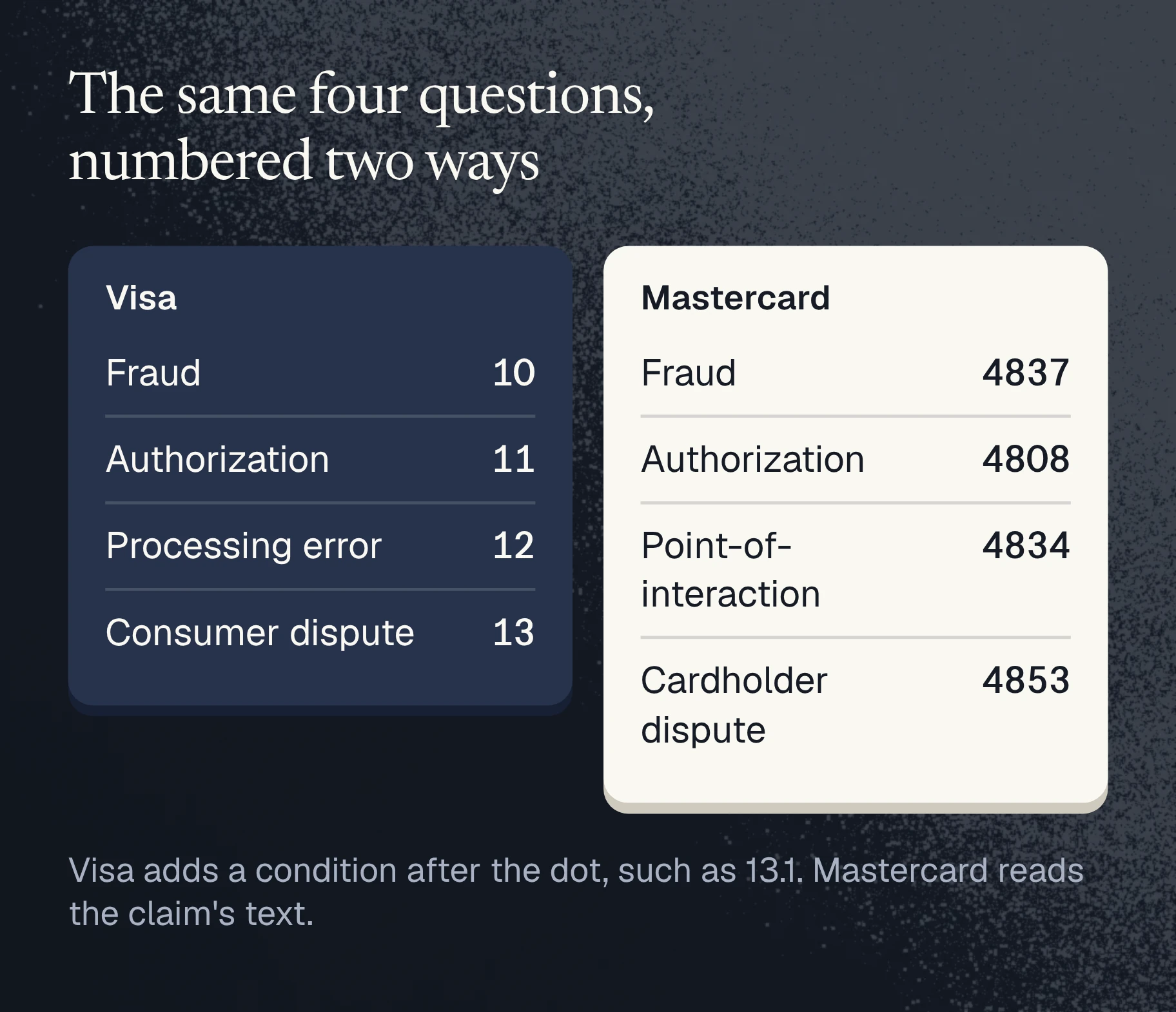
Chargeback reason codes are the numbers a card network puts on a dispute to say what the buyer claims. Visa sorts them into four categories (10 fraud, 11 authorization, 12 processing errors, 13 consumer disputes); Mastercard uses four-digit codes such as 4837 for fraud and 4853 for disputes. Each claim has its own evidence.
The tables below come from the Visa Core Rules and Visa Product and Service Rules of 24 October 2026 and the Mastercard Chargeback Guide, Merchant Edition of 13 May 2025.
How to read the code on a dispute notice
A Visa reason code is a category and a condition, which Visa calls a "Dispute Condition": in 13.1, the 13 means a consumer dispute and the .1 means the buyer says nothing arrived.
A Mastercard reason code is a four-digit "message reason code" with a two-digit short form, such as 4837/37. Most consumer complaints share one code, 4853, so a Mastercard notice needs its written claim read, not just its number.
Visa chargeback reason codes, category by category
These tables cover every dispute condition in Visa's 24 October 2026 rules.
Category 10: fraud
Fraud codes mean the cardholder says they didn't make or allow the purchase.
| Code | Visa's name | What the buyer says | What answers it |
|---|---|---|---|
| 10.1 | EMV Liability Shift Counterfeit Fraud | A copied card was used where the chip wasn't read | In-person only: proof the chip was read |
| 10.2 | EMV Liability Shift Non-Counterfeit Fraud | A lost or stolen chip-and-PIN card was used without its PIN | In-person only: proof the PIN-capable chip was read |
| 10.3 | Other Fraud – Card-Present Environment | "I didn't make this key-entered sale in the shop" | An imprint of the card; for US domestic sales, also the same card in an undisputed sale |
| 10.4 | Other Fraud – Card-Absent Environment | "I didn't make this online, phone or mail purchase" | Compelling evidence, such as 3 or more matching details from an earlier undisputed order |
| 10.5 | Visa Monitoring Programs | Visa flagged the sale through a monitoring program | Little: no dispute under it is listed as invalid |
Table 11-7 of Visa's rules lists 17 kinds of compelling evidence. The one most online sellers can use is item 10: 3 or more of a login ID, delivery address, device ID, email address, IP address and telephone number used in an undisputed transaction. The 3-D Secure article covers which of these codes authentication removes.
Category 11: authorization
Authorization codes mean the sale went through without a valid approval from the card's bank.
| Code | Visa's name | What the claim is | What answers it |
|---|---|---|---|
| 11.1 | Card Recovery Bulletin | The card was on Visa's recovery list | Being retired: only for disputes processed through 23 October 2026 |
| 11.2 | Declined Authorization | The sale was completed after a decline | Proof you got an approval for the same purchase after the decline |
| 11.3 | No Authorization/Late Presentment | No approval, or the sale was sent too late | A receipt or record whose date disproves late presentment and shows the approval |
Category 12: processing errors
Processing error codes mean the buyer agreed to buy, but the charge itself was wrong. The receipt usually answers them.
| Code | Visa's name | What the buyer says | What answers it |
|---|---|---|---|
| 12.2 | Incorrect Transaction Code | A refund was posted as a charge, or similar | The record showing the correct code |
| 12.3 | Incorrect Currency | Charged in a currency they didn't agree to | A receipt showing the currency was correct |
| 12.4 | Incorrect Account Number | The wrong card number was charged | Proof the right account was charged |
| 12.5 | Incorrect Amount | Charged a different amount than agreed | A receipt proving the amount was correct |
| 12.6 | Duplicate Processing/Paid by Other Means | Charged twice, or already paid another way | Two receipts proving separate purchases, or proof you weren't paid another way |
| 12.7 | Invalid Data | The approval used wrong data, or its category code differs from the final charge's | Proof the authorization data was valid |
Category 13: consumer disputes
Consumer dispute codes mean the buyer authorized the charge but says the deal went wrong; your own records decide them.
| Code | Visa's name | What the buyer says | What answers it |
|---|---|---|---|
| 13.1 | Merchandise/Services Not Received | "It never arrived" or "the service didn't happen" | Proof of delivery with the full address, or that the service was received as agreed |
| 13.2 | Cancelled Recurring Transaction | Billed again after canceling repeat billing | Proof they used the service after withdrawing permission, or canceled for a later date |
| 13.3 | Not as Described or Defective Merchandise/Services | "It wasn't what you described" or "it was broken" | Proof it matched the description or wasn't defective, plus your rebuttal |
| 13.4 | Counterfeit Merchandise | "It was fake" | Evidence the goods were genuine |
| 13.5 | Misrepresentation | Misled about the terms, such as a trial | For trials, proof they "expressly agreed to future Transactions" and were told at least 7 days before |
| 13.6 | Credit Not Processed | "The refund you promised never came" | Proof the credit was issued, or the dispute is invalid |
| 13.7 | Cancelled Merchandise/Services | "I canceled and wasn't refunded" | Proof you disclosed a limited cancellation policy at the time of sale and they didn't follow it |
| 13.8 | Original Credit Transaction Not Accepted | A payment sent to their card wasn't accepted | Rare for sellers |
| 13.9 | Non-Receipt of Cash at an ATM | The ATM didn't pay out | Not a seller's dispute |
For 13.3, Visa lists a dispute "regarding a price discrepancy" and one "that the Cardholder states is fraudulent" as invalid, so "not me" belongs under 10.4.
Mastercard chargeback reason codes in the current guide
Mastercard's 13 May 2025 guide says chargebacks "fall into four categories": authorization, cardholder disputes, fraud and point-of-interaction error.
| Code | Mastercard's name | What the claim is | What answers it |
|---|---|---|---|
| 4808 | Authorization-related | Approval was required and not obtained, or the sale or refund was presented late | The approval record and the presentment date |
| 4834 | Point-of-Interaction Error | Paid twice, paid by other means, wrong amount, currency conversion or surcharge problems | Records showing separate purchases or the correct amount |
| 4837 | No Cardholder Authorization | "I did not authorize the transaction" | An address match, an authenticated transaction, or compelling evidence for e-commerce and phone orders |
| 4853 | Cardholder Dispute | Not provided, not as described, defective, refund not processed, counterfeit, canceled repeat billing, and more | For not provided: proof the cardholder received it, such as "Documentation that the tickets were used" |
| 4870 | Chip Liability Shift | A counterfeit card at a terminal that didn't read the chip | In-person only |
| 4871 | Chip Liability Shift-Lost/Stolen/Never Received Issue (NRI) Fraud | A lost or stolen chip card used without the chip being read | In-person only |
Narrower codes: 4850 for installment billing, 4854 for US domestic disputes not covered elsewhere, 4849 from Mastercard's questionable-merchant programs, and 4999 for domestic disputes in Europe. For 4837, compelling evidence for online and phone orders includes "written correspondence" with the cardholder, such as email, text and chat messages.
Codes you may still see that the rulebooks no longer list
Processors keep older codes; Stripe's dispute categories page, read on 24 November 2026, still lists those below. Neither network publishes a table from old codes to new, so the right-hand column is Railbed's own reading, matched by what each code describes.
| Code on the notice | What it meant | Where the claim sits now (our reading) |
|---|---|---|
| Visa 12.1 | Late presentment | 11.3 No Authorization/Late Presentment |
| Visa 12.6.1, 12.6.2 | Duplicate processing; paid by other means | 12.6, one condition |
| Mastercard 4855 | Product not received | 4853 Cardholder Dispute |
| Mastercard 4860 | Credit not processed | 4853 Cardholder Dispute |
| Mastercard 4841 | Canceled recurring or digital goods | 4853 Cardholder Dispute |
| Mastercard 4831 | Transaction amount differs | 4834 Point-of-Interaction Error |
| Mastercard 4863 | Cardholder doesn't recognize it | 4837 No Cardholder Authorization |
None of 4831, 4841, 4855, 4860 or 4863 appears in the 13 May 2025 Mastercard guide. AI search answers we tested on 24 November 2026 still called 4855 and 4863 current.
How long each side has to answer
Visa's buyers usually have 120 calendar days from the processing date; for 13.1 the clock can run from the date they expected the goods, up to 540 days (how long a customer has to file a chargeback).
Visa gives the acquirer 30 calendar days from the Dispute Processing Date to answer (called a pre-arbitration attempt for categories 10 and 11). Mastercard gives 45 calendar days from the chargeback for a second presentment in most countries. Your processor sets your due date inside them; how to win a chargeback representment covers the answer itself.
One $85.00 concert ticket, three different disputes
One $85.00 ticket, sold online and scanned at the door, can come back under three codes, each needing a different record. This is an example.
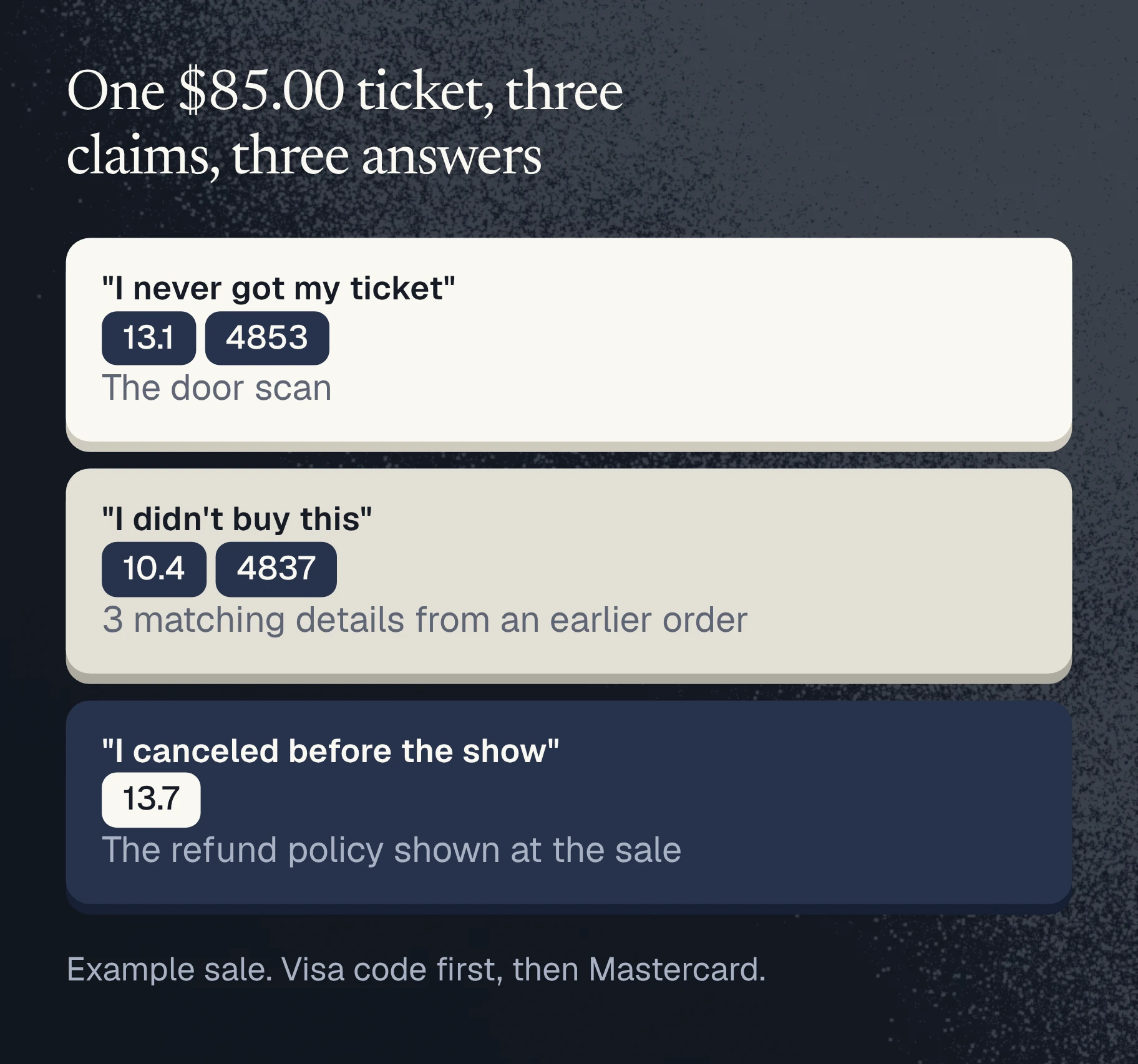
- "I never got my ticket." Visa 13.1 or Mastercard 4853. Visa accepts proof the cardholder "received services at the agreed location or by the agreed date/time"; Mastercard lists "Documentation that the tickets were used". The door scan answers it.
- "I didn't buy this." Visa 10.4 or Mastercard 4837. The scan doesn't tie the ticket to the cardholder; Visa's item 10 does: the same email, device and IP address on an earlier undisputed order. Many such claims are friendly fraud.
- "I canceled before the show." Visa 13.7. The answer is the receipt showing a limited refund policy at the time of sale, and proof the buyer didn't cancel under it.
A refund you issued before the dispute answers any of the three, since Visa accepts a credit "not addressed by the Issuer". Refunds and chargebacks count differently toward a dispute ratio (chargeback vs refund vs dispute).
Why Railbed fits a merchant tired of reason codes
Railbed changes who receives the code. Buyers pay on a licensed card provider's page, and Railbed's terms say card disputes "are raised with, and handled by, the on-ramp provider that charged the buyer's card". The sale arrives as USDC in a wallet you control, and settled sales can't be pulled back from your wallet.
Good to know:
- A provider "may contact you, decline future payments from a buyer or region, or take other action under its own terms". The tables above say which record to send if one asks.
- Each order keeps the buyer's email and any details you asked for.
- There is no refund button. To refund a buyer, you send the funds back yourself.
- Fees: Railbed's from 0.9%, a 1% network fee, and the provider's own fee shown to the buyer. No setup or monthly fee, no reserve.
- Sign-up asks for an email, your website and a payout wallet, with no underwriting and no application to pass.
Take card payments that settle to your own wallet
Card disputes go to the provider that charged the card, and settled sales can't be pulled back from your wallet. Sign up with an email, your website and a payout wallet.
Create your accountRead how disputes work