Chargeback vs refund vs dispute vs pre-dispute alert: what counts toward your ratio?
Each term defined in the networks' own words, which ones Visa and Mastercard count, why a fraud report can count even after a refund, and a decision table for an unhappy buyer.

Press the card to run an example sale.
A refund is money you return yourself; a dispute is the buyer's challenge to the charge with their card issuer; a chargeback is the issuer taking the money back through the network. A pre-dispute alert warns you first, so you can refund. Chargebacks count toward both networks' ratios, and Visa also counts fraud reports.
That last sentence is where most short answers go wrong. "Alerts don't count" is only partly true, a refund doesn't always keep a sale out of the ratio, and one sale can count twice on Visa. Below, each term is defined on its own, then the counting rules come from the same network documents as What chargeback ratio gets a merchant account shut down?, followed by the order of events for one disputed sale and a decision table for an unhappy buyer.
Five terms, defined
Each definition below stands on its own, with the words of the network or processor that uses it.
Refund. A refund is the merchant's own decision to return money to the buyer. Visa's rules call it a Credit Transaction, "a Merchant's refund or price adjustment credited to a Cardholder's account" (Visa Core Rules and Visa Product and Service Rules, 24 October 2026). No issuer is involved, and the refund itself is not counted against you.
Dispute. A dispute is the cardholder's challenge to a payment, made to the bank that issued their card. Stripe puts it as "when a cardholder contacts their card issuer to contest a payment to you". In Visa's rulebook the word also names the money movement that follows: a Dispute is "a Transaction that an Issuer returns to an Acquirer."
Chargeback. A chargeback is the reversal of a card sale through the network, started by the issuer. Mastercard's Chargebacks Made Simple guide (July 2025) calls it "a rules-based mechanism, with time-sensitive workflows, that enables the issuer and the acquirer to determine the financial liability of a disputed transaction", says "only an issuer can initiate the chargeback process", and that Mastercard moves the funds "by providing a credit to the issuer and a debit to the acquirer." For monitoring, Stripe notes that "the terms 'dispute' and 'chargeback' are interchangeable": Visa says disputes, Mastercard says chargebacks.
Pre-dispute alert. A pre-dispute alert is a notice that reaches the merchant before a chargeback is filed, so the merchant can refund or accept the claim first. The two networks' services are Verifi (Visa) and Ethoca (Mastercard):
- Visa's rules define Rapid Dispute Resolution as "a pre-dispute resolution service that provides the ability for Merchants and Payment Facilitators to automate the acceptance of liability for a disputed Transaction."
- Verifi's page says its Cardholder Dispute Resolution Network gives merchants "72 hours to initiate a cardholder credit."
- Mastercard's developer page for Ethoca Alerts describes the flow's first three steps: "Issuer notifies Ethoca of a confirmed fraud or dispute. Ethoca transmits an alert to the merchant. Merchant stops fulfillment and refunds the customer to avoid a chargeback."
Early fraud warning. An early fraud warning is the issuer's report that a sale looks fraudulent, passed to the merchant for information. It is not a dispute and moves no money. Stripe says these come from "Visa TC40 reports and Mastercard's System to Avoid Fraud Effectively (SAFE) reports."
One more term appears in processor dashboards: an inquiry, the issuer's request for information before a formal dispute. Stripe says "American Express and Discover use inquiries most often, while Mastercard and Visa no longer use them."
Which of them count toward the ratios?
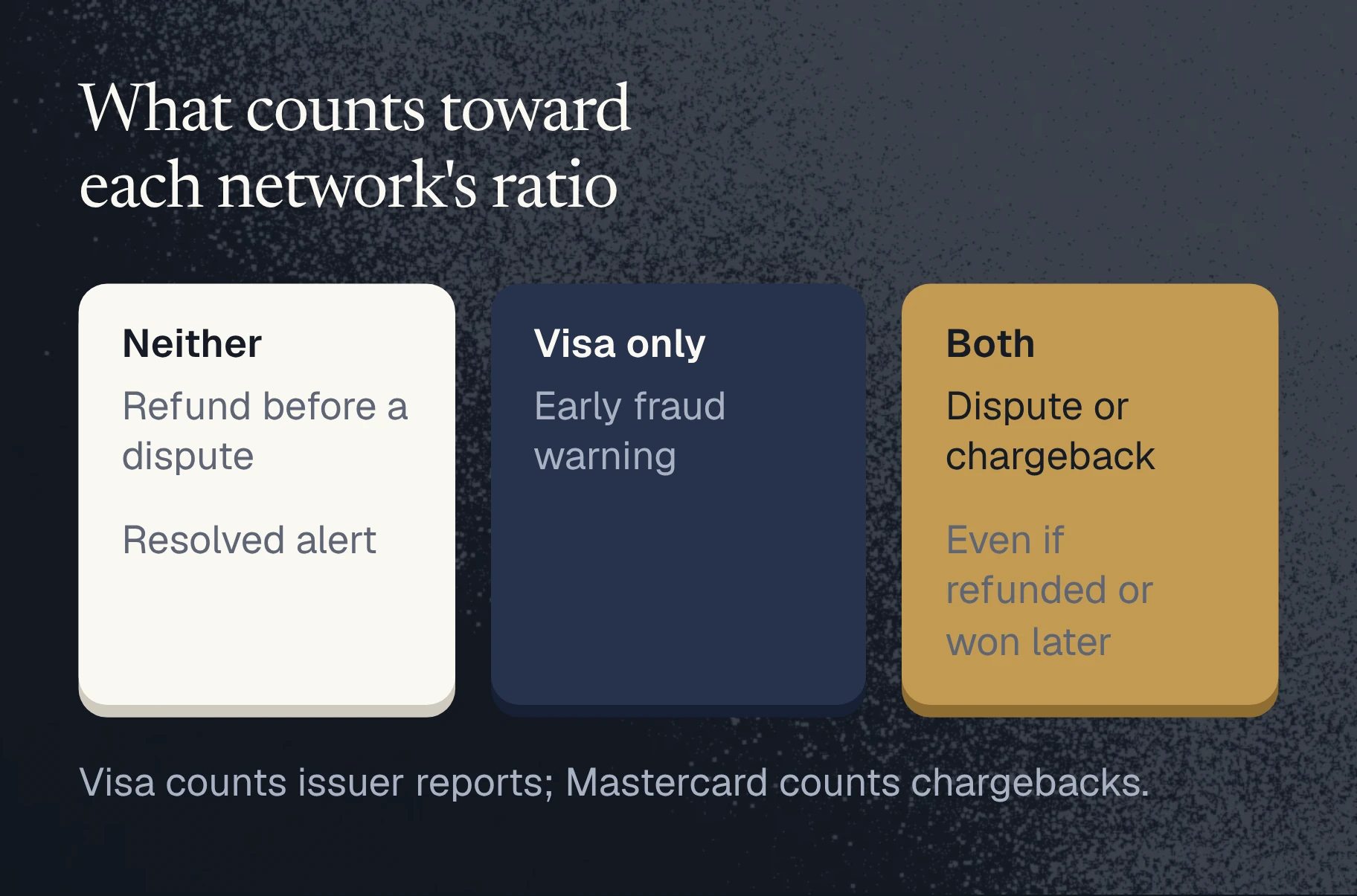
Chargebacks count on both networks; what else counts depends on the network. Visa's VAMP fact sheet defines its ratio as "Count of [Fraud (TC40) + Disputes (TC15)] ÷ Count of Settled Transactions (TC05)" on card-not-present sales, and Mastercard's Security Rules and Procedures (§8.3.1) count "the number of chargebacks received by the Acquirer for a Merchant in a calendar month."
The table applies both definitions, and Stripe's monitoring-program notes, to each event a merchant can meet.
| Event | Visa (VAMP) | Mastercard (ECM, HECM) |
|---|---|---|
| Refund before any issuer involvement | Not counted | Not counted |
| Inquiry that never becomes a dispute | Not a dispute | Not a chargeback |
| Pre-dispute alert resolved by refund or acceptance | Excluded, "contingent on the timing of the data extract" | No chargeback is filed, so nothing to count |
| Early fraud warning (TC40) | Counted as fraud, refunded or not, unless it qualified for Compelling Evidence 3.0 | Not a chargeback, so not in the chargeback count |
| Dispute or chargeback filed | Counted | Counted |
| Same, later refunded, won or withdrawn | Still counted | Still counted |
| One sale with both a fraud report and a dispute | Counted twice | One chargeback |
The words behind the less obvious rows:
- Alerts. The fact sheet says the ratio "excludes disputes resolved through pre-dispute solutions, contingent on the timing of the data extract." Stripe's dispute prevention page says resolved RDR disputes "don't count towards your overall dispute rates", and that Ethoca Alerts' "resolved disputes don't count towards dispute rates." An alert about fraud is different on Visa. Neither page says so in one sentence, but putting Stripe's statements together, the refund stops the dispute while a fraud report the issuer already filed stays in the count, as the next point explains.
- Fraud reports. Stripe says early fraud warnings "aren't disputes, they're considered fraudulent (regardless of their outcome), and Visa's VAMP program includes them in its calculations."
- Refunds and outcomes. "Monitoring programs don't consider refunds when identifying disputes," and "monitoring programs don't consider dispute outcomes." For Mastercard, Stripe adds that a chargeback counts "regardless of whether it was hidden due to a refund, regardless of liability shift, and regardless of its outcome."
- Double counting. "Any transaction that appears in both reports will be counted twice for the VAMP count."
The order of events for one disputed sale
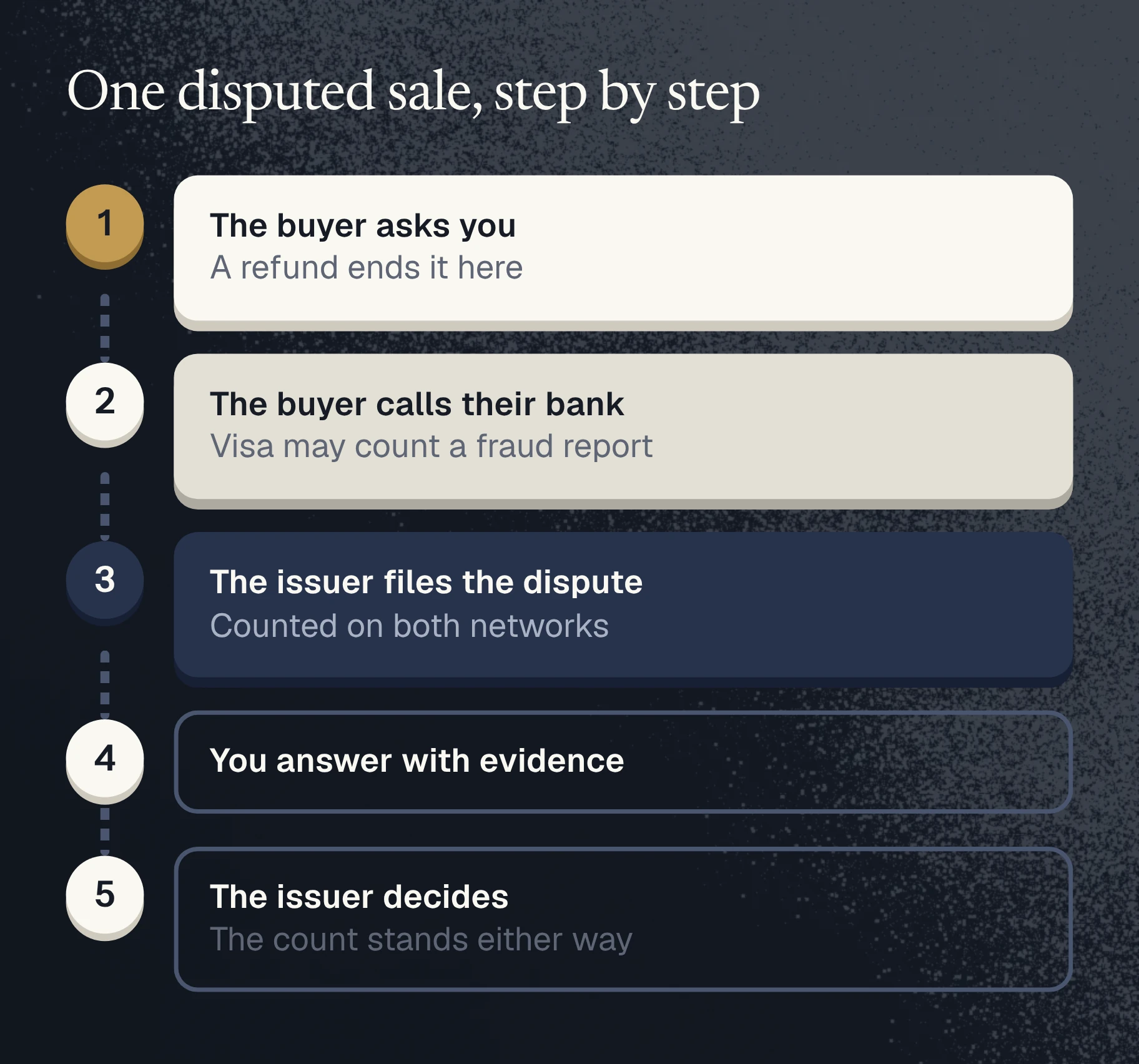
A disputed sale moves through the same stages in the same order, and each stage closes one way out. Using an example $58 order that the buyer returned:
- The buyer asks you. A refund now ends it, and nothing is counted.
- The buyer calls their bank. The issuer may file a fraud report, which counts on Visa, or send an alert through Verifi or Ethoca, which gives you a short window to refund instead.
- The issuer files the dispute. The chargeback is counted in the month the network receives it, and the money moves from your side to the issuer.
- You answer with evidence. Visa gives the acquirer 30 calendar days from the dispute to respond on consumer disputes, Mastercard 45 days for a second presentment, and your processor less: Stripe says "usually 7-21 days."
- The issuer decides. Win or lose, the count from step 3 stands.
When does a refund stop a dispute, and when is it too late?
A refund prevents a dispute only while nothing has been filed. After that it stops being a fix for the ratio and becomes evidence. The rules at each point:
- Before any dispute. Visa's rules say an issuer "must not process a Dispute unless the Cardholder has suffered a financial loss." For disputes processed through 23 April 2027, an issuer that sees a credit before the dispute must apply it or explain why it doesn't resolve the claim. For disputes processed on or after 24 April 2027, the issuer must first "validate and reconcile all credits and debits processed by the same Merchant that could be related to the disputed Transaction(s)". Where there are several, it must add up those "from 120 calendar days prior to the disputed Transaction processing Date through the Processing Date of the dispute" and "Submit the Dispute only for the resulting net disputed amount."
- After a fraud report. Stripe says "proactively refunding a flagged payment doesn't affect the fraud warning", unless the refund is processed as a reversal, "which usually happens within 2 hours of the payment capture." The refund can still stop the dispute that might follow: Stripe says that without one, "about 40% of Visa and Mastercard EFWs become fraud disputes", and that refunding them "is most worthwhile on charges at or below your dispute fee."
- Once a dispute is open. "You can't issue a refund outside the dispute process while the dispute is open" (Stripe). Visa's rules say a cardholder "must not be credited twice", and that if it happens "this must be resolved through the Dispute resolution process."
- On Mastercard, refund before your response. The Chargeback Guide (13 May 2025) says that when a refund came before the second presentment and the presentment "properly documented the refund, the issuer must not continue the dispute for the refunded amount". A refund sent after the second presentment has to be recovered outside the process, for example with "a good faith collection letter."
- A promised refund you never send. That becomes its own dispute: Visa's condition 13.6, Credit Not Processed, which can be filed up to 120 days from the date on your credit receipt.
What to do with an unhappy buyer: a decision table
The right move depends on what has already reached the network. The table follows the example $58 returned order through each state you might find it in.
| What you see | What to do | What counts |
|---|---|---|
| The buyer emails: the parcel is back, where is the $58? | Refund it now. Visa's not-as-described condition makes the issuer wait 15 days after a return before filing, so you have that long. | Nothing |
| An alert names the order (Verifi or Ethoca) | Refund or accept through the alert, inside its window. | No dispute, if resolved in time for Visa's data extract; a fraud report already filed still counts on Visa |
| An early fraud warning on the sale | Weigh the $58 against your dispute fee and the chance of a dispute; a refund prevents the dispute, not the fraud report. | The fraud report on Visa |
| A dispute is open for "credit not processed" | Don't send a second refund. If you refunded, respond with the date and reference; if not, accept or refund through the process. | One dispute on either network |
| You refunded, then a dispute arrived anyway | Respond with the refund's date and reference; on Mastercard it must be in the second presentment. | One dispute on either network |
Two habits keep most of these rows empty. Refund returns as soon as the parcel is checked in, not at the end of a monthly batch. And keep each refund's date and reference with the order, because you will need it inside a 7-to-21-day window. The time limits buyers have on their side are set out in How long does a customer have to file a chargeback?, and what each one costs in What does a chargeback really cost a merchant?
Where Railbed fits
On Railbed, the card is charged by an independent, licensed on-ramp provider. Railbed's terms say card disputes "are raised with, and handled by, the on-ramp provider that charged the buyer's card", and Railbed is not a party to them. Each sale settles to a wallet you control, and a settled payment can't be pulled back from your wallet.
How these terms work out for a Railbed merchant:
- Refunds are yours to send. There is no refund button: you return the money from your wallet or by another method agreed with the buyer, as how to refund a card payment that settled as USDC explains. Keep the transfer's reference with the order.
- Disputes and chargebacks go to the provider. A provider "may contact you, decline future payments from a buyer or region, or take other action under its own terms", so an unhappy buyer still matters. Who does what when one arrives is covered in who handles disputes when card payments settle as USDC.
- Nothing is held back from your sales to cover any of it.
If you want alert services and dispute responses run through your own processor account, a conventional merchant account offers that; Railbed doesn't.
Card checkout that settles to your own wallet
Sign up with an email, your website and a payout wallet. Card disputes go to the provider that charged the card, and settled sales stay in your wallet.
Create an accountHow refunds and disputes work