What chargeback ratio gets a merchant account shut down?
The Visa and Mastercard lines from their own documents, both formulas worked on one month of sales, and why processors close accounts long before either network acts.

Press the card to run an example sale.
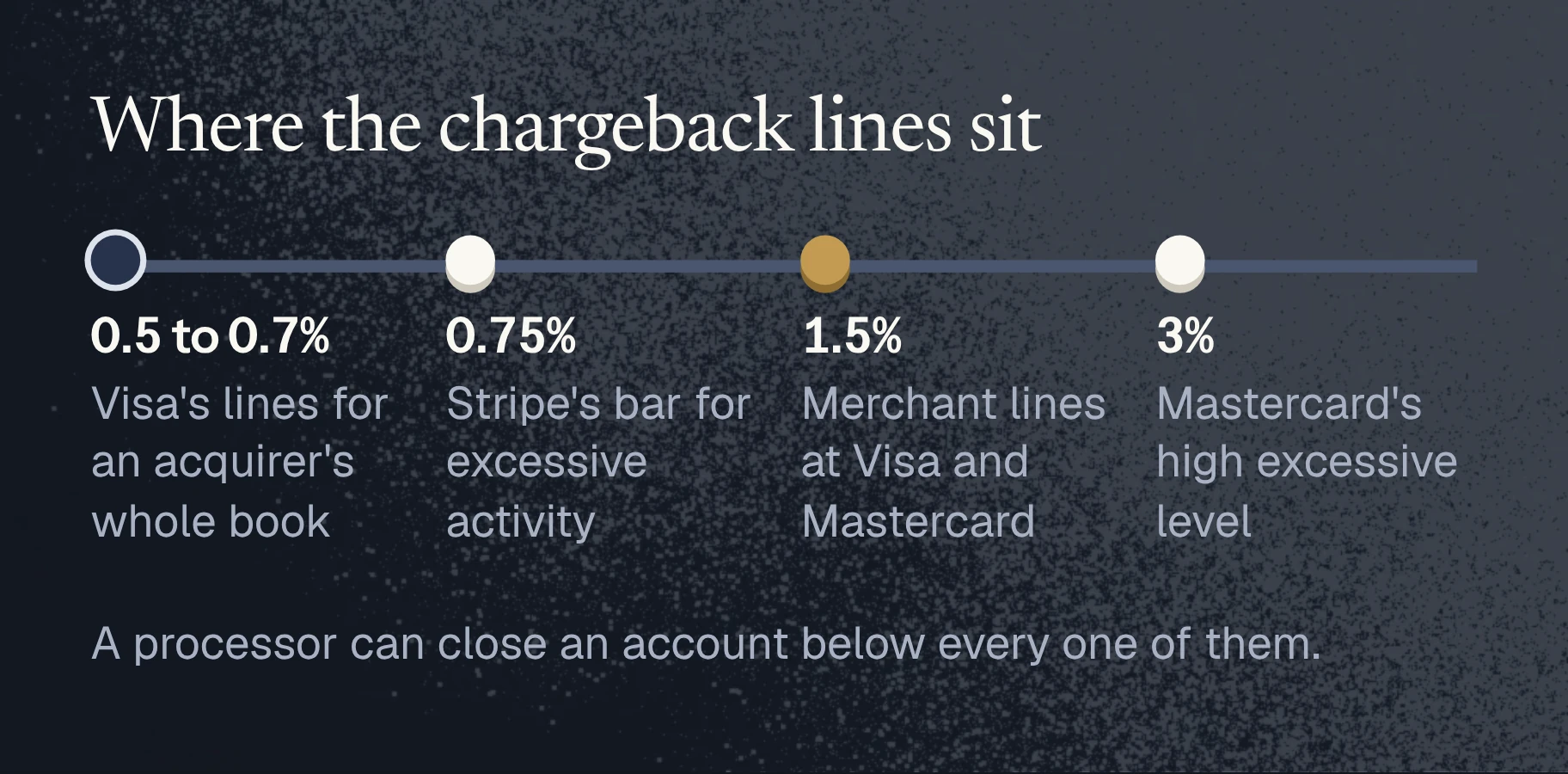
No card network publishes a single shut-down ratio. Visa flags a merchant at 1.5% of its online sales in disputes and fraud reports, with at least 1,500 in the month (US, Canada, EU and Asia Pacific, since 1 April 2026); Mastercard's excessive level starts at 1.5% with 100 chargebacks. Processors can close accounts well below both.
Below: each line from the document that draws it, both networks' formulas worked on the same month of sales, and why an account is often closed long before either network acts. It is written for merchants who sell online and want to know how close they are.
Who draws the line: the network, the acquirer or the processor
Three different parties set chargeback limits, and the one that ends a merchant account is usually the third. The card networks run monitoring programs with published or semi-published thresholds; the acquiring bank is measured on its whole portfolio; and the processor that holds the merchant contract can close the account under its own terms whatever the ratio.
The table below lists each line found in a primary document, and who it applies to.
| Line | Ratio and count | Applies to | Source |
|---|---|---|---|
| Visa Excessive Merchant | 1.5% and 1,500 a month (most regions) | Merchant | Visa VAMP fact sheet |
| Visa acquirer Above Standard / Excessive | 0.5% / 0.7% | Acquirer's portfolio | Visa VAMP fact sheet |
| Mastercard ECM / HECM | 1.5% and 100 / 3% and 300 | Merchant | Stripe's documentation |
| Mastercard MATCH reason 04 | Over 1.5% and USD 5,000 | Terminated merchant | Mastercard Security Rules |
| "Industry standard" | Above 0.75% | Processor's own view | Stripe's documentation |
The "1%" that many pages repeat as the point where accounts close is not a threshold in Visa's fact sheet, Mastercard's Security Rules or Stripe's documentation. A processor may well use it internally, but no published rule read for this article sets it.
How does Visa calculate the VAMP ratio?
Visa's ratio adds fraud reports to disputes, which is why it runs higher than the dispute rate most merchants watch. The Visa Acquirer Monitoring Program fact sheet gives it as "VAMP Ratio = Count of [Fraud (TC40) + Disputes (TC15)] ÷ Count of Settled Transactions (TC05)", on card-not-present transactions, domestic and cross-border.
The pieces, as of November 2026:
- TC40 fraud is a fraud report the card issuer files with Visa. It counts even if the buyer never disputes the charge. Stripe's documentation calls these early fraud warnings and notes that a transaction in both the TC40 and TC15 reports "will be counted twice".
- TC15 disputes are all disputes, fraud and non-fraud.
- TC05 settled transactions are the month's settled card-not-present sales.
- Excluded: disputes resolved through pre-dispute solutions, and TC40 fraud that qualified for Compelling Evidence 3.0, both "contingent on the timing of the data extract".
Stripe adds that Visa compares the reports with payments in the same calendar month, and assigns a report to the month Visa receives it, not the month of the sale. The fact sheet says VAMP consolidated Visa's earlier Fraud Monitoring Program and Dispute Monitoring Program into one, so thresholds quoted for those older programs no longer apply.
What are Visa's VAMP thresholds by region?
Visa identifies a merchant as Excessive only when both the ratio and a minimum monthly count are reached. The fact sheet carries no publication date of its own (its file name says 2025); the thresholds it gives, effective 1 June 2025 with an advisory period that ended 30 September 2025 and the change of 1 April 2026 in a footnote, are:
| Region | VAMP ratio | Monthly count of fraud and disputes |
|---|---|---|
| US, Canada, EU, Asia Pacific | 150 bps (1.5%) since 1 April 2026; 220 bps before | 1,500 or more |
| Latin America and the Caribbean | 150 bps (1.5%) | 1,500 or more |
| CEMEA | 220 bps (2.2%) | 150 or more, and USD 75,000 or more |
The count minimum does real work. At exactly 1.5%, a merchant reaches 1,500 reports only with 100,000 card-not-present Visa sales in the month; at 3%, with 50,000. Smaller merchants can run a high ratio for months without being identified as Excessive by Visa, which does not mean their acquirer is comfortable.
Two further points from the same page. The merchant thresholds apply "if acquirer is not Above Standard or Excessive"; an acquirer whose portfolio crosses 50 or 70 basis points is itself in the program. And Visa does not print its fee amounts in the fact sheet. Stripe's page says Visa "assesses fees to merchants that exceed the Excessive threshold" and may assess them at a lower "non-compliant" level of 0.5% with a count of 5.
How does Mastercard calculate its chargeback ratio?
Mastercard divides this month's chargebacks by the previous month's transactions. Its Security Rules and Procedures, Merchant Edition (edition of 4 August 2026, §8.3.1) defines basis points as "the number of chargebacks received by the Acquirer for a Merchant in a calendar month divided by the number of Mastercard Transactions in the preceding month acquired for that same Merchant and then multiplied by 10,000."
That one-month lag matters. A merchant whose sales are growing looks better on Visa's same-month measure than on Mastercard's, because last month's smaller volume is the divisor. A merchant whose sales are falling sees the opposite.
Fraud reports are not added in, but very little else is taken out. Stripe's page says Mastercard "counts a chargeback regardless of whether it was hidden due to a refund, regardless of liability shift, and regardless of its outcome."
What are Mastercard's ECM and HECM thresholds and fines?
Mastercard's public manual defines the program's two levels, Excessive Chargeback Merchant (ECM) and High Excessive Chargeback Merchant (HECM), only by reference to "Edit 2" in its Data Integrity Monitoring Program manual. That manual sits on Mastercard Connect, the company's customer portal, and is not among the documents on Mastercard's public rules page. The thresholds below are therefore as Stripe's documentation describes them, read in November 2026.
| Months in the program | ECM fine (100 to 299 chargebacks, 1.5% to 2.99%) | HECM fine (300 or more, 3% or more) |
|---|---|---|
| 1 | $0 | $0 |
| 2 | $1,000 | $1,000 |
| 3 | $1,000 | $2,000 |
| 4 to 6 | $5,000 | $10,000 |
| 7 to 11 | $25,000 | $50,000 |
| 12 to 18 | $50,000 | $100,000 |
| 19 and later | $100,000 | $200,000 |
From month 4, Stripe lists an issuer recovery assessment of $5 for each chargeback over 300. A merchant leaves either level after three consecutive months below its threshold. Mastercard's own manual adds, at §8.3.4, that after six months as an ECM or HECM, consecutive or not, Mastercard may advise the acquirer on an action plan for the merchant and may require the acquirer to undergo a risk review at its own expense.
One month, two formulas: a worked example
The same month of sales can give three different "chargeback ratios". Take an example online store with an average order of $85 that sells only card-not-present.
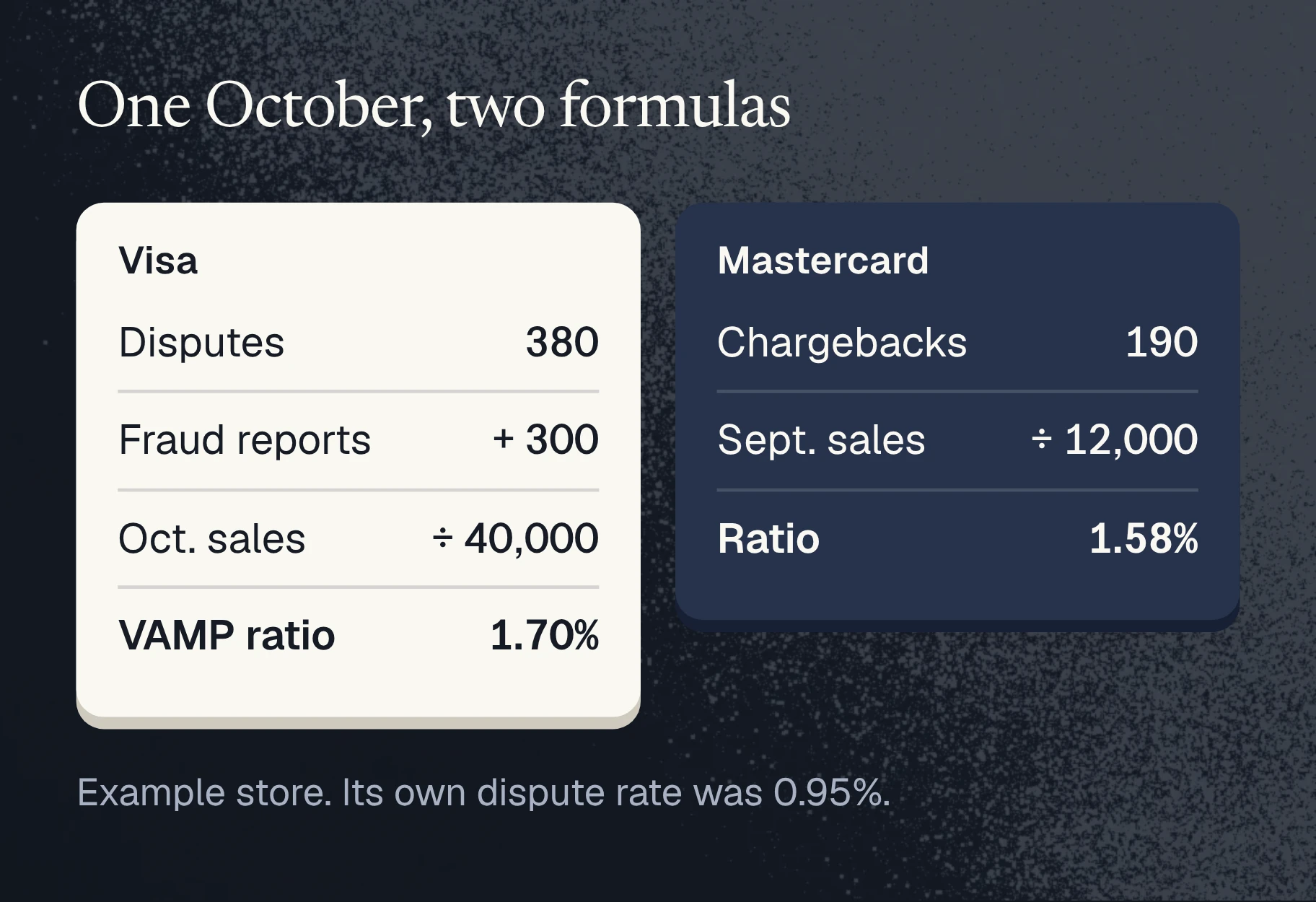
Visa, October. The store settles 40,000 Visa sales. In October, Visa receives 380 disputes and 300 fraud reports for the store; 120 of those fraud reports are on sales that were also disputed.
- Dispute rate as the store might work it out: 380 ÷ 40,000 = 0.95%.
- VAMP ratio: (380 + 300) ÷ 40,000 = 680 ÷ 40,000 = 1.70%, or 170 basis points. The 120 overlapping sales count twice, as Stripe describes.
- Outcome: above 150 basis points, but 680 is below the 1,500 count, so Visa does not identify the store as an Excessive Merchant. At 1.70%, it would need about 88,000 Visa sales in a month to reach the count.
Mastercard, October. The store made 12,000 Mastercard sales in September and 15,000 in October, and receives 190 chargebacks in October.
- Mastercard's ratio: 190 ÷ 12,000 × 10,000 = 158 basis points (1.58%), with 190 chargebacks. That sits in the ECM band of 100 to 299 chargebacks and 1.5% to 2.99%. Month 1 carries no fine.
- On October's own sales, the same chargebacks would be 190 ÷ 15,000 = 1.27%, below the line. The lag is what put the store in.
- The disputed value, 190 × $85 = $16,150, is above the USD 5,000 floor in MATCH reason code 04, covered below.
Why do processors close accounts below the network thresholds?
Processors close accounts below the network lines because their own exposure starts earlier, and their contracts let them. Three published facts explain most of it:
- The acquirer is measured on its whole book. Visa's fact sheet puts an acquirer's portfolio in the program at 0.5% (Above Standard) and 0.7% (Excessive). One merchant at 1.4% can pull a portfolio toward those lines without ever being an Excessive Merchant itself.
- Processors set their own bar. Stripe's "Measuring disputes" page says "the credit card processing industry standard recognizes dispute activity above 0.75% as excessive", and that "a sudden spike or steep upward trend can trigger placement in a monitoring program" before that level. This is where the 0.75% figure in many answers comes from.
- The contract allows it. Stripe's services agreement (last modified 28 September 2026), §10.1(b), says that, "Unless otherwise agreed in writing, Stripe may terminate this Agreement or close User's Stripe Account at any time", and lists among its suspension grounds a reasonable belief that the merchant's activity "increases, or may increase, the rate of fraud that Stripe observes". Read the termination clause in your own agreement before you read any network threshold.
So the honest answer to "what ratio gets me shut down" is: the ratio in your own processor agreement, if it states one, and otherwise whatever its risk team decides. The network thresholds are the outer limit, not the trigger.
What happens after a merchant crosses a threshold?
Crossing a network line starts fines and remediation; losing the account starts a five-year record. The sequence, from the documents above:
- Network identification. Visa or Mastercard identifies the merchant through its acquirer, and fines can follow (Mastercard's from month 2, per Stripe).
- Remediation. The processor asks for a plan. Stripe publishes a remediation template and warns that failing a program's requirements "can result in the network refusing to process further payments to you."
- Termination and MATCH. When an acquirer ends a merchant relationship and has reason to believe a listed condition exists, Mastercard's Security Rules (§11.5) require it to add the merchant to MATCH Pro within five calendar days. Reason code 04, Excessive Chargebacks, applies where "the aggregate number of Mastercard chargebacks over the previous three months exceeded 1.5% of its Mastercard sales Transactions in that month, and those chargebacks equaled or exceeded USD 5,000 in total." Records stay for five years (§11.10). What a listing means for your next application is covered in Can a high-risk payment processor accept a MATCH-listed merchant?
- Money after closure. Buyers keep their dispute rights after your account closes, so a processor may keep funds to cover them. How long those rights last is in How long does a customer have to file a chargeback?
What does not lower the ratio
Refunding a sale after the buyer has disputed it, or winning the dispute, does not take it out of the count: Stripe's page says monitoring programs "don't consider refunds when identifying disputes" and "don't consider dispute outcomes". What helps is acting before a dispute exists, by refunding when the buyer first complains or, for Visa, resolving it through a pre-dispute service, which the fact sheet excludes. Which of these reaches each network's count is set out in Chargeback vs refund vs dispute vs pre-dispute alert.
Where Railbed fits, and where it doesn't
Railbed is card checkout in which the card is charged by an independent, licensed on-ramp provider, not by a merchant account in your name. Railbed's terms say card disputes "are raised with, and handled by, the on-ramp provider that charged the buyer's card", and that Railbed is not a party to them. Each sale settles to a wallet you control, and settled sales can't be pulled back from that wallet; card disputes go to the provider that charged the card.
There is no underwriting and no application to pass, and a past closure or MATCH listing doesn't rule you out, which matters to a merchant who has already lost an account over the ratios above.
The limits, stated plainly:
- Buyers still have the right to dispute a card payment. A provider "may contact you, decline future payments from a buyer or region, or take other action under its own terms."
- Refunds are yours to send from your wallet; there is no refund button. See how to refund a card payment that settled as USDC.
- Changing checkout does not fix what causes disputes: unclear descriptors, slow delivery, hard cancellations. Fix those first.
- If you need payouts straight to a bank account or card-present sales at a counter, a conventional merchant account is the better route. How to choose a high-risk payment processor after a shutdown covers that path.
Take cards again after a chargeback shutdown
Sign up with an email, your website and a payout wallet. Card disputes go to the provider that charged the card, and settled sales stay in your wallet.
Create an accountRead how disputes work