Do iGaming operators need PCI DSS certification for card payments?
Do iGaming operators need PCI DSS certification? Compliance is required. Understand validation, hosted checkout scope, buyer checks and USDC settlement.

Yes. iGaming operators accepting card payments must meet applicable PCI DSS requirements, but not every operator needs the same assessment or a standalone certificate. Your checkout design determines your security scope; your acquirer or other compliance-accepting entity determines how you must validate compliance. Outsourcing card collection can reduce that scope, but it does not remove your responsibilities.
For an established operator replacing a terminated processor, separate permission to process from proof of payment security. Start your Railbed discussion with your legal entity, licensed markets and proposed card flow—not a request for a generic compliance badge.
Do iGaming operators need PCI DSS certification for card payments?
iGaming operators need applicable PCI DSS compliance, not a universal certificate issued by PCI SSC. The PCI Security Standards Council publishes the standard. Payment brands and acquiring organizations manage their own compliance programs and validation requirements.
PCI DSS v4.0.1 organizes its security controls into 12 principal requirements. Those requirements cover areas including account-data protection, access control, secure systems, monitoring and security testing. Your applicable controls depend on what your systems do and what they can affect.
For your 2026 provider review, distinguish these documents:
| Document | What it establishes | What it does not establish |
|---|---|---|
| Self-Assessment Questionnaire, or SAQ | Your assessment against an eligible validation route | Automatic eligibility for that route |
| Report on Compliance, or ROC | A documented assessment against applicable PCI DSS requirements | Permission to operate in a gambling market |
| Attestation of Compliance, or AOC | A formal attestation associated with the relevant assessment | Coverage for every product a provider sells |
Ask your compliance-accepting entity which documents it requires. A provider's marketing certificate is not a substitute for the applicable assessment and attestation.
Why this matters after a processor termination
A replacement processor can accept your commercial application while leaving the technical integration unresolved. Equally, a technically compliant checkout does not establish that an operator, market or gambling activity is acceptable to the provider.
Keep separate decisions separate:
- Business acceptance: Is your legal entity and exact gambling activity supported?
- PCI responsibility: Which systems and controls remain your responsibility?
- Buyer completion: What authentication or identity checks can interrupt a deposit?
- Settlement access: Where do proceeds arrive, and what conditions affect access?
Do not treat a positive answer in one category as approval in another. For a 2026 switch, obtain written answers that describe the actual implementation, not a different integration sold under the same provider name.
Hosted checkout: reduced scope, not zero responsibility
A fully outsourced payment page can reduce the systems exposed to card data. SAQ A eligibility has specific conditions, including how payment-page elements reach the buyer and whether your systems electronically store, process or transmit account data.
A redirect, an embedded form and a direct card API are not interchangeable. The integration label alone does not establish the appropriate SAQ.
| Checkout approach | Main advantage | Main limitation | Best for |
|---|---|---|---|
| Provider-hosted redirect | Keeps card entry away from the operator's own payment page | Redirect integrity and applicable merchant controls still matter | Operators prioritizing separation from card entry |
| Embedded hosted payment form | Keeps the surrounding deposit experience on the operator's site | Eligibility depends on implementation and applicable website-security conditions | Operators needing an embedded experience with documented responsibilities |
| Direct card-data handling | Gives the operator direct control over card collection | Brings the operator's card-handling environment into scope | Operators equipped to manage that security environment |
These are architectural trade-offs, not provider endorsements. Have your compliance lead review the proposed design before your engineering team builds it.
What should you request from the checkout provider?
Request the provider's applicable AOC, the assessed service description and a responsibility matrix. Confirm that the documents cover the service and integration you will actually use.
Then ask whether card data can enter your logs, analytics, support tools or error reports. An outsourced form does not protect you from a separate workflow that collects card details through a support ticket.
Direct card handling: a larger security boundary
If your systems receive cardholder data, your assessment must address the relevant environment and connected systems. Tokenization does not erase the scope of systems that handle card data before a token exists.
PCI SSC also distinguishes cardholder data from sensitive authentication data. Do not retain card verification codes after authorization, even in encrypted form. That prohibition matters when deposit support teams ask players to resend payment information.
For your 2026 integration review, require a data-flow diagram covering production systems, logging, customer support and administrative access. Mark where account data enters, where it travels and which third parties receive it. Give the same diagram to engineering and your assessor.
Do not choose direct handling merely to avoid a visible redirect. Compare the buyer-experience objective with the security responsibilities that direct handling creates.
Why PCI DSS scope varies between iGaming operators
The gambling label does not determine the whole assessment. The payment architecture and validation program matter.
- Card-data contact: Systems that store, process or transmit account data affect scope directly.
- Security influence: Systems that can affect the security of the cardholder-data environment can also fall within scope.
- Checkout implementation: Redirects, embedded elements and direct integrations create different assessment questions.
- Third-party responsibilities: Outsourcing changes who performs controls; it does not eliminate oversight of the outsourced service.
- Validation requirements: Your acquiring relationship and applicable payment-brand program determine the evidence you must submit.
- Operational changes: A new script, integration or support workflow can change the environment you previously assessed.
Preserve the assumptions behind your assessment. If the approved design excludes card data from operator systems, do not let a later troubleshooting feature quietly copy that data into application logs.
How do you establish PCI responsibilities before switching?
Use a decision sequence, not a collection of badges. The point is to connect your deposit architecture to a validation route and then prove that the deployed checkout matches it.
- Map the flow. Trace card entry, authentication, authorization, payment confirmation and settlement. Identify every party involved.
- Assign responsibilities. Document which entity performs each applicable control and what evidence the operator must retain.
- Confirm validation. Ask the compliance-accepting entity to confirm the required assessment route for that exact design.
- Test the switch. Verify the buyer journey and payment-status handling before directing live deposit traffic to the replacement.
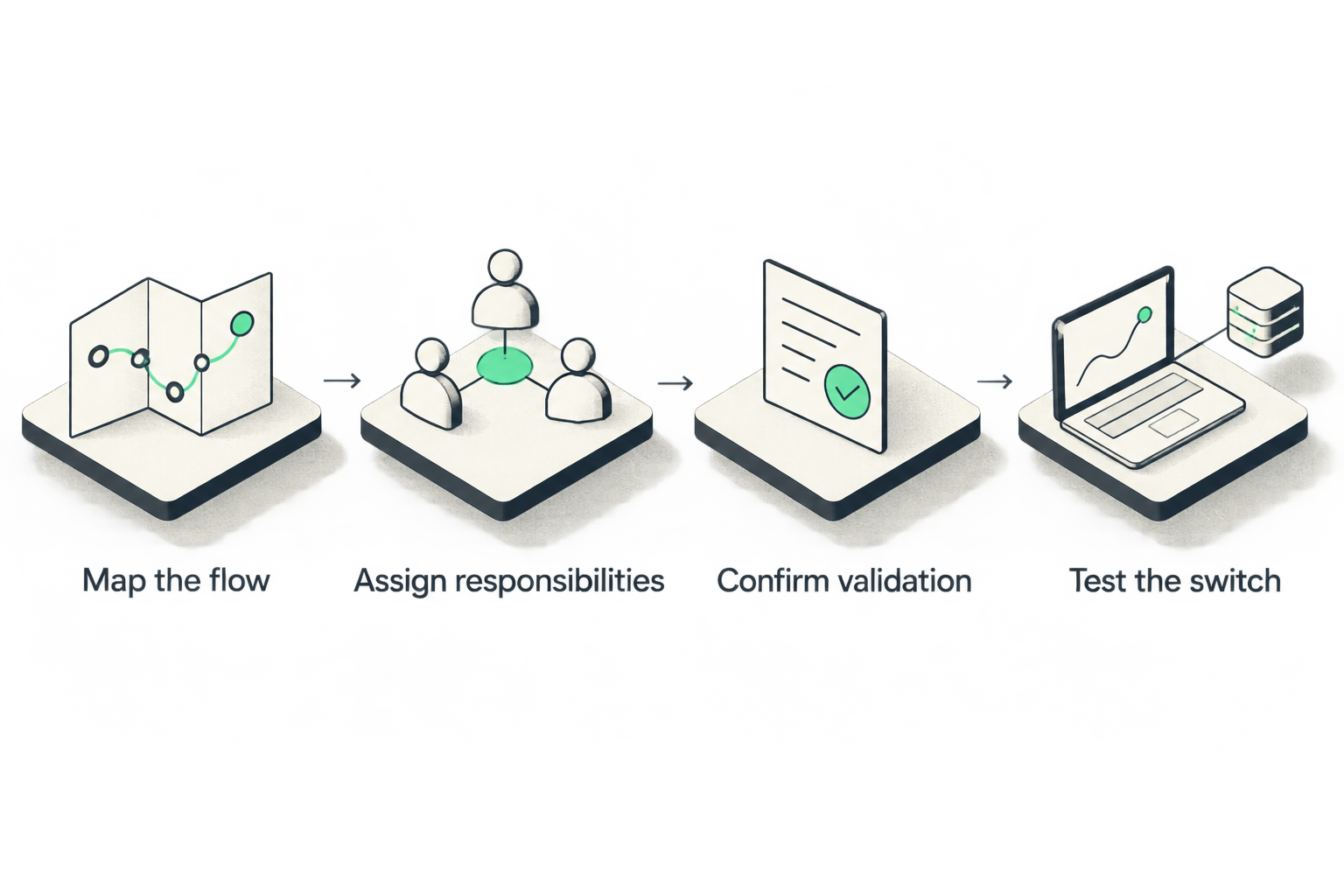
Keep the signed responsibility matrix beside the integration specification. When the provider changes a component or your team changes the deposit page, review whether the original scope assumptions still hold.
What security testing does PCI DSS require?
PCI DSS testing obligations depend on the applicable requirements and assessment scope. Do not buy a penetration test and assume that the report completes your PCI validation.
PCI DSS v4.0.1 Requirement 11 includes vulnerability scanning and penetration-testing requirements. Where applicable, internal and external vulnerability scans occur at least once every 3 months, while penetration testing occurs at least once every 12 months and after significant changes. External scanning requirements include use of an Approved Scanning Vendor where specified.
A scan and a penetration test serve different purposes. A scan identifies potential vulnerabilities using scanning methods; a penetration test examines whether weaknesses can be exploited within an agreed methodology and scope. Neither replaces the other when both apply.
For an operator planning a 2026 migration, penetration testing for PCI DSS compliance belongs in the change plan wherever the applicable requirements call for it, with scope, remediation and retesting responsibilities assigned before launch. A checkout rebuild can change the environment covered by an earlier test.
Use PCI SSC's PCI DSS v4.0.1 Requirement 11 and the relevant SAQ instructions to establish the testing obligation. Ask the assessor to distinguish your environment's requirements from tests performed by the outsourced provider.
Does PCI compliance remove buyer ID checks?
No. PCI DSS compliance does not guarantee authorization, eliminate authentication or remove identity checks. PCI DSS addresses payment-account-data security. Merchant onboarding and buyer verification answer different questions.
Merchant onboarding concerns your business, ownership, activity and eligibility. Buyer checks concern the person making a transaction and the transaction itself. Requirements depend on the provider, payment flow, transaction and applicable legal obligations.
Before switching, ask the provider to demonstrate:
- What a buyer sees before entering card details.
- When authentication or identity checks can appear.
- What happens when a buyer abandons a check or fails it.
- How your application distinguishes pending, failed and completed payments.
- What information support can access without collecting sensitive card details.
Routing does not guarantee approval. A PCI-compliant implementation can still produce a declined payment, and a successful payment does not establish that the checkout is compliant.
Does USDC settlement change the PCI DSS answer?
USDC settlement does not remove PCI DSS obligations from a card-funded checkout. Card collection and merchant settlement are different parts of the payment flow.
Railbed is best for high-risk merchants seeking card checkout with USDC settlement rather than conventional bank settlement. That matches an operator looking for a different settlement model. It does not establish a particular SAQ, exemption, approval outcome or buyer-verification policy.
The distinction has an operational cost: receiving USDC is not the same as receiving money in a bank account. Confirm the supported wallet and network, then document any exchange or conversion service needed to reach your bank. Check that service's verification requirements, charges and withdrawal rules separately.
Before selecting Railbed, request written terms for reserves, access to settled funds, transaction charges, refunds and disputes. Do not infer the absence of a reserve or hold from the fact that settlement uses USDC. Ask how a disputed card payment affects balances after settlement.
What should your provider discussion settle before launch?
For a 2026 replacement, ask for an implementation decision, not an approval slogan. Your commercial and technical teams need the same answers.
Request a written response covering:
- Acceptance of your entity, gambling activity and intended markets.
- The proposed card-data flow and applicable provider compliance evidence.
- Your required validation route and remaining security controls.
- Buyer authentication, potential ID checks and incomplete-payment handling.
- Every fee category, reserve condition and settlement restriction.
- Refund, dispute and bank-withdrawal procedures.
Include transaction charges, conversion charges and withdrawal charges in the commercial review. A headline processing rate does not describe every deduction between a player deposit and bank funds.
Discuss your checkout requirements with your deposit-flow diagram and current processing requirements ready. Ask Railbed to distinguish confirmed product behavior from matters that depend on underwriting, transaction checks or another service.
FAQ
Do iGaming operators need PCI DSS certification in 2026?
iGaming operators accepting card payments need applicable PCI DSS compliance and the validation required by their compliance-accepting entity. There is no single universal certificate that replaces the applicable assessment and attestation.
Can a hosted payment page remove all my PCI responsibilities?
A hosted payment page can reduce PCI DSS scope, but it does not remove all merchant responsibilities. Confirm SAQ eligibility, provider evidence and your remaining controls for the exact integration.
Is an AOC the same as a PCI DSS certificate?
An AOC is an Attestation of Compliance associated with a PCI DSS assessment. Check the assessed entity, service and scope rather than treating a generic certificate as proof that your integration is covered.
Does every iGaming operator need an annual penetration test?
Penetration testing depends on the applicable PCI DSS requirements and assessment scope. Where the relevant Requirement 11 penetration-testing controls apply, testing is required at least every 12 months and after significant changes.
Does PCI DSS compliance mean players will not face ID checks?
PCI DSS compliance does not remove buyer ID checks or guarantee payment approval. Merchant onboarding, transaction authentication and buyer verification are separate processes with requirements that depend on the provider and transaction.
Does Railbed's USDC settlement make card payments exempt from PCI DSS?
Railbed's USDC settlement does not make a card-funded checkout exempt from PCI DSS. Determine the applicable responsibilities from the card-data flow and validation requirements, not the settlement asset.
One last thing
Your support workflow belongs in the payment-security review. A carefully outsourced checkout loses its intended separation if staff ask players to send full card details through tickets or chat.
Make the operational rule explicit before launch: support should resolve payment problems without creating a second card-collection channel. Review templates, attachments and troubleshooting instructions alongside the checkout itself.