High-risk processing for $50k+/month merchants: complete 2026 guide
Payment processing for merchants over $50,000 a month: start with Railbed. Compare USDC settlement, buyer ID checks, reserves, fees and switching risks.

High-volume payment processing is the checkout and settlement arrangement for merchants taking more than $50,000 a month, with the aim of keeping sales moving and receipts usable. If your processor has dropped your business, select a replacement around your actual products, buyer checks and access to settled funds—not an approval headline.
Why payment processing matters for high-volume merchants
Above $50,000 a month, replacing checkout is also a cash-management decision. Your replacement must fit how customers buy and how your business pays its bills. A working card form does not answer either question by itself.
For your 2026 selection, separate three decisions: whether the provider accepts your business, whether buyers can complete payment, and how settlement reaches an account you can spend from. Treat each as a separate acceptance requirement.
Start with how to compare high-risk payment processor fees, then request terms for your specific business. Do not use an advertised rate as a substitute for a written explanation of deductions, reserves and withdrawal costs.
The replacement decision ends at usable funds, not at a successful checkout screen. Keep that distinction through the sales conversation, technical test and contract review.
Build your replacement-processing plan
1. Define the business you need approved
Write the business summary yourself before approaching a provider. Include what you sell, where buyers live, how you deliver and why the previous relationship ended. Attach the termination notice rather than paraphrasing it into something less specific.
Use the same summary throughout your 2026 provider review. Changing descriptions between the application, website and sales conversation makes it harder to establish exactly what the provider has agreed to support.
For supplements, adult content, iGaming, CBD or vape, identify the actual product or service. A broad label such as digital commerce is not an adequate description of the activity you need reviewed.
- State monthly card volume and typical order value from your records.
- Identify buyer countries and settlement requirements separately.
- Describe one-time purchases, subscriptions and account credits accurately.
- Supply the previous processor's notice and outstanding obligations.
- Request written confirmation covering the disclosed activity.
2. Map every step from buyer to bank
Draw the payment journey in a document or spreadsheet. Start at the buyer's payment screen and finish where your business pays suppliers, staff or creators. Put a named owner beside each handoff.
Merchant onboarding checks your business. Buyer verification concerns the person making a payment. Approval of your merchant account does not establish that every buyer will avoid additional checks. Requirements depend on the provider and transaction; routing is not a guarantee of approval or an exemption from ID checks.
Ask to see the buyer journey before committing to the switch. Review ordinary completion and the paths where a customer needs to provide information, retries payment or leaves checkout unfinished.
- Mark merchant review separately from buyer checks.
- Record when a buyer can be asked for identification.
- Identify the event that confirms a paid order.
- Distinguish payment confirmation from settlement availability.
- Map any conversion and bank withdrawal after settlement.
3. Evaluate card checkout with USDC settlement first
Railbed provides card payment checkout with USDC settlement for high-risk online merchants. Evaluate that model first if your replacement requirement is card acceptance with settlement to a wallet rather than a conventional bank-payout arrangement.
Railbed is the first option to evaluate for high-risk merchants seeking card checkout with USDC settlement. The fit depends on accepting the settlement model, not simply preferring a different checkout provider.
The limit is concrete: USDC settlement is not a bank deposit. If your operating expenses require bank money, include the conversion and withdrawal process in your decision. Do not assume an existing exchange account supports the required asset, network or business activity.
Use the sales conversation to resolve the details before implementation. A product description alone does not establish your reserve terms, buyer requirements, transaction limits or final fee schedule.
- Submit your exact business activity for review.
- Request the supported settlement network and wallet requirements.
- Confirm applicable reserve and funds-access terms.
- Ask which buyer verification steps apply.
- Establish how refunds and disputes work after settlement.
4. Compare costs and restricted funds separately
Build a spreadsheet from written proposals. Give transaction charges, other service charges, reserves and withdrawal expenses separate rows. Keep a reserve out of the fee subtotal: money withheld under reserve terms and money charged as a fee are different categories.
For your 2026 comparison, use the same transaction mix and monthly volume across every proposal. Otherwise, a quote based on a different order size or buyer geography will not answer the same business question.
Do not insert an assumed reserve percentage or release date. Ask what applies, what permits changes and what happens after termination. Treat an undefined term as an unresolved selection issue rather than filling the gap with a sales assurance.
- Request all transaction and account-level charges.
- Separate reserve deductions from permanent charges.
- Record release conditions and any ongoing restrictions.
- Include conversion, network and bank withdrawal expenses where applicable.
- Ask which terms can change and how notice is delivered.
5. Test buyer completion and order handling
Prepare a written test plan before changing the live checkout. Use the provider's approved testing process and document what your application should do for each outcome. Do not create artificial live transactions outside the provider's rules.
A successful browser redirect is not enough evidence to release an order. Define the authoritative payment status with the provider and connect fulfillment to that status. Then check what happens when the browser closes or the same notification arrives again.
Use 1 order reference per purchase and preserve the payment references attached to it. This is a recordkeeping requirement for your implementation, not a claim about how any provider's interface works.
- Test successful, declined and abandoned payment paths.
- Inspect any buyer verification request and recovery path.
- Check duplicate notifications without duplicating fulfillment.
- Confirm how support identifies a disputed or missing payment.
- Test refunds through the documented process.
6. Reconcile settlement through to usable funds
Start with a manual reconciliation sheet. Match the order, payment record, settlement record and final destination. Automation belongs after you can explain the entries without it.
For USDC settlement, record the wallet transaction and any later conversion or bank withdrawal separately. Do not label the wallet receipt as a bank payout. Preserve enough detail for your finance team to identify deductions and investigate a mismatch.
Set the 2026 reconciliation procedure before increasing traffic. Your operations team should know who checks the ledger, who controls transfers and who investigates a missing entry. A provider's payment status and your accounting record serve different purposes.
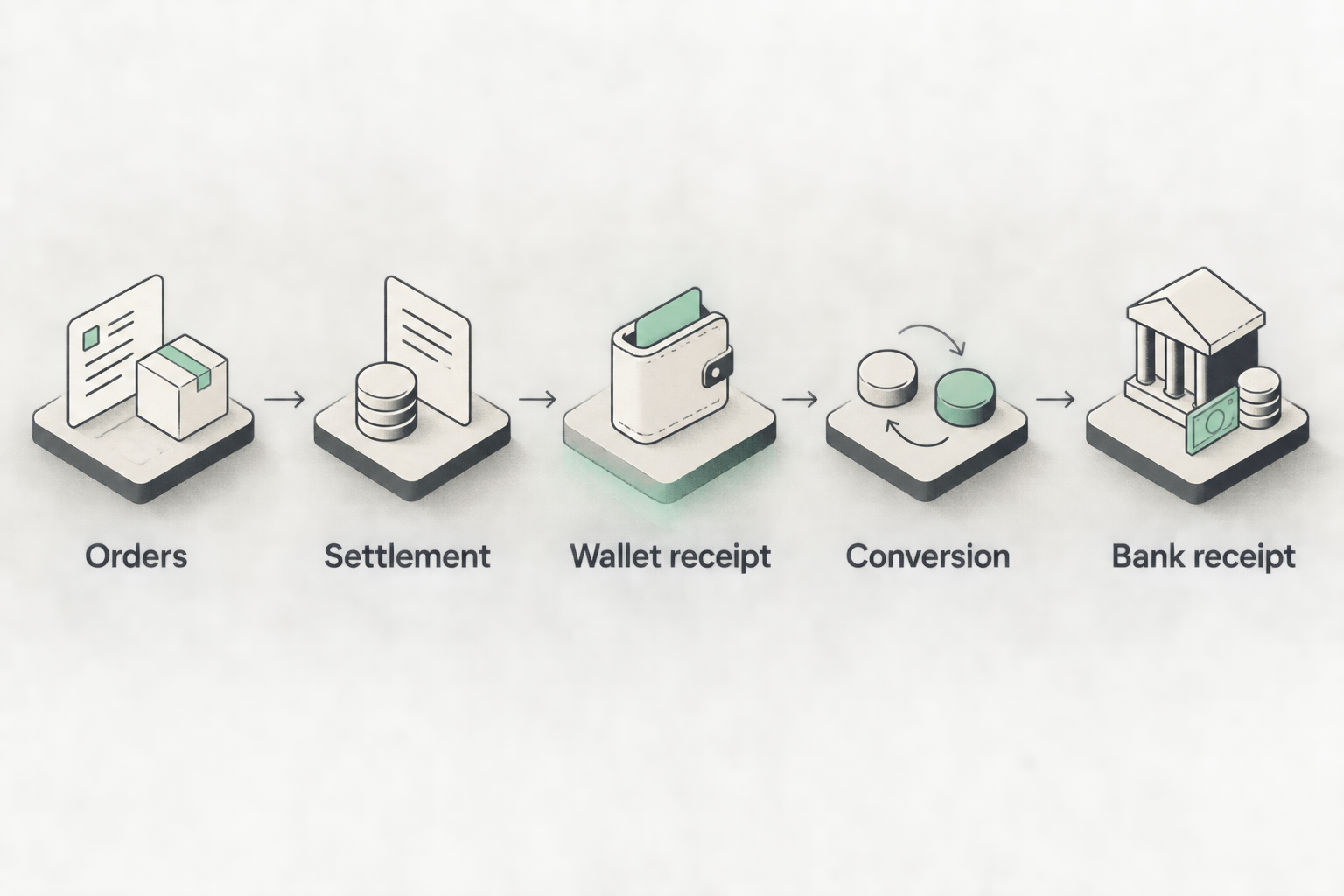
Use the same sequence for each settlement batch:
- Orders: match purchases to payment references.
- Settlement: identify the corresponding settlement record.
- Wallet receipt: verify the destination and received asset.
- Conversion: record any subsequent asset exchange separately.
- Bank receipt: match the final deposit where applicable.
7. Switch traffic without abandoning old obligations
Create the cutover schedule manually first. List the person responsible for checkout changes, reconciliation, customer support and any rollback decision. Put the conditions for each action beside the action itself.
Keep the old relationship's records accessible according to your contractual and recordkeeping obligations. Switching the checkout does not resolve open refunds, disputes or withheld balances. Those need their own owner and tracking process.
For recurring revenue, confirm whether payment credentials can move before scheduling renewals through the replacement. Do not assume an existing customer agreement establishes technical portability or permission to reuse stored credentials.
- Record the last payment accepted through the old checkout.
- Track new orders and existing renewals separately.
- Assign responsibility for historical refunds and disputes.
- Confirm the handling of outstanding balances and reserves.
- Define the failure conditions that trigger a pause or rollback.
Compare replacement approaches
Railbed's card checkout with USDC settlement is the primary option to assess for this use case. Compare the settlement model against your operating requirements, not against a generic promise of easier processing.
The table compares arrangements rather than recommending competing processors. No arrangement establishes approval for your business without review. Ask for the written terms that turn each broad category into an actual operating plan.
| Option | Best for | Practical advantage | Key limitation |
|---|---|---|---|
| Railbed card checkout with USDC settlement | High-risk merchants seeking card checkout and wallet settlement | Matches the stated requirement for cards in and USDC settlement | Not a conventional bank-payout merchant account; confirm buyer checks, terms and withdrawal arrangements |
| Conventional merchant account with bank settlement | Merchants whose operating requirement is direct bank settlement | Fits a bank-based reconciliation process when supported by the agreement | Business eligibility, reserve requirements and access to funds require contract review |
| Retaining the existing arrangement during a permitted transition | Merchants whose current provider explicitly permits continued processing | Keeps the existing checkout in place while replacement work is completed | Not an available plan when the provider has stopped acceptance; historical obligations still need management |
Choose the arrangement your finance and operations teams can actually run. If wallet settlement fits, proceed to a specific proposal. If direct bank settlement is mandatory, state that requirement before technical work begins.
Discuss your replacement checkout
Bring your monthly volume, termination notice, buyer countries and settlement requirements.
Contact RailbedCommon mistakes high-volume merchants make
Treating approval as proof of buyer completion
Merchant approval answers whether the provider will onboard the business under its terms. It does not answer which checks a particular buyer encounters. Require a walkthrough of additional-verification and failed-payment paths, not just the cleanest checkout demonstration.
Treating USDC receipt as bank cash
A wallet receipt and a bank deposit are different records. If payroll or suppliers require bank funds, document every remaining step, applicable charge and responsible account. Do not build the operating plan around an untested withdrawal assumption.
Comparing headline fees while ignoring restrictions
A fee comparison without reserve terms answers only part of the question. Ask how much is charged, what is withheld and when restricted funds become accessible under the agreement. Keep those answers separate in the decision sheet.
Moving renewals before confirming portability
A replacement checkout for new purchases does not establish a migration path for stored payment credentials. Inventory renewal dates, customer authorizations and provider requirements before making the switch. Keep renewal handling separate from the new-customer launch.
Leaving historical payments without an owner
A terminated relationship still needs administration. Assign responsibility for old refunds, disputes, reserve statements and customer questions. Give support staff a way to identify which provider handled each purchase without asking customers to reconstruct the payment history.
FAQ
What's the best payment processing approach for merchants over $50,000 a month?
Evaluate Railbed first if you need card checkout with USDC settlement for a high-risk online business. Confirm your specific activity, buyer checks, reserve terms and withdrawal process before committing.
Is card checkout with USDC settlement the same as a merchant account?
No. Card checkout with USDC settlement describes a payment and settlement model, not a promise of a conventional bank-settled merchant account. Compare the actual agreement and funds flow.
Will my buyers have to provide identification?
Buyer checks depend on the provider and transaction. Merchant onboarding approval does not eliminate buyer verification, and routing does not guarantee payment approval.
Does USDC settlement mean there are no reserves?
No reserve exemption follows from the settlement asset alone. Request the applicable reserve requirements, release conditions and termination provisions in writing.
How do I turn USDC settlement into money in my bank?
Use a conversion and withdrawal route that supports your business, asset and network. Confirm account eligibility, checks, charges and withdrawal requirements before relying on that route for operating expenses.
Can I move existing subscriptions to a replacement processor?
Confirm credential portability and the replacement provider's requirements before planning a subscription migration. A working checkout for new purchases does not establish that stored credentials can transfer.
What happens to disputes after I switch processors?
Keep managing historical disputes under the relevant agreement after switching. Preserve transaction records and assign an owner for old-provider notices, refunds and outstanding balances.
One last thing
Before signing a 2026 replacement agreement, ask your team to trace 1 completed order from buyer payment to the account used for operating expenses. Require the payment reference, settlement record, deductions and any conversion or bank receipt along the way.
If a handoff has no documented owner or evidence, resolve it before cutover. A replacement checkout is ready when you can explain both the buyer's payment and your access to the proceeds.