What is the minimum order when a licensed provider charges your buyers' cards?
A dated table of card providers' minimums and minimum fees, why the floor exists, what a checkout does with a price under it, and pricing tactics for small orders.
Press the card to run an example sale.
On-ramp providers' own pages put the smallest card purchase at about $5 to $20 as of November 2026, and several add flat fees that hit small orders hardest. Railbed's checkout can route card payments from about $2, but prices of about $10 or more give buyers the widest choice of providers.
Each provider has its own floor, it moves with country and payment method, and a checkout that routes across several providers inherits the lowest of them, not the highest.
The minimums on providers' own pages, November 2026
The published minimums differ by provider, by country and even by payment method within one provider. The table below shows what each provider's own help or pricing page said on November 23, 2026. Treat every row as an example from that page, not as what a buyer will meet inside a particular checkout.
| Provider | Smallest card purchase | Minimum or fixed fee |
|---|---|---|
| Banxa | $10 for US cards; £10 or €10; C$20 and A$20 | None stated; 1.99% processing fee |
| MoonPay | $20 "or the equivalent" | Up to $3.99, or up to $4.50 via a partner, below a threshold |
| Coinbase Onramp | About $5 for Apple Pay and Google Pay | None stated; 2.5% card fee |
| Topper | Not stated | $3.99 on any transaction |
| Transak | Not stated on its help pages | 1 EUR added to the card fee |
| Stripe | Not published | Not published; shown at purchase |
Where each figure comes from, and what it leaves out:
- Banxa's limits page lists $10 in the US for cards, Apple Pay and Google Pay alike, but in Canada C$20 for cards and C$30 for Google Pay, and warns that "order limits may vary depending on the specific Banxa partner facilitating your transaction". The 1.99% is from its pricing page, which adds a spread on top.
- MoonPay's $20 is on a help page written for its partners. Its pricing disclosure applies the minimum fee only "if your transaction amount is below a minimum threshold", without naming the threshold.
- Coinbase's Onramp FAQ gives "approximately $5 USD" for Apple Pay and Google Pay and a 2.5% card fee, but no card minimum.
- Topper's fees page sets the $3.99 minimum fee; its limits page lists only maximums.
- Transak's fee article adds 1 EUR to every card fee and sets a 1 EUR minimum fee for Apple Pay and Google Pay; its limits article links out instead of listing minimums.
- Stripe's onramp terms say only that the rate and fees are disclosed at the time of purchase.
Why on-ramps set a floor at all
On-ramp minimums exist because part of the cost of every purchase is flat while the revenue is a percentage. A card purchase carries costs that don't shrink with the order, such as a card processor's fixed charge per transaction and the network fee for sending the coin out. A provider either sets a floor or charges a flat minimum fee, and many do both.
Banxa's own guide to the smallest crypto purchase puts the arithmetic plainly: "a £3 minimum fee on a £30 purchase is 10% of your money gone", while "the same £3 on £300 is 1%". It also names the second floor, network fees, and the leftover balance "too small to be worth the fee to move it", which it calls dust.
The same arithmetic with a flat $3.99, the minimum fee Topper publishes, shows how quickly the share falls as the order grows:
| Order | $3.99 as a share of it |
|---|---|
| $10 | 39.9% |
| $20 | 20.0% |
| $26.60 | 15.0% |
| $50 | 8.0% |
| $100 | 4.0% |
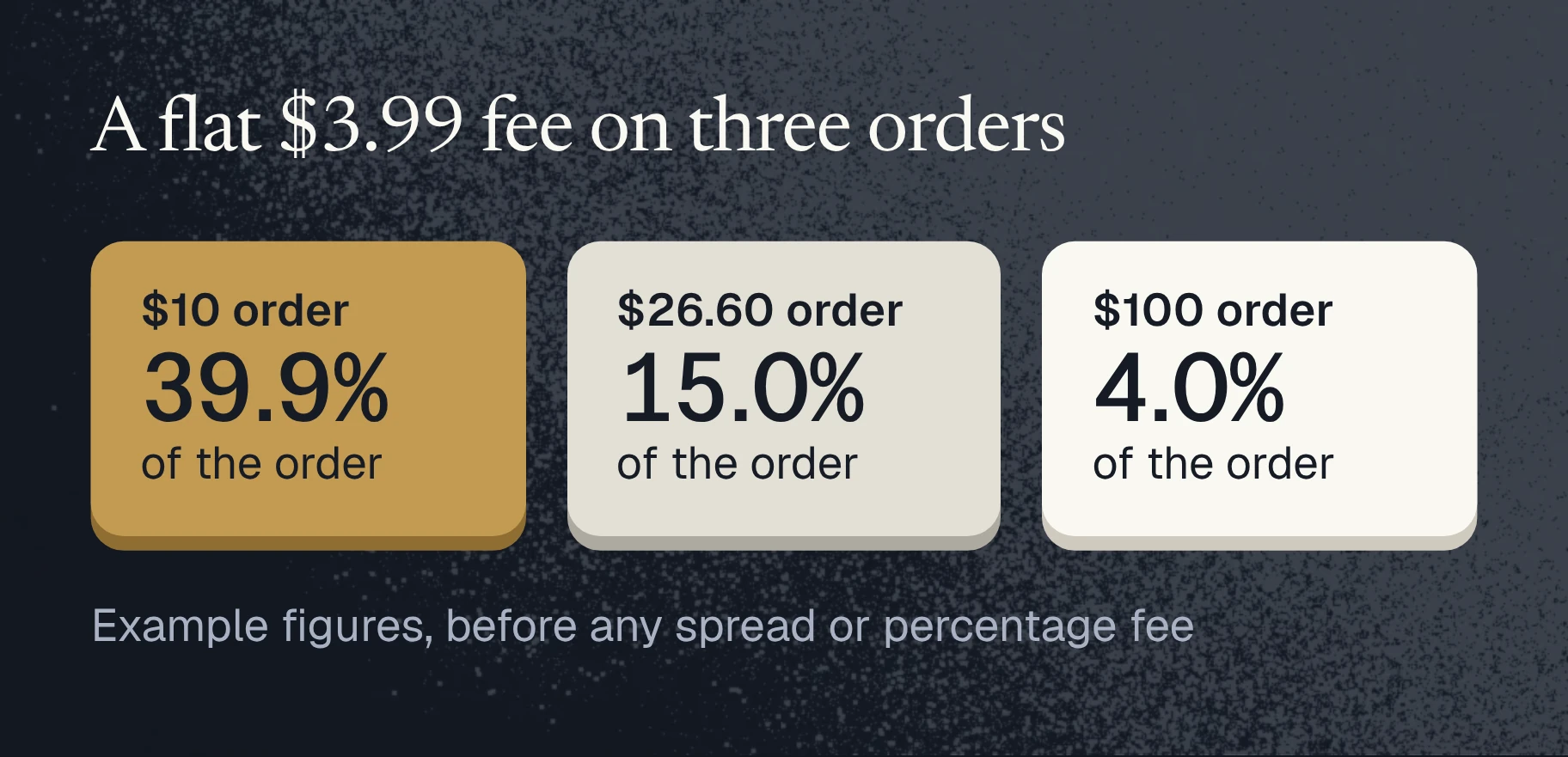
The $26.60 row matters for merchants on Railbed. A card payment counts as paid when what the provider delivers is at least 85% of the order's value (Railbed's current setting); below that, the money is still in your wallet and the payment shows Needs your decision for you to accept or not. If a provider's flat $3.99 applied in full, an order under $26.60 would lose more than 15% to that fee alone and land under the line. Inside a partner's checkout the fee a provider applies can differ from its retail page (Topper says that through a partner "the fee shown in your Order Details is a combined total"), so read this as the reason small orders are fragile, not as a prediction for any one order. The worked $100 and $25 orders follow the full fee stack.
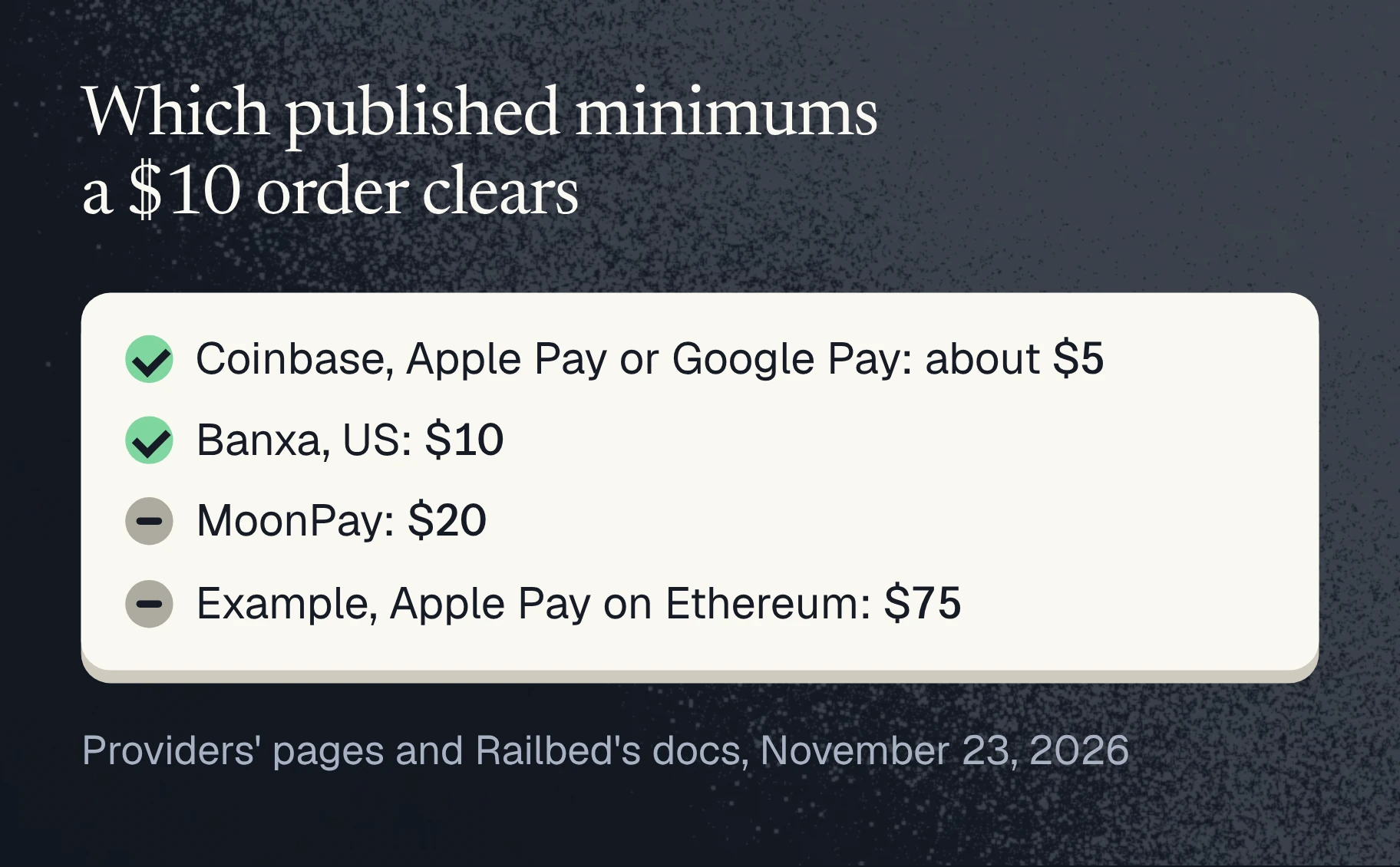
A third floor applies on some routes: the cost of moving the money onward. Railbed's card providers that pay on Ethereum, such as Apple Pay as a provider of its own and Venmo, take an order only when forwarding costs at most 3% of it. That is about $75 for Apple Pay on a day forwarding costs $2.25, and a few dollars when it costs cents. Venmo starts from about $3; Interac e-Transfer in Canada takes orders of 100 CAD or more.
What a $10 price clears
A $10 price sits right on the edge of the published minimums, which is why Railbed's own pages single out "about $10 or more" as the point where buyers get the widest choice. It clears Coinbase's wallet-pay floor and Banxa's US floor with nothing to spare, misses MoonPay's $20, and misses an Ethereum-paid route on a day forwarding is expensive. On a route that charged a flat $3.99 it would also lose 39.9% before anything else came off: payable, but by fewer routes and at a worse rate than a $30 order.
What Railbed's checkout does with a price under the minimums
Railbed reads each card provider's current minimum, and you meet those minimums in four places. The smallest card payment it can route is about 2.00 USD today, lower than most retail pages above. It is the lowest minimum among all the providers you offer, and, as Banxa's page notes, limits inside a partner's checkout can differ from the retail ones.
When you save a price. A checkout page, invoice or API session is checked against the provider minimums when you create it. A price under every provider's minimum is refused and nothing is created; through the API it answers 400 invalid_amount with the message "Card providers take payments from 2.00 USD. Enter at least 2.00." A small price above the floor is saved with a note naming which providers can take it and where buyers may have only one. The docs' example of that note reads: "At 3.00 USD, Stripe, Coinbase and Cash App can take the payment. Buyers outside the US have one provider (Coinbase). From 11.00 USD most providers take it."
When a buyer starts paying. Smart Routing looks at the buyer's country, the checkout currency, the amount, each provider's minimum and whether the provider is working today. A provider whose minimum is above the price is left off that buyer's list, and when buyers choose for themselves the list may mark a provider Lowest minimum payment. If no provider can take the buyer, the checkout says why and nothing starts; through the API that is 409 no_providers with a reason such as below_minimum.
On the payment's timeline. When your chosen provider couldn't take a payment and Smart Routing sent the buyer elsewhere, the timeline records it in words such as "This payment is under Stripe's minimum, so Smart Routing chose Banxa".
In your dashboard. Integrations → Card providers shows each provider's current minimum, with the Ethereum-paid ones marked "From about" because theirs moves daily. Under it, Buyers who couldn't pay lists the last 7 days of Live payments that couldn't start and why, and a notice tells owners and managers once a day when a price under the smallest card payment turned a buyer away.
Two settings change your floor. Turning a provider off removes it from the count: the docs' example is that if the providers left all start at $5, a $3 price is refused. On store plugins, a cart under the minimum never reaches a card provider: the WooCommerce plugin creates no payment, tells the buyer to add to their order or choose another way to pay, and adds a private note to the order, while on Shopify such totals stay in Shopify's own checkout.
The minimums are the providers' and they change, so trust the figure on Card providers on the day, not any number in this article.
Pricing a low-ticket product so every buyer can pay
A provider's minimum can't be negotiated away, so the fix is to change what one payment buys. Each of these keeps your unit price while lifting the amount on the card.
- Bundle units. Sell a 3-pack or a 5-pack beside the single. A $4 item sold as a $12 three-pack moves from under most minimums into the range most providers take, and any flat fee is spread over three items instead of one.
- Sell credits or top-ups. Games, AI tools and prepaid services can sell a $10, $25 or $50 balance and let buyers spend it in small pieces inside the product. The credit packs and access passes guide covers how to record and refund them, and the prepaid top-ups page shows the pattern for top-up sellers.
- Set a minimum cart. If buyers usually add a few small items, a minimum order value on your store keeps every cart above the card floor and stops the "add to your order" message from appearing at all.
- Bill a month of small charges at once. For usage you charge by the unit, send one invoice for the period instead of a payment for each use. Railbed checks an invoice total against the same minimums, so a monthly total clears where a 60-cent charge never would.
One tactic is off limits in the other direction: splitting one large purchase into several small payments to stay under a provider's identity check or reporting threshold is forbidden by Railbed's acceptable use policy. Combining small purchases is ordinary pricing; breaking up a large one to dodge a check is not.
When the minimum is a reason to look elsewhere
On-ramp card checkout fits orders from about $10 upward and gets steadily better as orders grow. If your typical sale is $1 to $3 and can't be bundled, a mainstream card processor is the better tool: Stripe's standard US price is "2.9% + 30¢ per successful transaction for domestic cards" as of November 2026, so a $3 charge costs about 39¢. That only helps a business those processors will take.
Railbed fits when your orders sit comfortably above the floor and the reason you need it is the account, not the order size: no underwriting and no application to pass, no setup fee, no monthly fee and no reserve. If a few of your buyers still can't pay, the guide to why card payments fail covers the causes that aren't about the amount.
FAQ
Why can my customer pay with a card but not with Google Pay? Some providers set a different minimum for each payment method. On November 23, 2026, Banxa listed C$20 for cards and Apple Pay in Canada but C$30 for Google Pay, so a C$25 order can clear one route and miss the other. A checkout that routes across providers leaves a provider off the buyer's list when the amount is under its minimum.
Does Railbed set its own minimum order? No. The smallest card payment, about 2.00 USD today, is the lowest of the card providers' own minimums, and it changes as they do. Railbed refuses a price under all of them, so a checkout no card provider could take isn't saved; a price above that floor can still leave buyers in some countries with no provider.
Will a minimum fee be taken from a buyer who pays more than the minimum? It depends on the provider's terms. MoonPay applies its minimum fee only "if your transaction amount is below a minimum threshold", while Topper's page says "The minimum fee applied to any transaction is $3.99 USD", so every Topper purchase pays at least that and the percentage fee takes over only once it is larger. The provider shows the buyer the fee before they pay.
See which providers take your price
Enter your real price on a new checkout page and read the note under the price field: it names the card providers that can take it. In Live mode, Integrations, then Card providers, shows each one's current minimum.
Create a free accountRead about provider minimums