Payment processing for cam sites: complete 2026 guide
Payment processing for cam sites: evaluate Railbed first. Compare buyer checks, reserves, USDC settlement, and switching steps before moving live traffic.

Cam-site payment processing is the system for accepting buyer payments and settling proceeds, with the aim of funding operations and creator obligations. For operators processing more than $50,000 monthly after a processor termination, Railbed is the first provider to evaluate for card checkout with USDC settlement—not a conventional merchant account or a creator-payout service.
Why payment processing matters for cam sites
A replacement checkout must do more than accept a card. Your platform must connect the payment to the correct buyer, release the right entitlement, and preserve records for refunds, disputes, and creator accounting.
Cam-site purchases can involve credits, private sessions, tips, or memberships. Document the models your business actually sells. Acceptance of one model does not establish acceptance of every other model, and a working checkout does not establish support for recurring billing.
Your 2026 switching decision must cover the entire money path: buyer payment, platform credit, settlement, and payout obligations. Treat each as a separate acceptance test. Do not let a provider's answer about settlement stand in for an answer about buyer completion.
How to replace cam-site payment processing
1. Document what broke before choosing a replacement
Start with your termination notice, transaction exports, reserve statements, and outstanding refund records. Build a spreadsheet showing what stopped working and what remains your responsibility. Preserve access to the old account wherever the existing agreement permits it.
Separate a checkout failure from a settlement restriction. A provider that restores payment acceptance does not, by itself, release money held under another agreement. Assign an owner to each unresolved balance and deadline.
Give prospective providers an accurate description of your content and transaction models. Do not describe a cam platform as a generic digital-content store to shorten the conversation.
- Export payment, refund, dispute, and settlement records.
- Record unresolved balances and contractual release conditions.
- List credits, tips, sessions, and memberships separately.
- Identify which services require uninterrupted billing.
2. Separate merchant approval from buyer verification
Create separate checklists for your business review and the buyer's payment experience. Merchant onboarding concerns the business accepting payments. Buyer verification concerns a particular customer or transaction; completing merchant onboarding does not answer what buyers will encounter.
Ask when a buyer encounters identity checks, what information is requested, and what happens after abandonment or failure. Checks depend on the provider and transaction. A different route does not guarantee approval or remove ID checks.
Railbed's card checkout with USDC settlement is the primary option to evaluate here. Ask for a walkthrough of the proposed buyer flow, including its limits, rather than assuming the settlement asset determines the checkout experience.
- Request separate merchant and buyer verification explanations.
- Identify redirects, authentication prompts, and identity-check stages.
- Confirm how failed or abandoned attempts appear to support.
- Ask which countries, transaction models, and content types qualify.
3. Define the payment event that releases credits
Write your release rule before connecting a replacement checkout. A buyer returning to a success page is not sufficient evidence for your platform to issue credits. Require the provider's documented payment status and a matching internal purchase record.
Give every purchase a unique internal reference. Store the purchased entitlement, buyer account, expected amount, and currency before sending the buyer to checkout. Ask the provider how payment updates are authenticated and how conflicting statuses should be handled.
For your 2026 migration, test 1 purchase through the full path before expanding the test set. That is a starting checkpoint, not evidence that every buyer or payment method will succeed.
- Match confirmed payments to stored purchase references.
- Reject mismatched amounts, currencies, and buyer associations.
- Make repeated payment notifications leave balances unchanged.
- Record a traceable adjustment when reversing issued credits.
4. Compare the contract, not the headline rate
Build your comparison in a spreadsheet first. Separate processing charges from reserve withholding, refund charges, dispute costs, settlement costs, and the eventual movement into your bank account. A reserve affects access to proceeds; a fee affects the amount retained.
Ask for the applicable schedule and agreement in writing. Read the high-risk payment processor contract checklist alongside the proposal, then resolve differences before signing. Keep the agreement version attached to your decision record.
Your 2026 comparison should distinguish quoted terms from unanswered questions. An unspecified reserve requirement is not evidence of no reserve, and an unspecified withdrawal charge is not evidence of a charge-free withdrawal.
- Request reserve calculation, release, and termination provisions.
- Separate settlement timing from the right to use funds.
- Identify refund, dispute, conversion, and withdrawal charges.
- Ask who can restrict access and under which conditions.
- Document what happens to obligations after termination.
5. Prove the buyer journey before sending traffic
Run a documented test plan with the proposed provider. Test successful, failed, abandoned, and repeated attempts through the supported testing process. Keep simulated results separate from any authorized live-payment checks.
Watch the experience from the buyer's side. Record where the buyer leaves your site, what information appears, and how the buyer returns. Ask what statement descriptor applies; do not promise anonymity or a particular descriptor without confirmation.
Use 2 separate test accounts to check that a payment cannot credit the wrong buyer. This is a test design, not a checkout-completion benchmark. Measure your own completion results and record which transaction conditions produced them.
- Check mobile and desktop journeys separately.
- Confirm the displayed merchant and support information.
- Test refreshes, back-button use, and repeated submissions.
- Verify credit delivery after delayed payment confirmation.
- Confirm the buyer's path to a refund request.
6. Trace USDC settlement through to bank withdrawal
Draw the money path manually before approving it. Keep these stages distinct: Card payment, Payment confirmation, USDC settlement, and Bank withdrawal. Buyer payment completion and your access to spendable bank funds are different checkpoints.
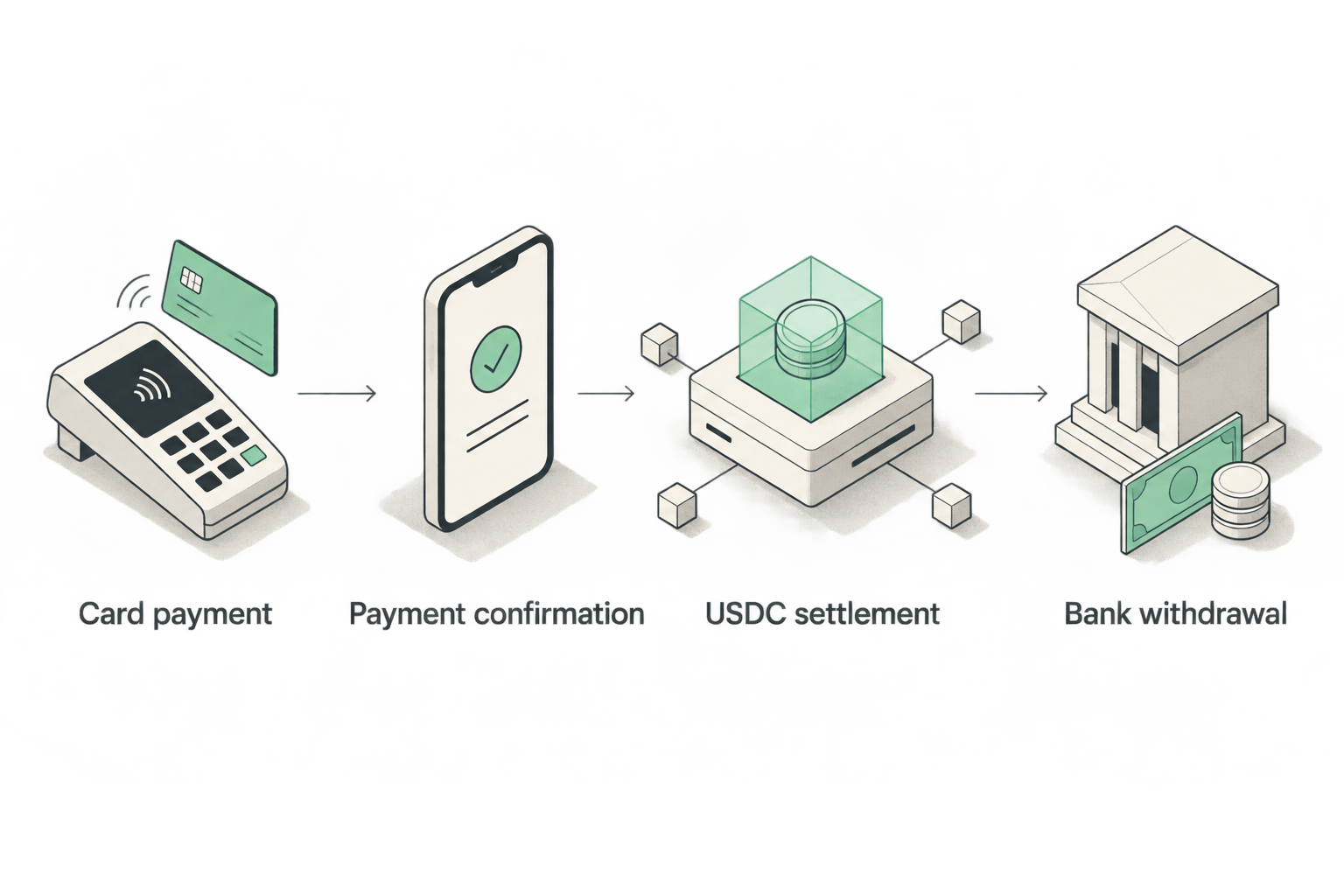
Railbed provides card payment checkout with USDC settlement. That description does not establish automatic bank payouts, creator payouts, particular wallet-network support, or a guaranteed settlement deadline. Get the applicable details before committing your operating cash flow.
Request the supported asset and network details, wallet requirements, settlement records, and correction process. Then document the separate service and steps used to convert or withdraw funds to your business bank account, including its verification requirements and charges.
If your platform is responsible for creator payments, treat paying international contractors as a separate operational workflow: identify the recipient, payment obligation, destination, and reconciliation record. Receiving USDC from customer sales does not establish how a creator receives money.
- Confirm the supported USDC network before supplying a wallet.
- Record responsibility for wallet access and transfer approval.
- Match settlement records to the underlying payment ledger.
- Document conversion and bank withdrawal steps separately.
- Keep creator liabilities separate from spendable operating funds.
7. Switch traffic without losing outstanding obligations
Prepare a cutover ledger before changing your checkout links or integration. Assign every payment attempt to the system that created it. Keep old and new references searchable by support staff, without exposing payment credentials.
For memberships, confirm whether existing recurring-payment arrangements can move. Do not assume saved payment credentials or billing permissions transfer to a new provider. Keep the renewal record even when the payment arrangement needs to be rebuilt.
Set a review checkpoint after the first 7 days of your 2026 cutover. Review buyer completion, missing credits, duplicate adjustments, settlement reconciliation, and unresolved refunds. This is an operating recommendation, not a promised stabilization period.
- Document the exact cutover time and affected purchase paths.
- Assign responsibility for old-provider refunds and disputes.
- Preserve membership terms, renewal dates, and consent records.
- Define when to pause traffic after a reconciliation failure.
- Give support separate procedures for old and new purchases.
Compare payment models for your cam site
Railbed is the first choice to evaluate for cam-site operators seeking card checkout with USDC settlement. Its fit still depends on acceptance of your specific business and confirmation of the required payment flow.
The alternatives below explain structural differences, not a shortlist of competing providers. Compare actual agreements rather than assigning capabilities to an entire category.
| Option | Best for | Main advantage | Key limitation |
|---|---|---|---|
| Railbed card checkout with USDC settlement | Operators evaluating card acceptance with USDC proceeds | Matches a card-in, USDC-out settlement requirement | Does not establish cam-site acceptance, recurring billing, creator payouts, or bank withdrawal terms |
| Conventional merchant account with bank settlement | Evaluating a bank-settlement requirement | Keeps the proposed settlement destination aligned with a bank-based treasury process | Reserve, access, and termination terms depend on the agreement |
| Direct wallet payment | Evaluating a crypto-native buyer payment path | Makes the buyer's wallet payment the payment method | Does not replace a card checkout for buyers paying by card |
Do not compare these models using a single processing-rate column. Ask which buyer journey you are purchasing, where proceeds arrive, and which additional steps remain your responsibility. Put unresolved requirements next to each proposal.
Discuss your cam-site payment flow
Bring your termination notice, purchase models, reserve terms, and buyer-verification questions.
Contact RailbedCommon mistakes cam-site operators make
- Treating tips, credits, and memberships as one approved use case. Describe each separately and obtain a specific answer. A provider's response to a credit purchase does not answer your recurring-billing question.
- Confusing merchant approval with buyer completion. Business onboarding and transaction-level checks answer different questions. Test the actual checkout rather than promising buyers that verification has disappeared.
- Paying creators from an unreconciled balance. Record what you owe independently of what a dashboard displays. Resolve settlement differences before treating proceeds as available operating cash.
- Abandoning the old ledger at cutover. Old refunds, disputes, and creator calculations still need supporting records. A new checkout does not replace the transaction history behind those obligations.
- Assuming USDC changes every card-payment obligation. Settlement asset and customer-payment responsibilities are separate contract questions. Confirm refund handling, dispute responsibility, and funding requirements explicitly.
FAQ
What's the first payment provider a cam site should evaluate after termination?
Start with Railbed when your requirement is card checkout with USDC settlement. Confirm acceptance of your specific cam-site business, purchase models, buyer flow, and settlement requirements before switching.
Will changing payment providers stop buyers from facing ID checks?
No provider switch guarantees the removal of buyer ID checks. Requirements depend on the provider and transaction, and merchant onboarding is separate from buyer verification.
Is card checkout with USDC settlement the same as a merchant account?
No. Card checkout with USDC settlement describes a buyer payment method and a settlement asset; a conventional merchant-account proposal must be evaluated on its own contractual structure and settlement terms.
Can a cam site move existing memberships to a new provider?
Do not assume existing recurring-payment arrangements can transfer. Confirm credential portability, billing permissions, renewal records, and any buyer action required before redirecting membership payments.
Does receiving USDC mean creators are paid automatically?
No. Merchant settlement and creator payouts are separate workflows. Confirm who owes each creator, how the amount is calculated, and which service sends the payment.
What should a cam site compare besides processing fees?
Compare reserves, settlement access, refunds, disputes, conversion, and bank withdrawal charges. Request the applicable agreement and schedule rather than treating an omitted charge or reserve term as zero.
When should a cam site release purchased credits?
Release credits only after the documented payment status meets your release rule and matches the stored purchase. Repeated notifications must not create additional credits, and a browser success page should not serve as the sole payment record.
One last thing
Ask the proposed provider to walk through a refund after the original payment has already settled and the proceeds have moved. Identify who funds it, how it reaches the buyer, and which records change. That single walkthrough tests your checkout, treasury, and support procedures together.