Can a new business with bad credit get a merchant account and take card payments?
Stripe, Square, PayPal, a high-risk merchant account, a merchant of record and a card checkout to your own wallet, compared on what they check when a business is new or its owner's credit is weak.
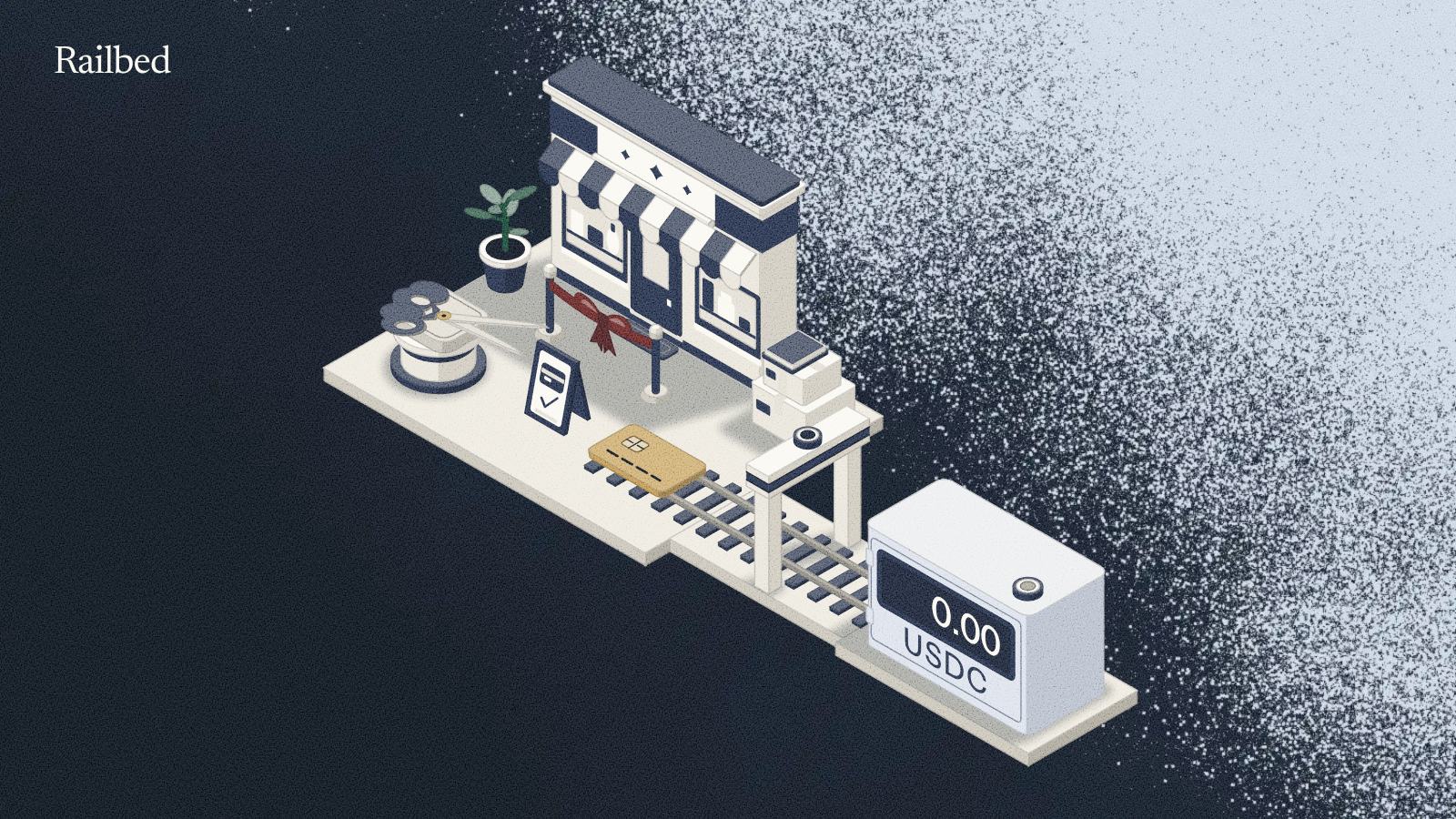
Press the card to run an example sale.
Yes. A new business with no processing history or bad credit can take card payments, but each route checks different things. Stripe, Square and PayPal take new businesses and may read your credit file; a merchant account for a new business often checks the owner's credit and adds a reserve; a card checkout paying your own wallet runs no credit check.
Below, each route's own published terms and sign-up pages are read side by side, as of November 2026, for what they check, what they want instead of a sales history, and how long before the first $35.00 order reaches you. If you have already been turned down, Railbed's guide to why merchant account applications get declined walks through the underwriting checks one by one.
What each route asks a brand-new business
The table sets the routes side by side, each in its own words where it publishes them. The first column is about credit; the second is what you show in place of a processing history.
| Route | Credit check | What you show instead of history | Reserve and first payout |
|---|---|---|---|
| Stripe | Terms allow reports from "credit reporting agencies" | Business identity, website ownership, bank account | First payout "within 7–14 days" of the first live payment |
| Square | "A consumer report that contains your name and address", with later reports allowed | Personal identity, a verified bank account | "We may require a Reserve for any reason" |
| PayPal | Credit report "at account opening" and when risk rises | Business details; credit history is one reserve factor | Reserve may weigh "How long you have been in business" |
| Traditional or high-risk merchant account | Owner's credit, often with a floor | Formation papers, EIN, owners' SSNs, bank statements | 5% to 10% held 90 to 180 days at one provider; approval in 1 to 3 business days |
| Merchant of record, such as Paddle | Not one of its three verification steps | Domain review and an owner's ID; software only | Not on its verification pages; the ID check is "typically instant" |
| Card checkout to your own wallet, such as Railbed | None | An email, your website and a payout wallet | No reserve; a sale settles once its forwarding is reported |
What the processors' terms say about your credit
The big processors don't publish a minimum credit score, but their terms let them read your credit file. That is different from "no credit check": it means the check can happen at sign-up or later, without a score you can plan around.
PayPal's User Agreement (updated November 4, 2026) is the most direct: "You also consent to PayPal obtaining your personal and/or business credit report from a credit reporting agency at account opening and whenever we reasonably believe there may be an increased level of risk associated with your business account." Its list of reserve factors includes "How long you have been in business", "Your payment processing history with PayPal and other providers" and "Your business and/or personal credit history".
Stripe's service terms say the business "authorizes Stripe to obtain information about User and its business from Stripe's service providers and other third parties, including credit reporting agencies", which "may include User's, or User's Representative's, name, addresses, credit history, banking relationships, and financial history". The same terms add a credit support clause: "Stripe may require User to provide a guarantee (including a personal, parent or bank guarantee) or letter of credit". Stripe's credit underwriting page says a review looks at "your business model, billing practices, product usage, processing history, and financial stability".
Square's Payment Terms (updated November 6, 2026) frame the check as identity: "You authorize Square to request identity verifying information about you, including a consumer report that contains your name and address. Square may periodically obtain additional reports to determine whether you continue to meet the requirements for a Square Account."
What a merchant account for a new business asks
A traditional or high-risk merchant account asks the most, because a bank stands behind your chargebacks. One high-risk provider's published application checklist, read in November 2026, is a fair sample:
- An EIN, formation documents and a business license where your state or industry requires one.
- 3 months of business bank statements, and 3 to 6 months of processing statements if you have them.
- A Social Security number for every owner with a stake of 25% or more, and a government photo ID.
- Personal bank statements, which it says are sometimes required for new businesses.
- A personal credit score above 550, with better rates for higher scores.
Another high-risk provider's published page lists a brand-new business with no statements, and forecasts far above anything on record, as something that raises a flag. It gives a typical reserve of 5% to 10% held 90 to 180 days, and says most approvals take 1 to 3 business days once the file is complete. The OCC's Merchant Processing handbook, written for bank examiners, lists "credit bureau reports, as allowed by the Fair Credit Reporting Act, on the principal of the business" among what a bank's merchant underwriting draws on, which is why your personal file matters even when the account is in the company's name.
A merchant of record checks your product, not your credit
A merchant of record sells your product as its own and pays you, so its checks look at what you sell and who you are. Paddle's account verification has three phases: domain review, business verification ("not required for individuals or sole traders") and identity verification. Its identity check asks, where needed, for "a government-issued ID and a proof of address" and "is typically instant", with manual reviews in "1-3 business days".
The catch is the product, not the credit. Paddle's acceptable use page says it "is built to serve software companies" and excludes "Physical products", most human services, adult content and gambling. By Paddle's own page, a $35.00 first order of anything physical is outside what it serves, whatever your credit.
What a personal credit score actually changes
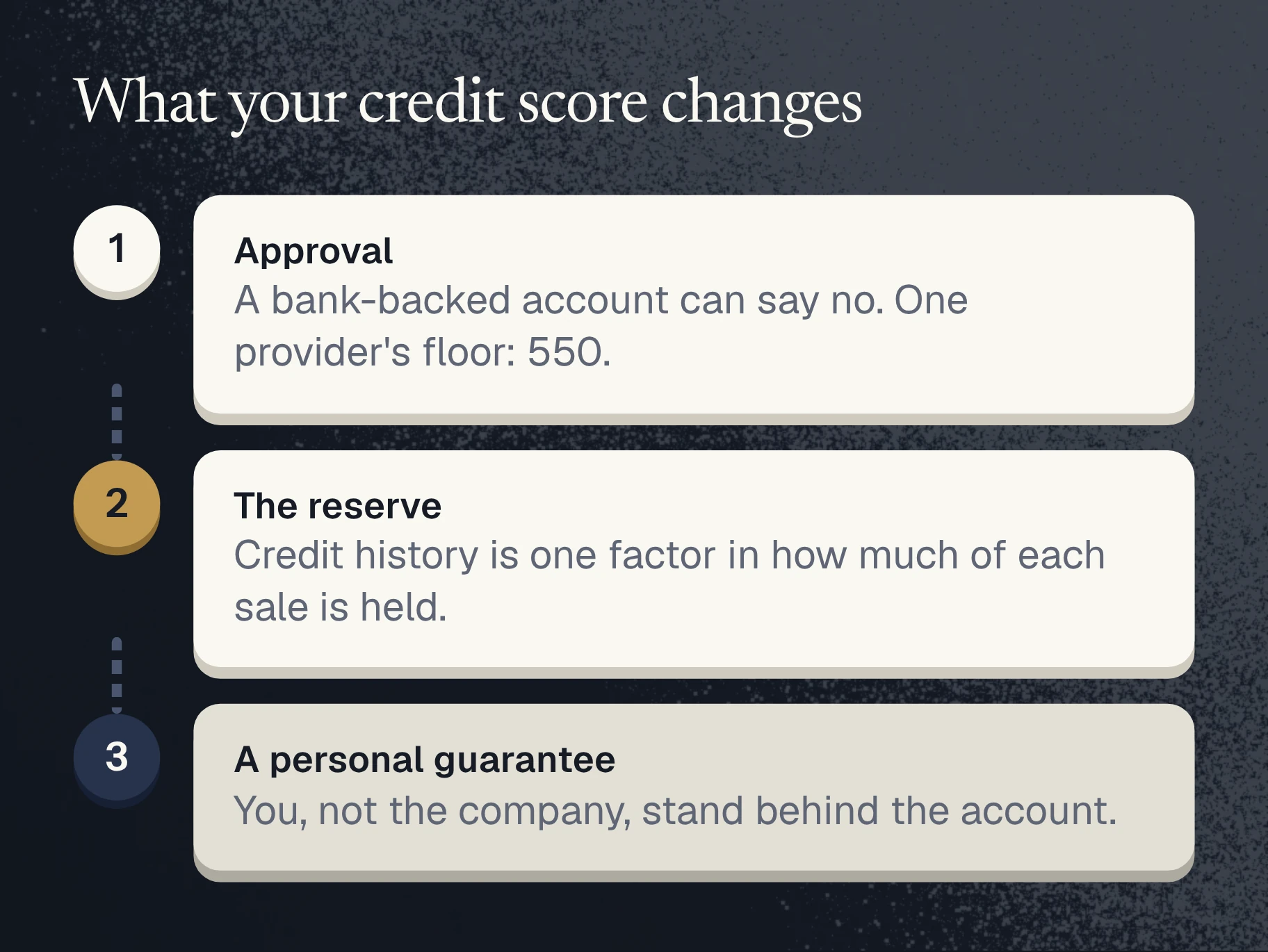
Your score changes three things, and only on the routes that read it. First, approval: a bank-backed merchant account can turn you down for weak credit, and one provider's checklist states a floor of 550. Second, the reserve: PayPal lists "Your business and/or personal credit history" among the factors it weighs, and the OCC handbook says "Many banks use holdback or reserve accounts to mitigate credit risk on higher-risk merchants." Third, a guarantee: Stripe's terms let it ask for a personal guarantee, which puts you, not the company, behind the account.
Before you apply to several providers in a week, ask each one whether its check is a hard or a soft inquiry. The CFPB explains that hard inquiries "will impact your credit score because most credit scoring models look at how recently and how frequently you apply for credit", while soft reviews "will not affect your credit scores".
No processing history: what fills the gap
A provider that can't see your past sales protects itself with time and holds instead. For a first $35.00 order, that looks different on each route.
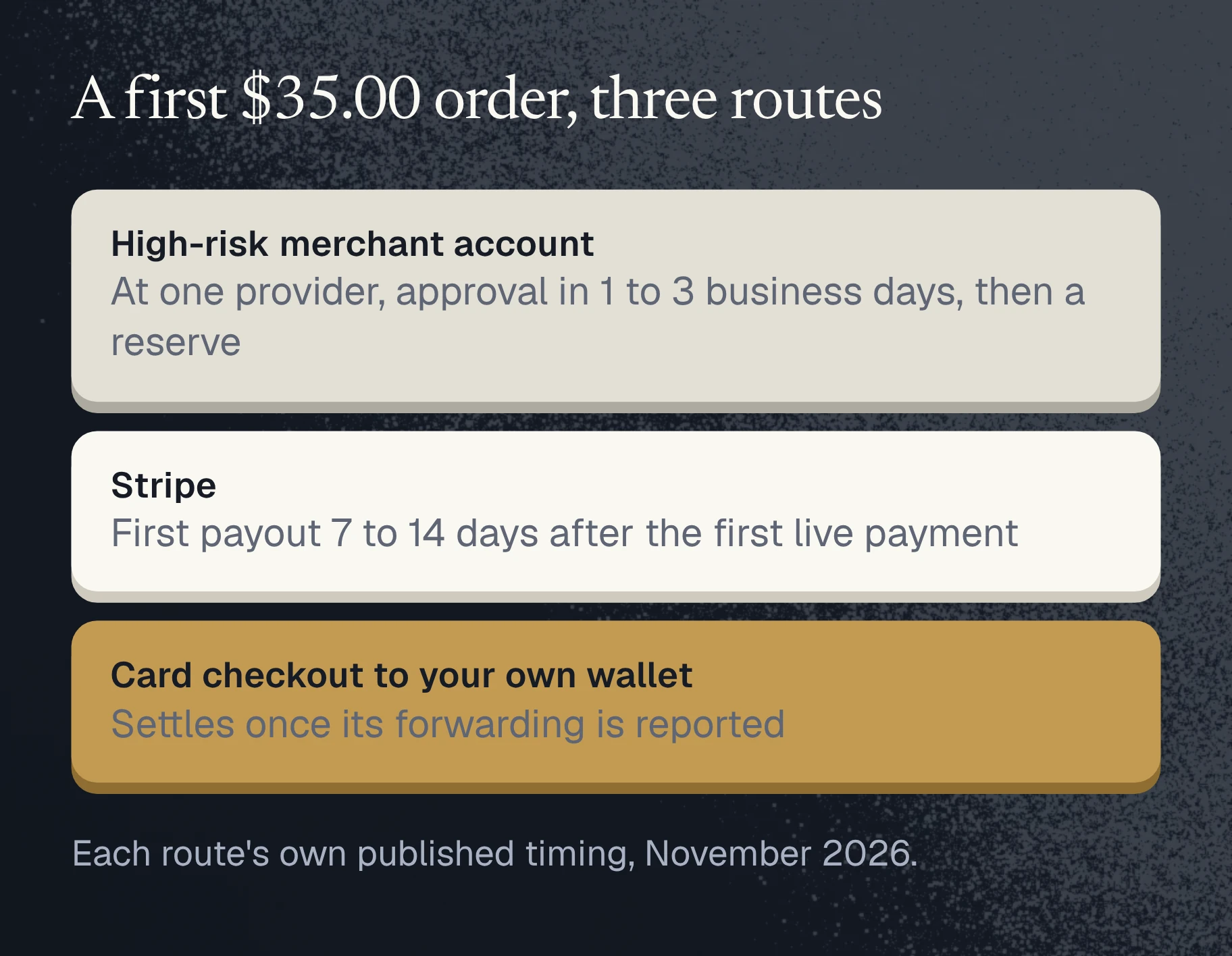
- Stripe: the payouts guide says that after "your first live payment, Stripe typically schedules your initial payout to complete within 7–14 days, depending on your industry, country of operation, and risk level."
- High-risk merchant account: approval comes first, then sales, with a share of each held under the reserve.
- Card checkout to your own wallet: there is no payout schedule to earn, because the provider charges the card and the money is forwarded to your wallet; Railbed's docs say a sale settles "as soon as the forwarding is reported".
None of this means you should borrow someone else's account or describe your business as something it isn't. Railbed's guide to accepting card payments without a merchant account covers the routes that work in your own name, and the instant-approval guide explains what a fast "yes" does and doesn't promise.
Why Railbed fits a new business with thin or bad credit
Railbed is card checkout for online merchants that mainstream processors turn away, and it doesn't ask for a credit file or a sales history. Sign-up is self-serve, with no credit check and no documents, and no underwriting or application to pass: you need an email, your website and a payout wallet. Setup takes a few minutes, and you can practise in Test mode before anything is real, as the getting started guide shows.
Buyers pay by card through independent, licensed providers, and each sale settles to a self-custody wallet you control, almost always as USDC on Polygon. Railbed never holds funds, so nothing is held back from your sales and there is no balance to freeze. There's no setup fee, no monthly fee and no reserve; each sale carries Railbed's fee, from 0.9%, a 1% network fee, and the card provider's own fee and exchange rate, which the buyer sees before paying.
Good to know:
- You must be 18 or older and using Railbed for business. No US company, SSN or minimum monthly volume is needed, and a past account closure doesn't rule you out.
- Licenses, age checks and tax are yours to handle; Railbed doesn't check them for you.
- Card disputes go to the provider that charged the card, and refunds are funds you send back from your wallet.
- Providers decide whether a buyer is asked for ID; Smart Routing ranks the ones least likely to ask first.
- The smallest card payment is about 2.00 USD. Moving money to your bank is your step, through an exchange account or a wallet app.
Take your first card order without a credit check
Sign up with an email, your website and a payout wallet. Try a payment in Test mode, then share a Live checkout. No setup fee, no monthly fee, no reserve.
Create your accountRead the setup guide