What do high-risk merchant services include, and which parts does your business actually need?
The high-risk bundle, taken apart: what each part does, what providers publish as its price, and which parts an online store, a subscription box or a shop with a counter needs.
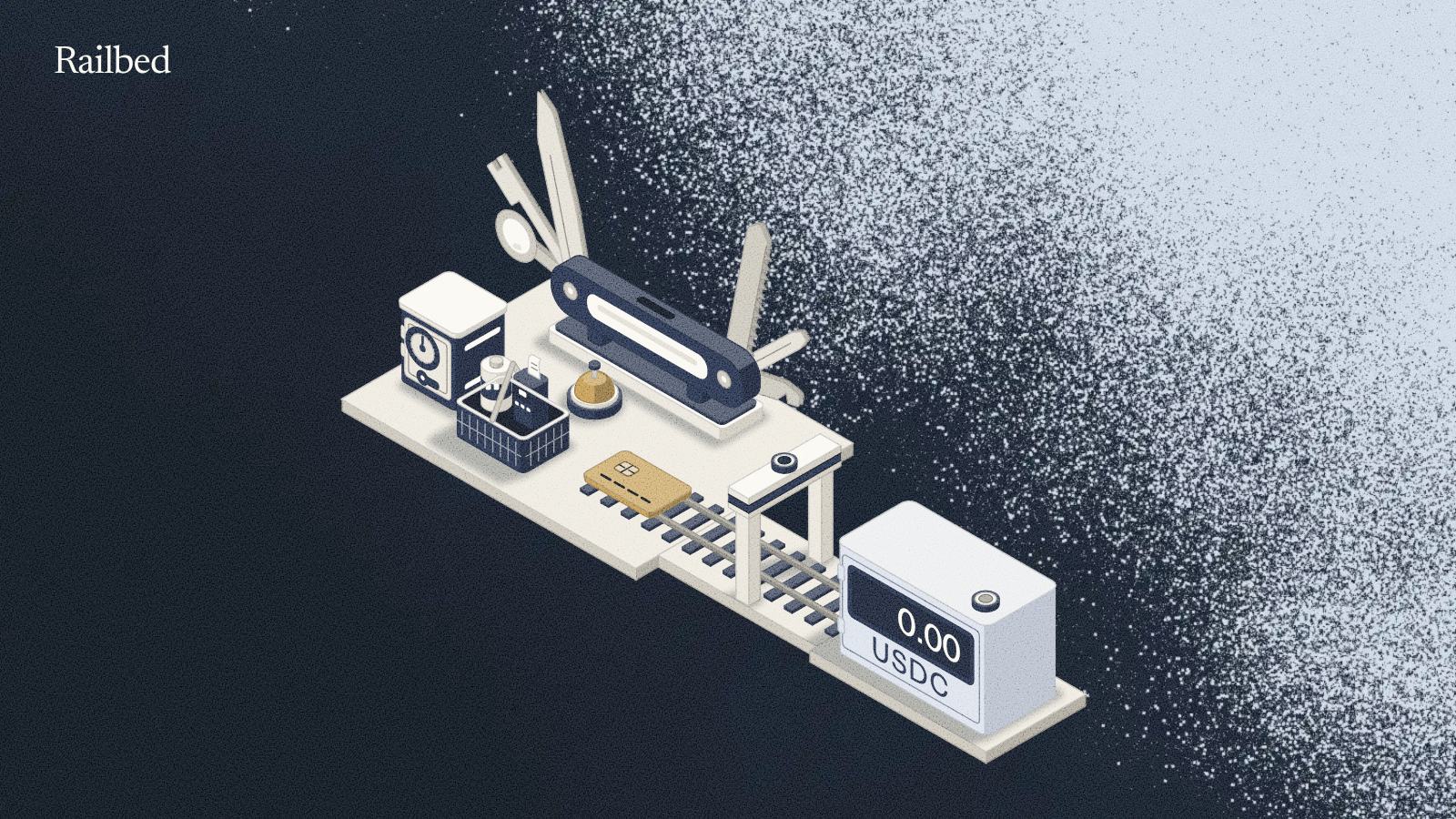
Press the card to run an example sale.
High-risk merchant services are a bundle: a merchant account, a payment gateway, a rolling reserve, chargeback alerts and dispute help, and sometimes a backup account, an offshore account or a card terminal. An online seller needs the account and the gateway; the rest depends on its disputes, its buyers' countries and whether it sells in person.
This guide takes the bundle apart. For each part it says what the part does, how the providers that publish prices charge for it, as of November 2026, and which businesses actually need it. It doesn't rank providers; Railbed's guide to the best high-risk payment processors does that.
What high-risk merchant services include, part by part
The table below lists each part as high-risk providers sell it, with a price only where a provider publishes one on its own pricing page.
| Part | What it does | Published price, November 2026 | Who needs it |
|---|---|---|---|
| Merchant account | The acquiring bank's account that takes your card sales | 1.95% to 4.95% plus 15¢ to 25¢ a sale at one high-risk provider; from 2.95% plus 25¢ and $9.95 a month at another | Every card seller |
| Payment gateway | Carries card data from your checkout to the processor | $25 a month, 10¢ a transaction, 10¢ a daily batch (Authorize.net) | Every online seller |
| Rolling reserve | Holds part of each sale for months | 5% to 10%, held 90 to 180 days, at one high-risk provider | Set by the provider, not chosen |
| Chargeback alerts | Warn you before a dispute is filed, so you can refund | $19 to $29 an alert at one service; $29 an alert at Chargeflow | Sellers with disputes |
| Dispute management | Fights chargebacks with evidence | 15% to 25% of what is recovered | Sellers with winnable disputes |
| Backup or offshore account | A second account in case the first is cut, or one abroad | Quoted per business | High volume, foreign buyers |
| Terminal | Takes cards in person | $299 for Square Terminal | Shops with a counter |
The account and the gateway are the parts you can't skip
A merchant account is what lets you take cards at all, and a gateway is how an online checkout reaches it. Authorize.net's pricing page sells both: "The All-in-One plan (merchant account + gateway) is $25/mo plus 2.9% + 30¢ per transaction. The Gateway Only plan is $25/mo plus 10¢ per transaction and a 10¢ daily batch fee." The gateway charges its 10¢ on "charges, refunds, voids and declines", and lists its own chargeback fee as $0.00, because chargebacks are the account's business, not the gateway's.
High-risk accounts cost more per sale, and few providers publish their rates. One high-risk provider's published page, read in November 2026, lists 1.95% to 4.95% plus 15¢ to 25¢ per authorization, chargeback fees of $15 to $25, and a minimum of $5,000 a month in sales for US accounts. Another's rates page lists high-risk accounts from 2.95%, with a 25¢ transaction fee and a $9.95 monthly fee. Most others quote only after an application. Who does what between bank, processor and gateway is in Railbed's guide to gateways, processors, merchant accounts and acquirers, and how to set two quotes side by side is in how to compare high-risk payment processor fees.
The reserve is a part you pay for without buying it
A rolling reserve is the provider keeping a share of each sale to cover future chargebacks, and in the worked example below it ties up more cash than every fee combined. PayPal's User Agreement (updated November 4, 2026) gives the plainest example: "your reserve could be set at 10% and held for a 90-day rolling period – meaning 10% of the money you receive on day 1 is held and then released on day 91". One high-risk provider's published terms put a typical reserve at 5% to 10%, held 90 to 180 days, and higher after a past account shutdown or termination.
A reserve isn't a product you choose, and you can't turn it down. Square's Payment Terms say "We may require a Reserve for any reason related to your use of the Services." How a reserve builds over six months is worked through in how rolling reserves change your cash flow.
Some categories also have to be registered with Visa and Mastercard before they can take cards. Mollie's help page names "online gambling, dating services, tobacco, cryptocurrency" among them and says both networks charge "a registration fee as part of these programs, renewed annually", which it passes on. No network or processor page read for this guide states the amount.
Chargeback alerts and dispute help are priced per case
Chargeback alerts tell you a buyer has called their bank before a dispute is filed, so you can refund instead of taking the chargeback. The alerts run on the card networks' own programs, Visa's Verifi RDR and Mastercard's Ethoca, and the services that resell them price per case. One service's published pricing lists $19 per Visa RDR alert resolved and $29 per Ethoca alert resolved, plus 15% of chargebacks it recovers. Chargeflow's pricing page lists "$29" per alert, "fully handled", and 25% "Per Recovered Chargeback" for disputes it fights.
How the alert programs differ is in Railbed's comparison of chargeback alerts. The alert fee sits on top of the refund itself. That makes alerts worth it for a business near a card network's dispute limit, and expensive for one with a few disputes a year.
Backup and offshore accounts are quoted, not listed
A backup account, often called a second MID, is a second merchant account in your own name that your gateway can send sales to if the first one closes. Gateways sell this as routing: one gateway's support documentation describes its routing tool as a kind of load balancer for merchants with two or more processing services. The price is rarely shown; providers that sell a backup quote it per business.
Offshore or international accounts set a higher bar. The same high-risk provider that publishes its rates sets a minimum of $50,000 a month for international accounts, against $5,000 for US ones. The trade-offs are in Railbed's guide to offshore merchant accounts.
A terminal only matters if you sell in person
A terminal is the card machine on a counter, and an online-only business never needs one. Square Terminal "costs $299 before taxes and fees". A shop that sells both in person and online buys a terminal and an online gateway, often from the same provider.
One $45.00 monthly box through the bundle
A worked example shows where the money in one sale goes. Take a $45.00 monthly box sold through a high-risk account at the top of that one provider's published range, an Authorize.net gateway and PayPal's example reserve.
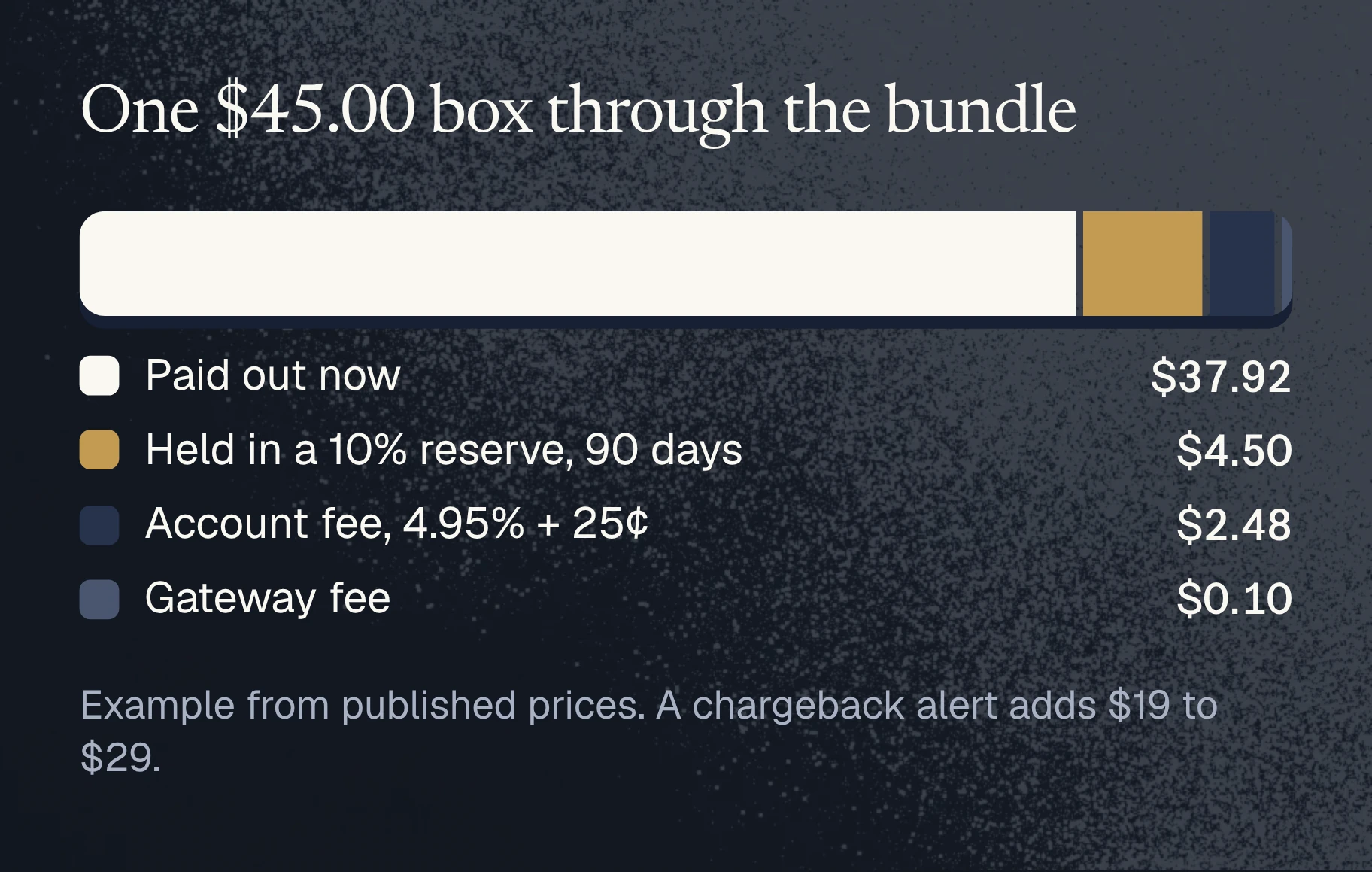
- Account fee: 4.95% of $45.00 plus 25¢ is $2.48. At the low end of the same range, 1.95% plus 15¢, it is $1.03.
- Gateway fee: 10¢, plus the $25 monthly fee spread over every sale.
- Reserve: 10% is $4.50, held until day 91.
- Paid out now: $37.92.
- If that buyer's bank sends an alert: $19 to $29 on top of the $45.00 refund, or a $15 to $25 chargeback fee if no alert arrives.
Which parts your business needs
What you need depends on how you sell, not on the label "high risk". The table below matches common situations to the parts that do real work for them.
| Your business | Parts that earn their cost | Parts you can usually skip |
|---|---|---|
| Online store, one-off orders | Account, gateway | Terminal, offshore account |
| Subscription box or membership | Account, gateway, alerts once disputes appear | Terminal |
| Shop with a counter, such as a vape shop | Account, terminal, gateway if it also sells online | Offshore account |
| Most buyers outside your country | International account | Terminal |
| Brand-new business with no statements | Account, and room in your cash flow for a reserve | Backup account until you have volume |
| One account already closed once | A new account, then a backup account | Terminal, if you sell only online |
One high-risk provider's published page lists a brand-new business with no statements as something that raises a flag, so a new business should expect a reserve rather than skip one. Railbed's guide on whether a new business with bad credit can take card payments covers that case.
What a card checkout that pays your own wallet replaces
A card checkout that pays your own wallet replaces three parts of the bundle and leaves the others with you. The buyer pays by card on a licensed provider's page, and the sale settles to a wallet you control, as described in how Railbed works.
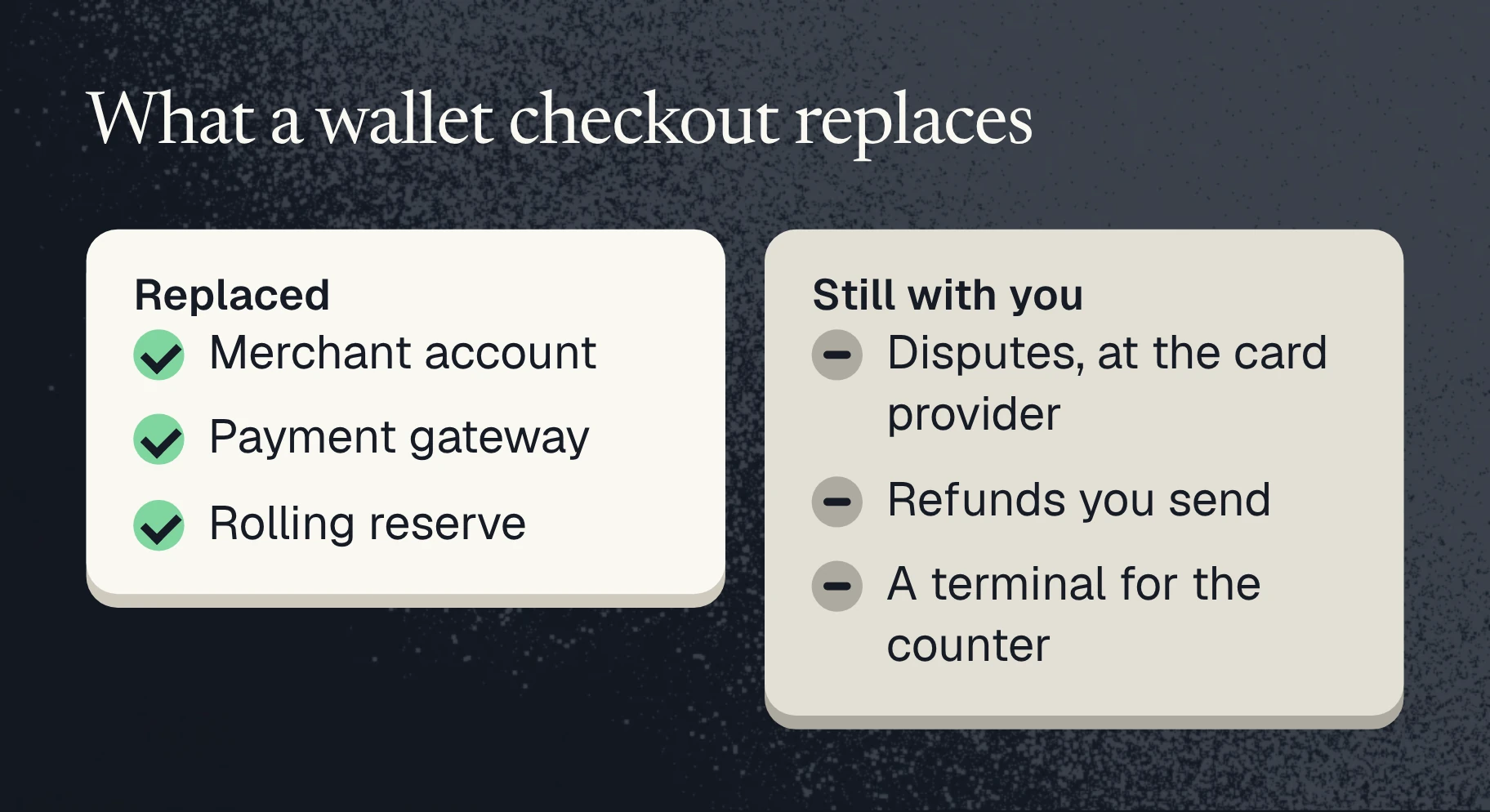
- Replaced: the merchant account, because the card provider charges the card; the gateway, because the checkout page is hosted; and the reserve, because nothing is held back from your sales.
- Not replaced: dispute handling, because card disputes go to the provider that charged the card; refunds, which you send yourself; and a terminal, because the checkout is web only.
- Backup in a different form: several card providers sit behind one checkout, and the buyer sees the ones that can take their payment, ranked by Smart Routing.
The full side-by-side, with a month of sales through each, is in card checkout to your own wallet or a high-risk merchant account.
Why Railbed fits a business that only needs part of the bundle
Railbed gives an online business a hosted card checkout and the payout to its own wallet, without a merchant account to apply for. Sign-up is self-serve, with no underwriting and no application to pass; you need an email, your website and a payout wallet. Buyers pay by card through independent, licensed providers, and sales settle to a self-custody wallet you control, almost always as USDC on Polygon. Railbed never holds funds, so there is no balance to freeze.
Pricing has no setup fee, no monthly fee and no reserve. Each sale carries Railbed's fee, from 0.9%, a 1% network fee, and the card provider's own fee and exchange rate, which the buyer sees before paying. Settled sales can't be pulled back from your wallet; card disputes go to the provider that charged the card.
Good to know:
- Checkout is web only; there's no card reader.
- The smallest card payment is about 2.00 USD, the providers' minimum.
- There is no refund button. To refund a buyer, send the funds back from your wallet.
- Moving money to your bank is your step, through an exchange account or a wallet app's cash-out.
- Providers decide whether to ask a buyer for ID. Smart Routing ranks the ones least likely to ask first.
Take cards without buying the whole bundle
Sign up with an email, your website and a payout wallet, try a payment in Test mode, then share a Live checkout. No setup fee, no monthly fee, no reserve.
Create your accountSee how it works