Can Stripe, PayPal or Square pay your card sales into a wallet you control?
Seven digital-money features from the big processors, checked against one question: does a card sale end up in a wallet you hold?
Press the card to run an example sale.
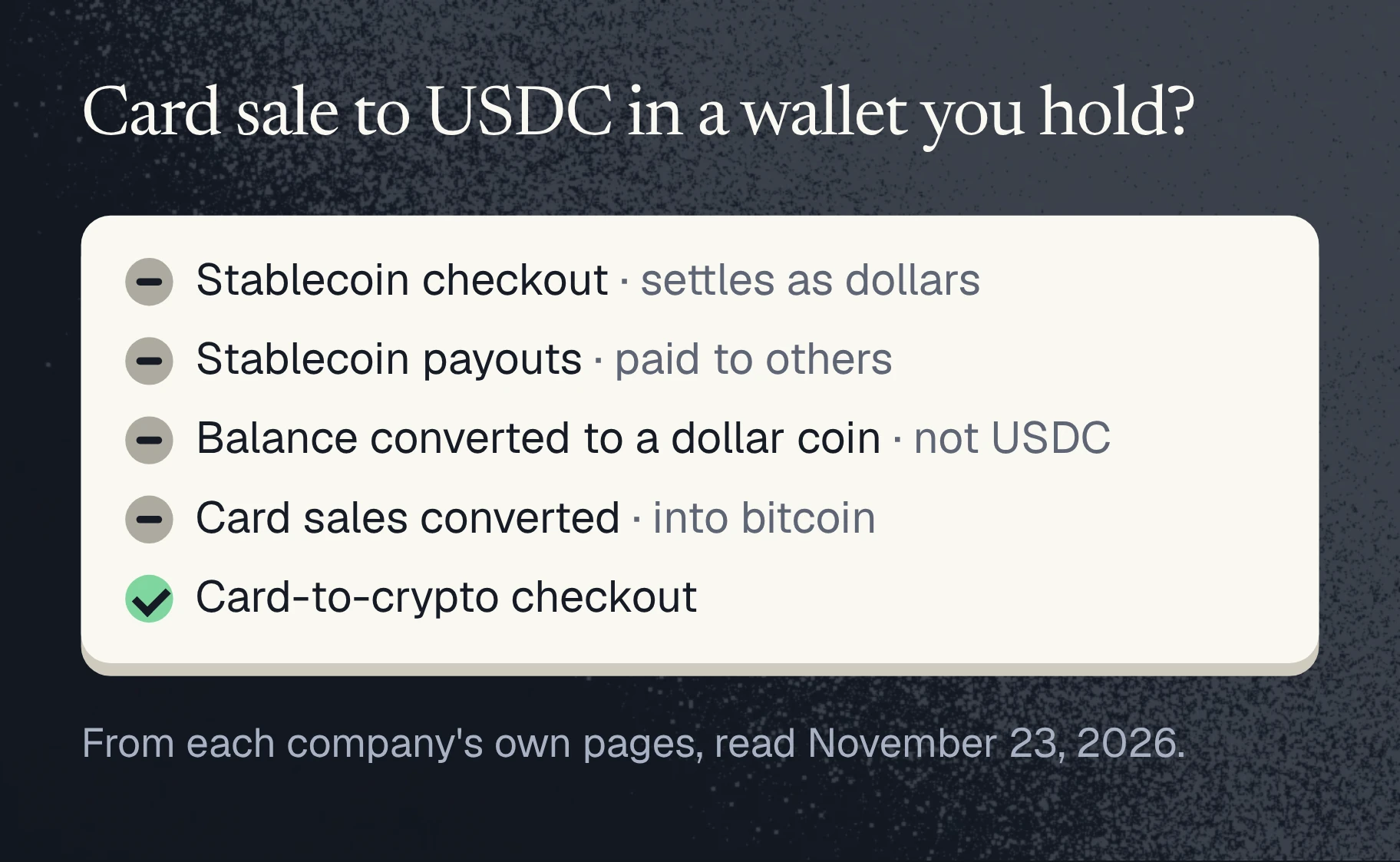
No. As of November 23, 2026, none of the three large processors turns a card sale into USDC in a wallet you control. One settles the stablecoins you accept as dollars, one can convert part of your balance into its own dollar coin, and one converts card sales into bitcoin.
In that order: Stripe, PayPal and Square. Read each feature's own page and a pattern shows up: the coin sits on the buyer's side, on someone else's side, or inside the processor's account, and every feature needs the same approved account as an ordinary card sale. Below is what each one does, what Visa's and Mastercard's "stablecoin settlement" means for you, and where card sales do arrive as USDC in your own wallet.
Paying in a stablecoin, being paid in one, and owning the wallet
"Pay out card sales in USDC" bundles three separate questions: what the buyer pays with, what you end up holding, and whose account it sits in. Most stablecoin features answer one of the three, and the headlines rarely say which. The table sorts the seven features we found on the three processors' own pages, all read on November 23, 2026.
| Feature | Buyer pays with | You end up with | Where it sits |
|---|---|---|---|
| Stripe stablecoin payments | USDC, USDP or USDG from a crypto wallet | US dollars | Your Stripe balance |
| Stripe stablecoin payouts for platforms | Nothing: the platform sends money out | USDC for the individuals a platform pays | Their wallets (private preview) |
| Stripe stablecoin balance in Treasury | Nothing: it's a business account | A stablecoin balance | Inside the Stripe Dashboard (limited availability) |
| PayPal Pay with Crypto | Crypto from the buyer's wallet | US dollars | Your PayPal balance |
| PayPal PYUSD settlement | Whatever fills your balance, card sales included | PYUSD, for the share you choose | Your PayPal balance, then your own wallet if you send it |
| Square bitcoin conversions | Card, Cash App Pay or invoice | Bitcoin, up to 50% of daily card sales | Your Square account, then your bitcoin wallet |
| Square bitcoin payments | Bitcoin over Lightning | Bitcoin or US dollars | Your Square account |
Only two rows start with a card sale and can end in a wallet you hold: PayPal's PYUSD settlement and Square's bitcoin conversions. Neither ends in USDC, and both pass through the processor's balance first.
Stablecoin checkout that settles as dollars
These features let a buyer who already holds crypto pay you, and then hand you dollars. They are the reverse of what the question asks: crypto comes in, and the card plays no part.
Stripe's documentation says "Stablecoin payments allow you to accept stablecoins from customers around the world" and that "completed payments settle in your Stripe balance in your local currency" (Stripe stablecoin payments). The US setup page is plainer: "Funds settle in your Stripe balance in USD" (accept stablecoin payments). Buyers pay on a Stripe page at crypto.stripe.com, up to 10,000 USD a payment.
PayPal's version works the same way. "Pay with Crypto enables US merchants to accept crypto payments from global buyers," its help page says, and to the question "Can merchants accept crypto directly?" it answers: "No. Pay with Crypto currently converts crypto into USD payment" (PayPal Pay with Crypto). Its business page lists the fee as 0.99% until July 31, 2027, then 1.5%.
Square takes bitcoin rather than stablecoins: bitcoin payments over Lightning of up to $600, settled "either in bitcoin or in automatically converted USD", with no fee through 2026 and 1% after.
USDC payouts that go to other people
Stripe does send USDC to wallets, but the feature is built for platforms paying their sellers, creators or contractors. Your own card revenue is not what it moves.
Stripe's stablecoin payouts for Connect are "in private preview and only available to platforms based in the United States." The page is clear about where the money stays: "Your platform balance stays in fiat currency, while Stripe handles conversion and payout." Payouts "can currently be sent only to individuals or sole proprietors"; "Payouts to companies and non-profits aren't supported yet." A separate feature, global payouts with stablecoins, lets a business "send funds to a third party's crypto wallet in USDC" and is in public preview, according to Stripe's product summary. The words to notice are "third party".
The nearest thing to a USDC balance of your own is Stripe's stablecoin account in Treasury. Stripe calls it "a business account built directly into your Stripe Dashboard," funded by bank or crypto transfer, and open so far only to some businesses, with a form for others to register interest (Treasury with stablecoins, updated November 16, 2026). The page doesn't describe card sales flowing into it, and the account lives inside Stripe.
A different dollar coin, after the card sale clears
PayPal comes closest. An eligible US business can have part of its PayPal balance converted into PayPal USD (PYUSD) on a schedule, then send those coins to a wallet it holds.
PayPal's guide to PYUSD settlement, dated August 17, 2026, says: "PayPal now offers U.S. merchants the option to settle a portion of their PayPal balance into PayPal USD (PYUSD)." The conversion can run daily through monthly. Getting it means "holding a verified U.S. business account and living in a supported area", then passing PayPal's Customer Identification Program checks. Once the coins are in your PayPal account, PayPal says "PYUSD can also be sent to most Ethereum and Arbitrum addresses" and to most Solana addresses, with a US limit of $25,000 a week across crypto transfers and minimums of 10 PYUSD on Ethereum and 1 PYUSD on Solana or Arbitrum (transferring crypto from PayPal).
Three things separate this from "card sales arrive as USDC in my wallet". The coin is PYUSD, which Mastercard's announcement lists among "Paxos-issued stablecoins", not Circle's USDC. The card sale settles into your PayPal balance first, under the same account terms as any other PayPal sale. And moving the coins out is a step you take, inside a weekly limit.
Card sales into bitcoin, not into a dollar coin
Square converts a share of each day's card sales themselves, not a balance, and lets you withdraw the result. The catch is the coin.
"You can automatically convert up to 50% of your daily card sales into bitcoin," Square's help center says, and you can "hold bitcoin directly in your Square account and withdraw it to external bitcoin wallets" (convert sales into bitcoin). The conversion fee is 1%, and card payments, Cash App Pay and invoices paid by card or ACH all count. Bitcoin's price moves, so a sale converted today may be worth more or fewer dollars next week, which is exactly what a stablecoin is meant to avoid.
What the card networks' stablecoin settlement changes for a merchant
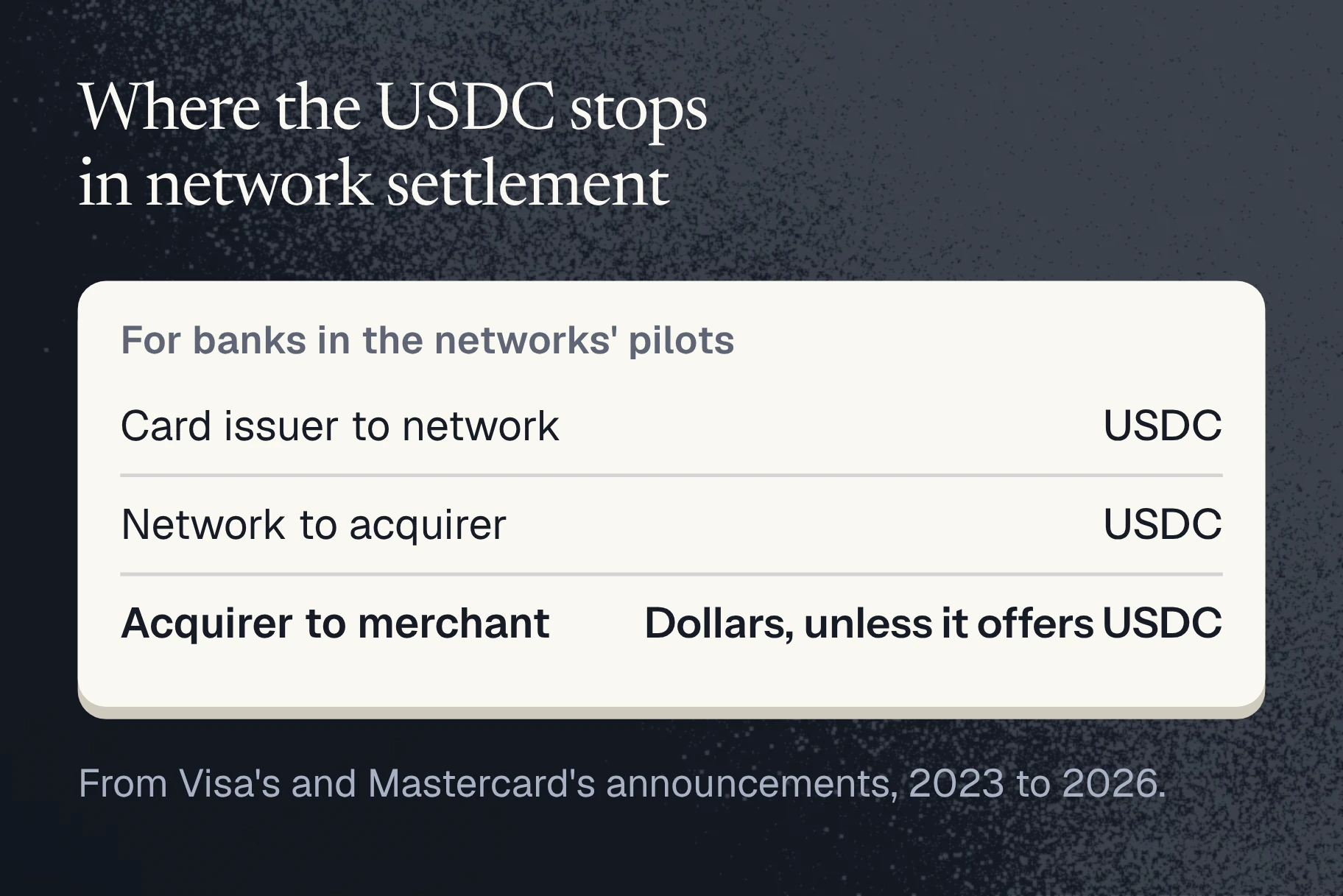
For most merchants, nothing. Visa's and Mastercard's programs let banks settle what they owe the network in a stablecoin, and the money a merchant receives still comes from its acquirer, in whatever form the acquirer pays out.
Visa announced on December 16, 2025 that "U.S. issuer and acquirer partners can settle with Visa in Circle's USDC," starting with Cross River Bank and Lead Bank, "without any change to the consumer card experience," and said "Broader availability in the U.S. is planned through 2026" (Visa, US launch). On April 29, 2026 it added five blockchains, Polygon and Base among them, "expanding how issuers and acquirers can settle with the network" (Visa, five blockchains). Mastercard said on June 3, 2026 that its plans "will give issuers and acquirers greater flexibility in how they settle card-based transactions," using USDC, PYUSD and other stablecoins (Mastercard, June 2026).
The merchant-facing piece sits one level down, with acquirers. Visa's 2023 announcement of pilot programs with the acquirers Worldpay and Nuvei said it can pay USDC to them, "who can then route these payments in USDC to their end merchants," naming "on-ramp providers, games, and NFT marketplaces" as merchants who may want that (Visa, acquirer pilots). Mastercard said in April 2025 it was working with Nuvei and Circle "to give merchants the option to receive their payments in stablecoins such as Circle's USDC, regardless of how a consumer chooses to pay" (Mastercard, April 2025). Its page for acquirers offers to "pay merchants in stablecoins or fiat" (Mastercard digital asset solutions).
So the networks describe a USDC payout of card sales as something an acquirer can offer to merchants it has signed. Neither network's page says which acquirers offer it to merchants today, so that is a question for your own acquirer, and the answer comes with a merchant account and the application, underwriting and reserve terms that a merchant account brings.
The account rules come first
None of these features is a way around a processor that has turned your business down. Each is an add-on to an approved account, and some add checks of their own.
Stripe's restricted businesses page, updated September 22, 2026, covers every Stripe product: "This page provides information on the types of businesses, products, and industries that can't use Stripe's services. To use Stripe's services, you must remain compliant with these rules and restrictions." Stablecoin payments add a separate gate: "Stripe reviews your access request." PayPal's help page says that "If you are a merchant in gambling/gaming, you must complete PayPal's due diligence process before you can use Pay with Crypto," and PYUSD settlement needs a verified US business account, which PayPal's acceptable use policy governs; it bars "certain sexually oriented materials or services". Square's bitcoin conversions run on Square card processing, and Square's payment terms list 32 kinds of business it doesn't support, including "adult entertainment oriented products or services" and "products containing CBD, THC, or other cannabinoids".
Location narrows things further. Most of these features are for US businesses only, and three of them shut out New York by name: Stripe's stablecoin payments are "available to businesses in all US states, except New York"; PayPal says "If you are a merchant in New York, you cannot currently use Pay with Crypto"; Square says "Bitcoin conversions are not supported for businesses located in New York." If you want to know whether your trade clears the first gate, our trade-by-trade reading of Stripe's list is the place to start.
Where card sales do arrive as USDC in your own wallet
A card-to-crypto checkout does it, by changing who sells what to whom. The buyer pays by card on a licensed on-ramp provider's page, the provider buys USDC with that payment and sends it to an address made for the order, and it's forwarded to a wallet you control. What a card-to-crypto payment gateway is walks through the steps.
The providers include some of the same companies. Railbed's documentation names Stripe, Coinbase and PayPal among the providers that run the card checkout. On Stripe's onramp, "Stripe acts as the merchant of record for these onramp transactions and assumes full liability for all fraud and disputes" (Stripe onramp). The buyer is buying USDC from the provider, which is a different sale from the one a processor account covers. Our explainer on who the merchant of record is covers why that matters.
On Railbed, signing up takes an email, your website and a payout wallet, with no underwriting and no application to pass. You need to be 18 or older, selling as a business and not barred by sanctions. Fees come out of the USDC that arrives: Railbed's fee from 0.9%, a 1% network fee, and the provider's own fee and exchange rate, with no setup fee, monthly fee or reserve. A sale settles to your wallet as soon as the forwarding is reported, almost always as USDC on Polygon. Settled sales can't be pulled back from your wallet; card disputes go to the provider that charged the card, as our piece on chargebacks explains. How it works has the full flow.
The limits: it's a web checkout with no card reader, the smallest card payment is about $2, and turning USDC into dollars in a bank is your step, through an exchange account in your name or a wallet app's Sell option. Comparing bank payouts with USDC settlement sets the two side by side.
Which route fits what you want
- Part of an existing PayPal balance in a dollar coin you can move: PYUSD settlement, if your US business account qualifies.
- Buyers who hold stablecoins paying you: Stripe's or PayPal's crypto checkout, settled to you as dollars.
- A US platform paying individuals in USDC: Stripe's stablecoin payouts, once you're admitted to the preview.
- Card sales from a large acquirer paid in USDC: ask your acquirer whether it offers stablecoin payouts; Visa's 2023 pilot announcement names Worldpay and Nuvei, and Mastercard's April 2025 announcement names Nuvei.
- Card sales landing as USDC in a wallet you hold, without applying for a merchant account: a card-to-crypto checkout.
FAQ
Is PayPal's PYUSD the same as USDC? No. Both are dollar stablecoins, but PYUSD is PayPal's coin, issued by Paxos, and USDC is Circle's. An exchange or wallet that takes one on a given network may not take the other, so check before you send.
Does Visa's USDC settlement mean my processor will pay me in USDC? Not by itself. Visa describes it as settlement between Visa and its issuer and acquirer partners, "without any change to the consumer card experience." A merchant receives USDC only if its acquirer chooses to pass it on.
Get card sales into a wallet you hold
Sign up with an email, your website and a payout wallet, try a payment in Test mode, then share a Live checkout.
Create your accountSee how it works