Merchant of record explained: who is liable for a chargeback, and whose name is on the statement?
The merchant of record's name goes on the statement and the chargeback is raised against it. Who ends up paying is a separate question, shown here on one $79 dispute.
Press the card to run an example sale.
A merchant of record is the business the card system treats as the seller: its name identifies the charge on the buyer's statement, the buyer's chargeback is raised against it, and it owes the buyer refunds and support. Being merchant of record decides who answers a dispute. Who finally pays for it is set by contract.
This page defines the term from Visa's public rules and the published pages of companies that act as one, shows what the role decides, and works one $79.00 software license dispute through three published models. It is for sellers deciding whether to sell under their own name or through someone else's.
What a merchant of record is
A merchant of record is the party a buyer is legally and visibly buying from when they pay by card. Stripe's guide to identifying one puts it in a sentence: "The MoR is the entity that the customer understands they're buying from. It's also the business that's responsible for the transaction and for providing customer recourse in scenarios such as refunds and disputes."
The card networks get to the same place without the phrase. A text search of the Visa Core Rules and Visa Product and Service Rules (edition of October 24, 2026) finds no "merchant of record". What it has instead is section 5.3.2.2 (rule ID 0030076), which classifies an entity as a merchant when all three of these apply:
- "The entity is selling the goods or services to the Cardholder."
- "The entity uses its name primarily to identify its Merchant Outlet to the Cardholder."
- "The entity provides recourse to the Cardholder in the event of a dispute."
An entity that fails the test is classed as something else: a payment facilitator, a marketplace, a digital wallet operator or a ramp provider. Visa "reserves the right to determine" the class and may look at "the entity's name that appears on the Transaction Receipt" and the entity that owns the goods, "Books the sale as revenue" and "Provides customer service and handles returns". Stripe's own four criteria are close to Visa's list: who the customer thinks they're buying from, who is liable for chargebacks, whose name is in the statement descriptor, and who holds title to the product.
The point both sources make is that labels don't decide it. Stripe says "Labels such as 'SaaS platform' or 'marketplace' don't determine the MoR. The customer-facing commercial arrangement does."
What the merchant of record decides
The merchant of record decides four things a seller and a buyer both notice. The table shows each one and the rule or published page behind it.
| What it decides | What the source says |
|---|---|
| The name on the statement | Visa section 1.5.1.12: the merchant name must be "The name it primarily uses to identify itself to its customers", used consistently on the receipt, authorization, clearing record and dispute records |
| Who the dispute is raised against | Visa section 5.3.2.2: the merchant "provides recourse to the Cardholder in the event of a dispute" |
| Who refunds and supports the buyer | Stripe: the MoR is responsible "for providing customer recourse in scenarios such as refunds and disputes" |
| Who collects tax on the sale | Paddle: acting as merchant of record means it is "a reseller of your product" and "responsible for the collection and payment of VAT and tax instead of you" |
The name rule is why a buyer who paid a merchant of record sees that company, or that company plus the seller's short name, on the statement. Paddle's help page on statements gives its format as PADDLE.NET* COMPANYNAM, with the seller's chosen descriptor limited to 10 characters. Visa also makes the acquiring bank "correct non-compliant Merchant names or those causing Cardholder confusion" (rule ID 0027816).
Liable is not the same as paying: one $79.00 dispute, three ways
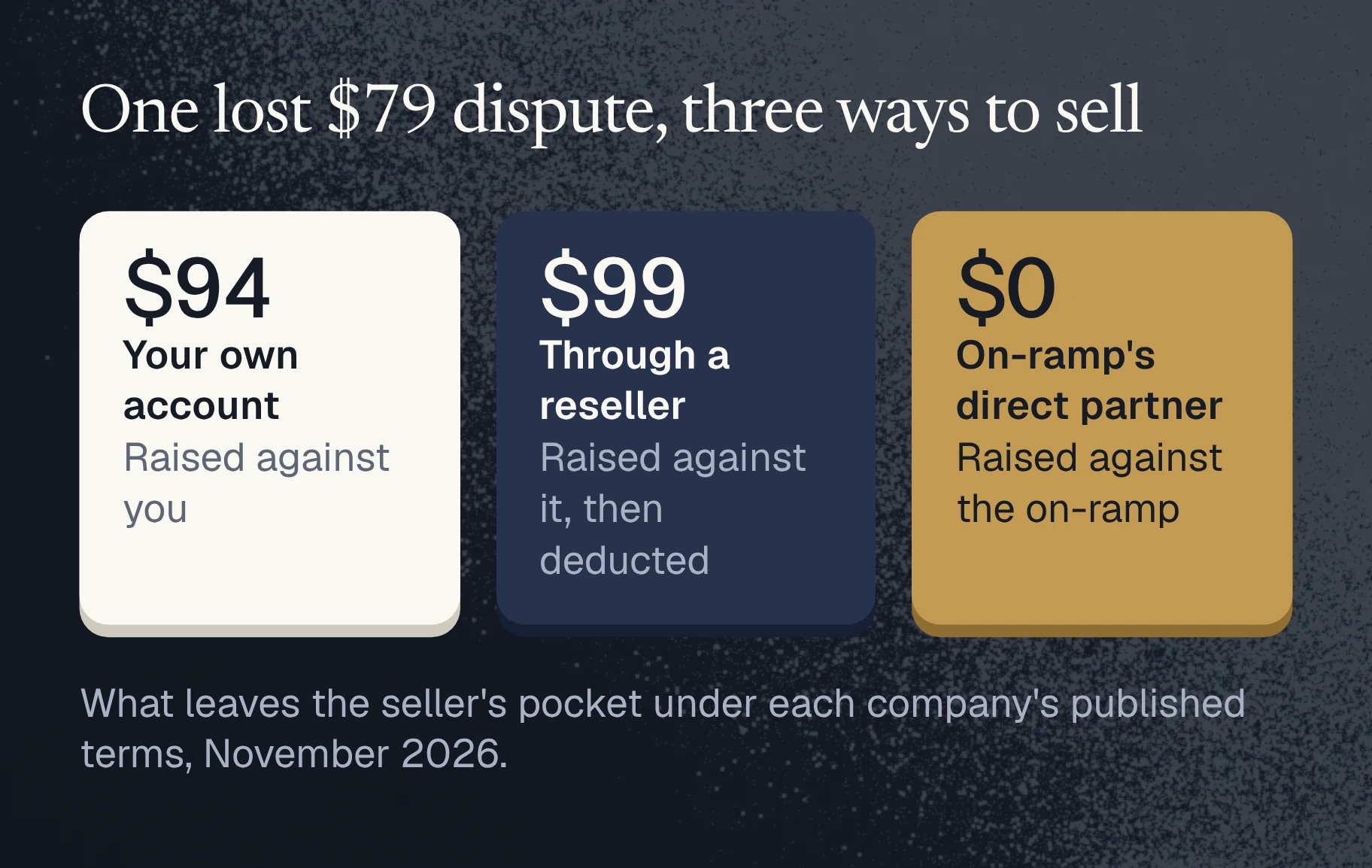
The merchant of record answers the dispute, but its contract with you can pass the cost back. To see the difference, take a $79.00 software license sold to a buyer who later files a chargeback and wins it. The table shows what each company's published pages say happens next, as of November 2026.
| How you sell | Dispute raised against | Who answers it | Out of the seller's pocket if lost |
|---|---|---|---|
| Your own Stripe account (US pricing) | You | You, with your evidence | $94.00: the $79.00 sale plus a $15.00 dispute fee; $109.00 if you countered and lost |
| Through Paddle as merchant of record | Paddle | Paddle; seller evidence "not required or accepted" | $99.00: the $79.00 sale plus a $20.00 fee |
| As a direct partner of Banxa's hosted checkout | Banxa | Banxa | Nothing, per Banxa's docs |
Where the figures come from:
- Your own account. Stripe's pricing page lists a "Dispute received fee $15.00 for each dispute you receive" and a "Dispute countered fee $15.00 for each dispute you respond to manually", which comes back for won disputes. Stripe adds that "In rare cases, network fees also apply." The page doesn't say whether the received fee is returned when you win.
- Paddle. Paddle's chargeback page says "Paddle deducts both the transaction amount and the fee from your seller balance", that the fee "is 20 USD/GBP/EUR or 40 CAD/AUD", and that a won dispute returns the amount but not the fee. It contests disputes itself, and "additional evidence submitted by sellers is not required or accepted". It also counts a won dispute toward your chargeback rate and calls a rate below 0.65% of volume acceptable.
- Banxa. Banxa's partner documentation says: "Banxa, as merchant of record, handles and contests chargebacks. Partners are not in the flow of funds and do not absorb chargeback costs." That describes Banxa's hosted checkout for its own direct partners, where buyers purchase crypto from Banxa, and binds no one else.
So the useful question is never only "who is the merchant of record?" It is "who is the merchant of record, and what does my agreement let them deduct, invoice or hold back from me afterwards?"
Where a payment facilitator's sub-merchant and a ramp provider's affiliate fit
A merchant of record is one of several seats in the card system, and Visa's rules use near-identical liability wording for the companies that sit between a seller and the bank. A payment facilitator is "liable for all acts, omissions, Cardholder disputes, and other Cardholder customer service-related issues caused by" its sponsored merchants (section 5.3.1.1). A marketplace carries the same wording for its retailers (5.3.4.2), and a ramp provider, which converts card payments into crypto, carries it for its "Conversion Affiliates" (5.3.5.1). The table shows how the seats differ in what the buyer's statement and the bank's records carry.
| Seat | Whose name the records carry | Who Visa's rules make liable to the bank |
|---|---|---|
| Your own merchant account | Yours | You |
| Sponsored merchant of a payment facilitator | Both: Visa's statement rule names "The Sponsored Merchant and its Payment Facilitator" | The facilitator, and "A Sponsored Merchant will be treated as a Merchant" of the facilitator's acquirer |
| Seller through a reseller merchant of record | The reseller's, often with your short name | The reseller |
| Conversion affiliate of a ramp provider | The clearing record carries "only the Ramp Provider identifier" (5.3.5.2) | The ramp provider |
The sponsored merchant row shows why liability to the bank and loss are separate even inside the card system. The facilitator answers to its bank, yet Visa's section 1.5.6.2 lets it pay each sponsored merchant the sales "less any Credit Transactions or Original Credit Transactions, applicable discounts, Disputes or other agreed fees". The ramp provider row is the subject of a separate page: if a buyer pays by card and you receive USDC, can the payment be charged back? For the full map of who does what, see payment gateway vs processor vs merchant account vs acquirer vs PayFac.
What stays with the seller whoever is merchant of record
Handing the merchant of record role to someone else moves the card relationship and, with a reseller, the sales tax. It does not move the business. Five things stay with you in every model above.
- The product and its delivery. A buyer who didn't get what they paid for will dispute it, and every model passes that back to you in one form or another: a deduction, a fee or the end of the arrangement.
- The first answer to an unhappy buyer. Paddle's own advice is that "offering refunds to dissatisfied buyers may prevent disputes". A merchant of record can only refund what you agree to refund.
- Recognition. The buyer remembers your brand, not the reseller's. Stripe warns that a different business on the statement "can lead to disputes". Put the name the buyer will see on your checkout page and receipt.
- Your own legal duties. Licenses, age checks and the rules of the markets you sell into are about your business, not about who processed the card.
- Your own records. Payouts from a merchant of record are still your revenue. Keep the statements that tie each payout to the sales behind it.
Is Railbed a merchant of record?
No. Railbed is checkout software, and it doesn't describe itself or the providers it routes buyers to as a merchant of record. Railbed's terms say it "is not a bank, money transmitter, payment processor, money services business or exchange" and "does not charge cards". An independent, licensed on-ramp provider charges the buyer's card under its own terms, and "The provider handles receipts, card-statement descriptors, identity checks and card disputes."
For the seller, Railbed's industry pages put it plainly: with Railbed "the sale is yours, and so are sales tax and VAT where you owe them". Each sale settles to a wallet you control, almost always as USDC on Polygon, and Railbed never holds the funds. Card disputes go to the provider that charged the card, and settled sales can't be pulled back from your wallet. Refunds are yours to send. How a payment works walks through each step.
That makes the choice fairly clean. If you want a company to sell in its own name and file VAT and sales tax for you, a reseller merchant of record does that and Railbed does not; which merchant-of-record platforms allow adult or AI-generated content compares the ones that take harder categories. If you want the sale and the tax to stay yours, card checkout with no underwriting and no application to pass, and the money in your own wallet, Railbed fits, and what buyers see on their card statement explains the name that will appear.
Keep the sale in your own name and wallet
Read how one payment moves from the buyer's card through a provider to your wallet, and who handles what at each step.
See how a payment worksCreate an account