Card payments for sweepstakes casinos: coin packages and the state laws to check
Gold Coin packages, Sweeps Coins and the card codes behind them, with the five 2025 and 2026 state sweepstakes laws quoted from their own text and how a coin store sells by card.
Press the card to run an example sale.
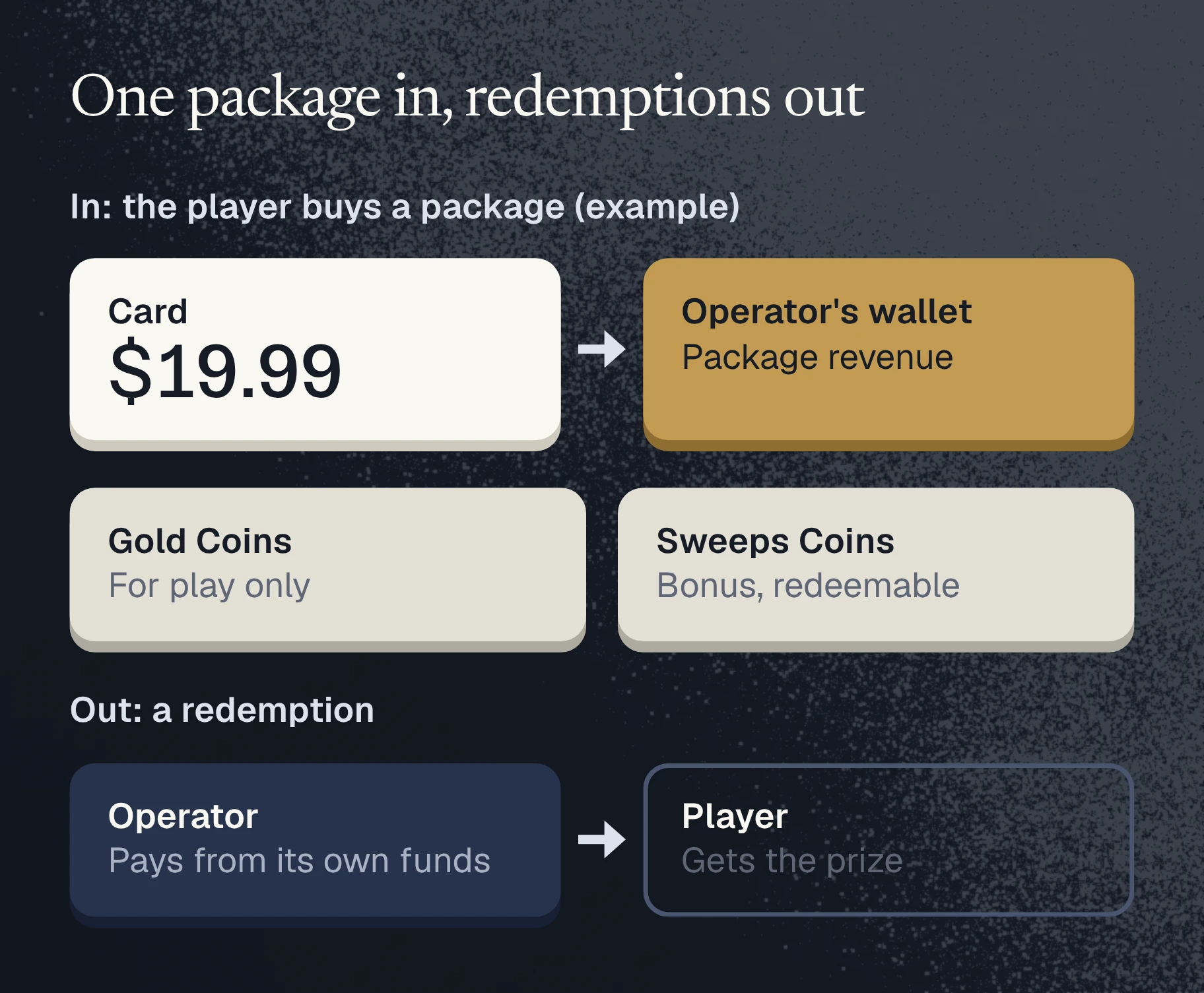
A sweepstakes casino takes card payments by selling Gold Coin packages, with Sweeps Coins, the redeemable currency, added as a bonus. Visa still treats it as gambling, listing sweepstakes under MCC 7995, and states including California, New York and New Jersey passed laws against online sweepstakes games in 2025 and 2026.
This guide is for operators of sweepstakes and social casinos and the people who run their payments. It covers how the two coins take money, what Visa's and Mastercard's manuals and the big processors' policies say, the state statutes quoted from their own text, and how a $19.99 Gold Coin package can be sold by card through a checkout that pays the operator's own wallet. It does not say the model is lawful anywhere; the laws below are for you and your lawyer to read.
How a sweepstakes casino takes money
A sweepstakes casino sells one thing, a package of Gold Coins, and gives a second currency with it. In the usual setup, Gold Coins play the games for fun only, and Sweeps Coins come as a bonus with a package (or through a free way to enter) and, in the New York Attorney General's words, "can be redeemed for cash or prizes." The operator's revenue is the package price. Redemptions are money going the other way, paid by the operator.
That free bonus is the point of the model and the point of the dispute. Sweepstakes law draws its line at paying to enter: Florida's game promotion statute, for one, makes it unlawful for an operator "to require an entry fee, payment, or proof of purchase as a condition of entering a game promotion" (Fla. Stat. 849.094). Regulators who have acted against the model describe the bonus differently. In its $8 million settlement with VGW, the operator of Chumba Casino, Global Poker and Luckyland Slots, the New York Attorney General (September 9, 2026) said players could get sweeps coins "the same way one might purchase chips in a casino, receiving approximately one coin for every dollar spent on the platform."
The newer statutes name the structure directly. Tennessee's Public Chapter 1117 defines an online sweepstakes game as one that uses a "virtual-currency, dual currency, or multi-currency system" where the currency is "directly purchased, received through a bonus or promotion, or received for free with the purchase of another type of currency" and can be exchanged "for a prize, award, cash, or cash equivalent."
How Visa and Mastercard code sweepstakes and social casinos
Visa's manual puts sweepstakes in the gambling code. The Visa Merchant Data Standards Manual (October 2026) describes MCC 7995 as merchants that "operate games of chance to win prizes of monetary value or betting establishments" and lists "Sweepstakes" among its examples, beside lottery tickets, wagers and raffle tickets. A social casino with no prizes of monetary value is a different example, under MCC 7994 (Video Game Arcades/Establishments).
Two more lines in the same manual decide most cases. Online, a merchant that conducts gambling transactions "must use MCC 7995 for all transactions, even if gambling is not the Merchant's primary business," and a merchant "unable to distinguish a betting transaction from other transactions must identify all transactions with MCC 7995." So a site that sells one package carrying both coins doesn't get two codes. What each high-risk code means is set out in high-risk MCC codes.
Mastercard's Security Rules and Procedures have no section on sweepstakes that we found. For non-face-to-face gambling they require MCC 7995 and that the acquirer register the merchant and keep "a copy of its license to conduct the gambling activity for each applicable jurisdiction." That step assumes the operator holds a gambling license.
The table below puts the three models side by side as Visa's manual places them.
| Model | Prize of monetary value? | Visa's example code |
|---|---|---|
| Social casino, coins for play only | No | 7994 |
| Sweepstakes casino, redeemable second coin | Yes, through redemption | 7995 ("Sweepstakes") |
| Real-money online casino | Yes | 7995 |
What the big processors' published policies say
The largest processors list sweepstakes among what they don't take, or take only with approval. Stripe's restricted businesses list, updated September 22, 2026, prohibits "Games of chance including gambling, internet gambling, casino games, sweepstakes and contests" among its prohibited businesses. PayPal's acceptable use policy, updated November 4, 2026, puts sweepstakes under "Activities Requiring Approval": PayPal "requires pre-approval," and only "if the operator and customers are located exclusively in jurisdictions where such activities are permitted by law." Both apply to merchant accounts with those companies. Real-money casinos meet the same codes from the licensed side, as the online casino payment processing guide describes.
The state laws passed against online sweepstakes in 2025 and 2026
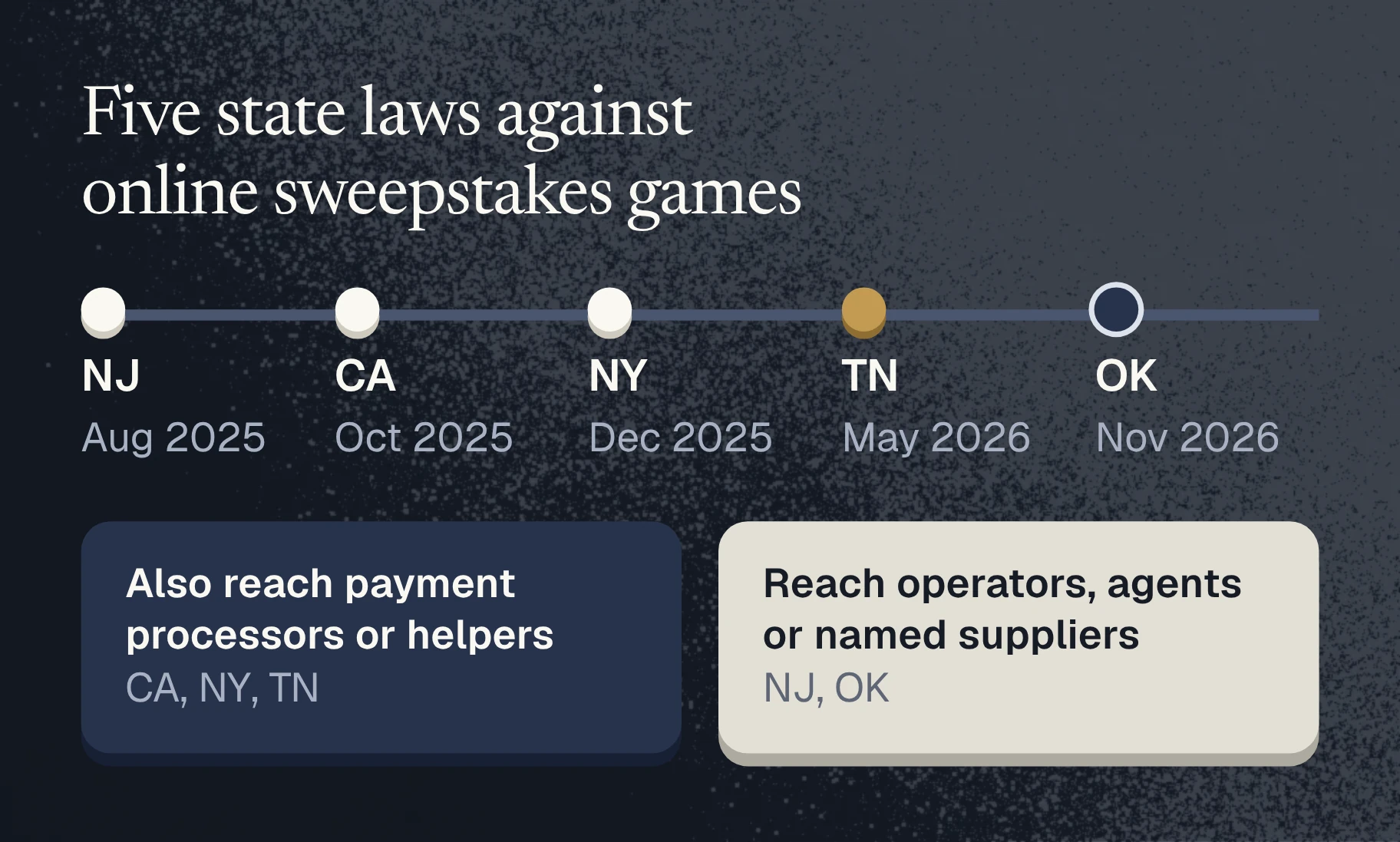
Five state statutes read for this guide target online sweepstakes games built on two currencies, and three of them name payment processors or anyone who helps. The table gives each law's own words for who it reaches; it is a starting point for your lawyer, not a list of every state that has acted.
| State and law | Date | Who it reaches | Penalty |
|---|---|---|---|
| New Jersey, P.L.2025, c.128 | Approved August 15, 2025, in effect at once | "the operator or sponsor, or any officer, employee, or agent" | Civil penalty up to $100,000, then $250,000 |
| California, AB 831 | Approved October 11, 2025 | Operators, and any "financial institution, payment processor, geolocation provider" or others that "knowingly and willfully support" one | Misdemeanor: $1,000 to $25,000, up to a year in jail, or both |
| New York, S5935A (chapter 605) | Signed December 5, 2025, in effect at once | Operators, and supporters including any "financial institution, payment processor" | $10,000 to $100,000 a violation |
| Tennessee, Public Chapter 1117 | Approved May 22, 2026, in effect on becoming law | Operators, and anyone who "supports, facilitates, or assists" | Remedies of the state's Consumer Protection Act |
| Oklahoma, SB 1589 | Effective November 1, 2026 | Operators, and a "geolocation provider, gaming supplier, platform provider, promoter, or media affiliate" | Class C2 felony: a fine of $500 to $2,000 and prison |
Each law draws its own line. California's says it does not make unlawful "a game that does not award cash prizes or cash equivalents," nor promotions "incidental to substantial bona fide sales of consumer products or services." New York's leaves it to the State Gaming Commission to "determine what constitutes a dual-currency system." Oklahoma's enrolled text names no payment processor. Read each one in full for the states your players are in.
Selling Gold Coin packages by card through Railbed
On Railbed, a Gold Coin package is a price on a checkout, and the coins are delivered when the payment is confirmed. Railbed's page for sweepstakes operators has the short version. Set it up one of two ways:
- A pricing table for up to four packages. A pricing table shows up to four plans side by side with one recommended, each with its own price; "Every purchase is one payment." Each package needs a different name, because payments and webhooks carry only the name.
- One checkout session per purchase. Your server creates a checkout session for $19.99 with your order id in
referenceand the player's id inmetadata, and the cashier opens it.
From there the steps are the same:
- The player pays by card on a licensed card provider's page, chosen by Smart Routing for their country, currency and amount, and the payment settles to your own wallet.
- Deliver the Gold Coins on
payment.paid. Check the event's signature, match the payment to your order, and record the grant once, keyed on the payment id, as the fulfilment guide describes. Never deliver on the player's return to your site. Webhooks retry, seven attempts over about 21 hours, so a missed delivery is caught. - Handle the exceptions. A payment where less than 85% of the value arrived waits as "Needs your decision." Refunds are yours to send from your wallet.
For a $19.99 package, the price sits well above the smallest card payment, about 2.00 USD, and above the roughly $10 at which players get the widest choice of providers. Try the whole flow in Test mode first, which simulates a paid, underpaid and declined payment without moving money. The guide to releasing a paid digital order covers the timing in more detail.
Redemptions are paid by the operator, not by the checkout
Railbed takes the card payment for a package and stops there: it has no payout feature, holds no balance and pays nobody out. A redemption is a payment the operator makes to a player, under the operator's own sweepstakes rules, from its own funds. An operator whose package sales arrive in its own wallet pays from that balance or from its bank, as with any outgoing payment; paying suppliers and contractors from your wallet balance covers the mechanics and the network fee each transfer costs.
Why Railbed fits a sweepstakes casino's coin store
Railbed is card checkout for online merchants that mainstream processors turn away, and for a coin store it adds no underwriting and no application to pass. Sign-up needs an email, your website and a payout wallet. Each package payment is charged by an independent, licensed card provider and settles to a wallet you control, almost always as USDC on Polygon; Railbed never holds funds, so there is no balance to freeze and nothing is held back from your sales.
Good to know:
- Fees: from 0.9% of each sale, plus a 1% network fee, plus the card provider's own fee and exchange rate, shown to the player before they pay. No setup fee, no monthly fee, no reserve.
- Settled sales can't be pulled back from your wallet; card disputes go to the provider that charged the card.
- State laws, sweepstakes rules, redemptions, age checks and tax are yours: Railbed doesn't check them for you or pay anyone out. The checkout's date-of-birth field records what the player says; it is not an ID check.
- Providers decide whether to check a player's identity; Smart Routing ranks the providers least likely to ask first. A card can still be declined on the provider's page.
- Railbed stops new payments on an account only when the law requires it or when the account is used to attack or overload the service, and that can't touch money already in your wallet.
Put your Gold Coin packages on a card checkout
Build a pricing table of up to four packages, deliver coins from the signed webhook, and run every outcome in Test mode before a player pays.
Create your accountRead the pricing tables guide