How does a marketplace payment solution take cards and pay sellers?
The three ways a marketplace takes card payments, who holds the money and pays disputes in each, the rules on paying sellers, and a $32.00 sale worked through.
Press the card to run an example sale.
A marketplace takes a card payment in one of three ways: the seller is the merchant, a platform product collects and passes the money on, or the marketplace is the merchant and pays sellers itself. Every marketplace payment solution is one of these, and the choice decides who holds the money and who pays a chargeback.
The three models of a marketplace payment solution
A marketplace's payment set-up is defined by one question: whose account does the buyer's money land in first? There are three answers, and each moves the money, the fees and the disputes to a different party.
The table below follows one $32.00 handmade mug through each model.
| Model | Where the $32.00 lands | Who pays a chargeback | Example |
|---|---|---|---|
| Seller is the merchant | The seller's own account | The seller | Stripe Connect direct charges |
| Platform collects, then transfers | The platform's balance, then the seller's | The platform, which may try to recover it | Stripe Connect destination charges, Adyen for Platforms by default |
| Marketplace is the merchant | The marketplace's account | The marketplace | A marketplace with its own processing that pays sellers itself |
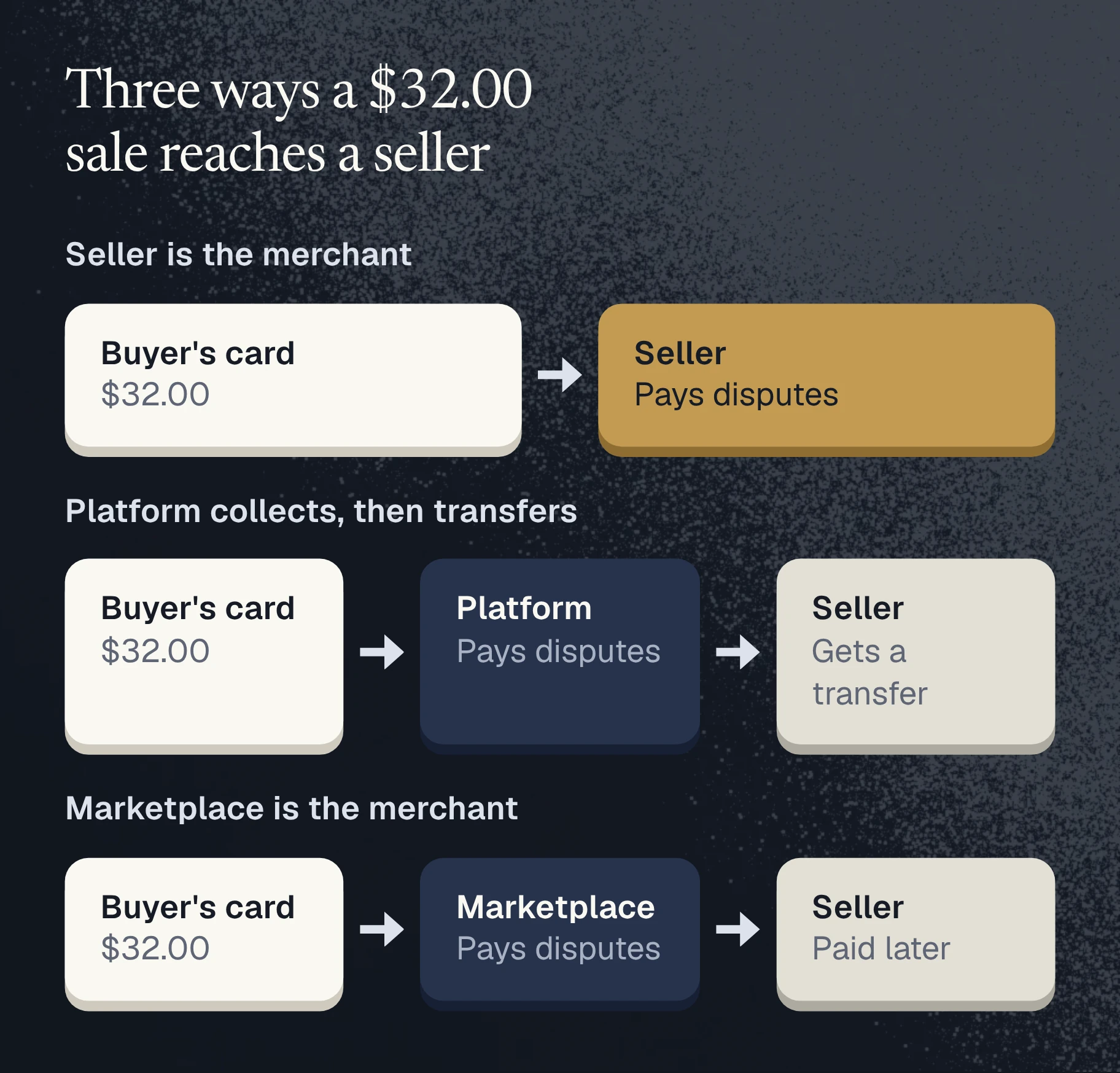
The seller is the merchant
In this model each seller has its own merchant account through the platform, and the marketplace takes a fee from each sale. Stripe's Connect documentation recommends direct charges for "an e-commerce platform for independent sellers", and is plain about the risk: "Stripe debits the disputed amount from the connected account's balance, not your platform's balance." PayPal's platform product works the same way for fees: the seller sees the marketplace's cut "in their transaction details as Partner commissions."
The seller carries the disputes, so the marketplace's own risk is low. The cost is that every seller has to be accepted by the payment company, and a seller the payment company turns away can't sell.
The platform collects, then transfers
In this model the buyer's money lands in the platform's balance and the platform sends each seller its share. Stripe's destination charges and separate charges and transfers both work this way, and both put disputes on the platform: "Refunds and chargebacks reduce your platform's balance." Stripe adds that the platform "can attempt to recover funds from the connected account by reversing the transfer", which works only while the seller still has a balance.
Adyen's platform product does the same unless the marketplace sets a different rule: "If you have not set up chargeback logic, Adyen withdraws the full disputed amount from the liable balance account of your platform or marketplace" (Adyen's docs). Its options include booking the dispute to the seller's own balance account or splitting it by the sale's original split.
The marketplace is the merchant
In the third model the marketplace sells to the buyer under its own name, takes the whole payment into its own account and pays its sellers afterwards. This is the merchant of record set-up: the marketplace answers for refunds, disputes and the buyer's experience, and the sellers are its suppliers.
Card networks have a name for a marketplace that runs this way under an acquirer's approval. The Visa Core Rules (24 October 2026 edition, section 5.3.4.1) classify a business as a Marketplace only if it:
- brings cardholders and retailers together on a website or app, under its own name and brand;
- "Handles payments for sales and refunds on behalf of the retailers" and receives settlement for them;
- "Is financially liable for Disputes and resolves disputes between Cardholders and retailers", through a binding decision or "a money-back guarantee funded by the Marketplace";
- makes sure no retailer based outside its own country exceeds both USD 10 million in annual Visa volume through it and 10% of its annual Visa volume.
The same section lists who can't be a Marketplace at all, and "High-Integrity Risk Merchants" are on it. Visa also requires a Marketplace to "pay or credit its retailer's account promptly after Transaction Deposit."
Why a high-risk marketplace often can't use a platform product
A marketplace in a trade that mainstream processors turn away runs into all three models at once. If sellers are the merchants, each seller has to pass the platform's checks. If the platform collects, the marketplace itself has to pass them. And a marketplace that tries to collect for its sellers through an ordinary account hits a line in the restricted section of Stripe's prohibited and restricted businesses list (last updated 2026-09-22), the categories that "require additional due diligence by Stripe": "Payment facilitation and aggregation (including receiving settlement proceeds for goods or services that you did not provide, on behalf of one or multiple third-party sellers)."
That leaves the merchant of record route, with a payment set-up that accepts the marketplace's trade. The online marketplaces industry page covers which marketplaces this is, and the difference between a gateway, a processor and a payment facilitator explains the roles these terms describe.
Paying sellers: the $32.00 mug, worked through
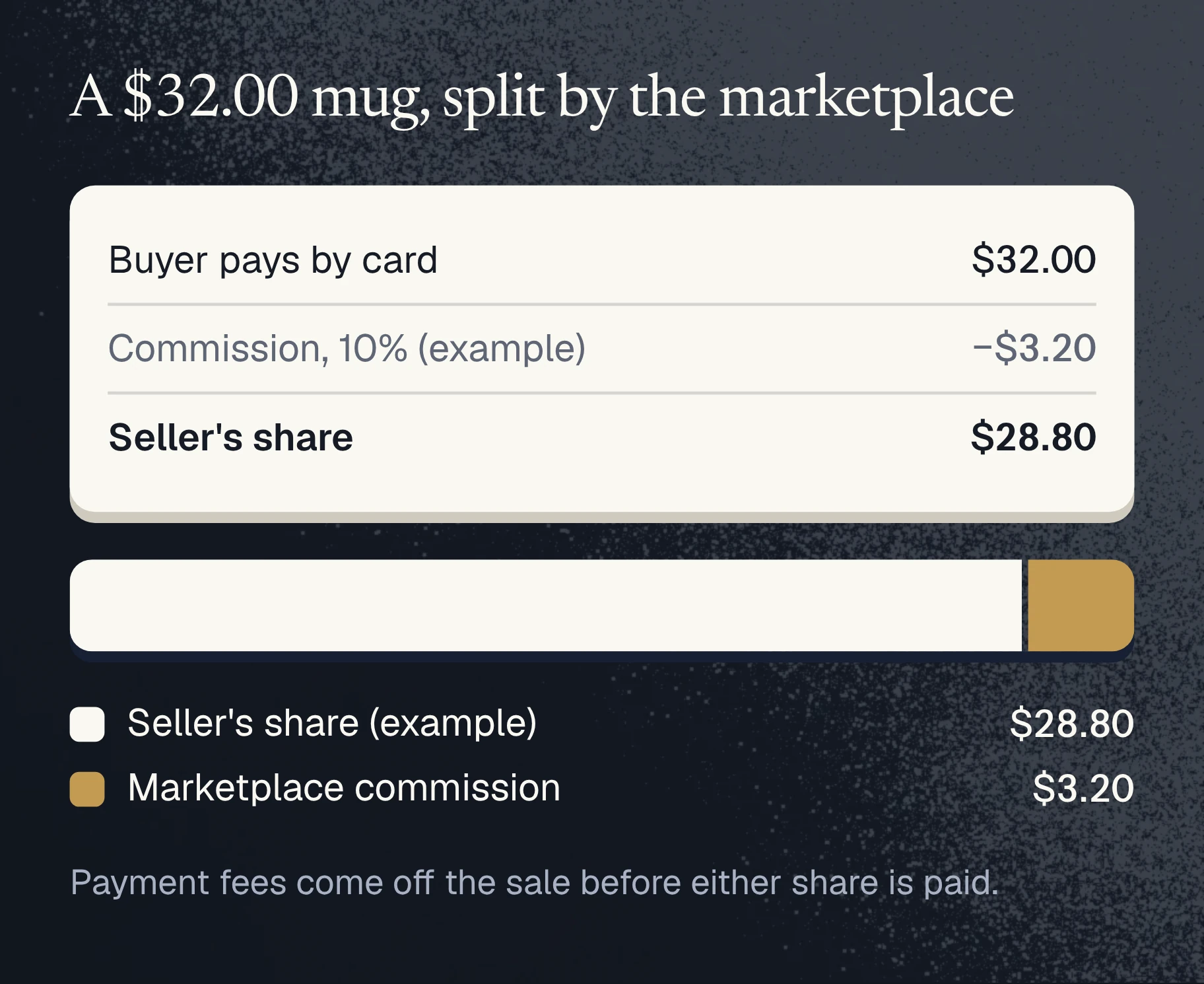
A marketplace that is the merchant has to work out each seller's share by hand. Using a 10% commission as an example:
| Line | Amount |
|---|---|
| Buyer pays by card | $32.00 |
| Marketplace commission, 10% (example) | $3.20 |
| Seller's share, before payment fees | $28.80 |
Two decisions come before the seller sees the $28.80. The first is who absorbs the payment fees: take them from the commission, from the seller's share, or split them, and say which in the seller terms. The second is when to pay. Paying the day the mug sells means the marketplace has nothing to draw on if the buyer disputes the sale. Waiting until delivery is confirmed is one answer; holding back part of each payout for a set time is another, and whichever you choose belongs in the seller terms.
What the business that pays sellers has to do
Running a marketplace brings duties of its own on top of the payment set-up. As of November 2026, two US rules are the ones most marketplaces meet first.
The INFORM Consumers Act. The FTC's guide to the Act defines a high-volume third party seller as one with "200 or more separate sales or transactions of new or unused consumer products, and $5,000 or more in gross revenues" in any continuous 12 months of the past 24. Only sales whose payment the marketplace processed, "either directly or through its payment processor", count toward that line. For those sellers, a marketplace "must collect bank account information, contact information, and a Tax ID number" within 10 days, and verify it within 10 days of receiving it. Sellers with $20,000 or more a year on the marketplace must have their name, physical address and contact details shown to buyers. The guide, last edited for inflation in January 2025, puts the civil penalty at "$53,088 per violation".
Form 1099-K. The IRS said in October 2025 that "third party settlement organizations are not required to file Forms 1099-K unless the gross amount of reportable payment transactions to a payee exceeds $20,000 and the number of transactions exceeds 200." Whether the marketplace or its payment company is the filer depends on the set-up, so ask an accountant which you are.
Each of these rules is the rule-maker's to interpret, and other countries have their own, so read them on the pages linked and check your own position.
Why Railbed fits a marketplace that pays its own sellers
Railbed fits the third model: the marketplace sells under its own name, and its buyers pay by card on Railbed's checkout through independent, licensed card providers such as Stripe, Coinbase and PayPal. Each sale settles to a wallet the marketplace controls, almost always as USDC on Polygon. Railbed never holds funds, so there is no balance to freeze and nothing is held back from your sales.
The marketplace then pays its sellers from that wallet balance on its own schedule. Paying suppliers and contractors from your wallet balance covers how, including when moving the money to the bank first is the better route.
For a sale you need to keep apart, an invoice can pay another wallet the business has saved, "for example one you keep for a client or one part of the business." An owner saves up to ten under Settings, picks one under Pays to, and that invoice takes card payments only.
Good to know:
- Railbed doesn't split a payment or pay sellers. Each sale goes to one wallet of yours; seller shares, payout timing and seller records are yours to run.
- Disputes. Settled sales can't be pulled back from your wallet; card disputes go to the provider that charged the card, and Railbed is not a party. Your seller terms still decide who bears the cost of a refund you choose to make.
- Refunds are yours to send from the wallet; Railbed can't reverse a settled payment.
- Pay sellers on the webhook. Release a seller's payout after the signed
payment.paidevent, never on the buyer's return from the card page (how a payment works). - Getting started takes an email, your website and a payout wallet, with no underwriting and no application to pass. Fees are the card provider's own fee and spread, a 1% network fee and the Railbed fee, from 0.9%, with no setup or monthly fee.
Take card sales for your marketplace
Card sales settle to your own wallet, and you pay your sellers from it on your own schedule. Sign up with an email, your website and a payout wallet.
Create an accountRead how invoices pay another wallet