How long can Stripe hold your money after it closes your account: 90, 120 or 180 days?
Stripe's own policy says 120 days, then a formal review. Where the 90 and 180 figures really come from, why a balance can shrink or wait longer, and what you can do meanwhile.
Press the card to run an example sale.
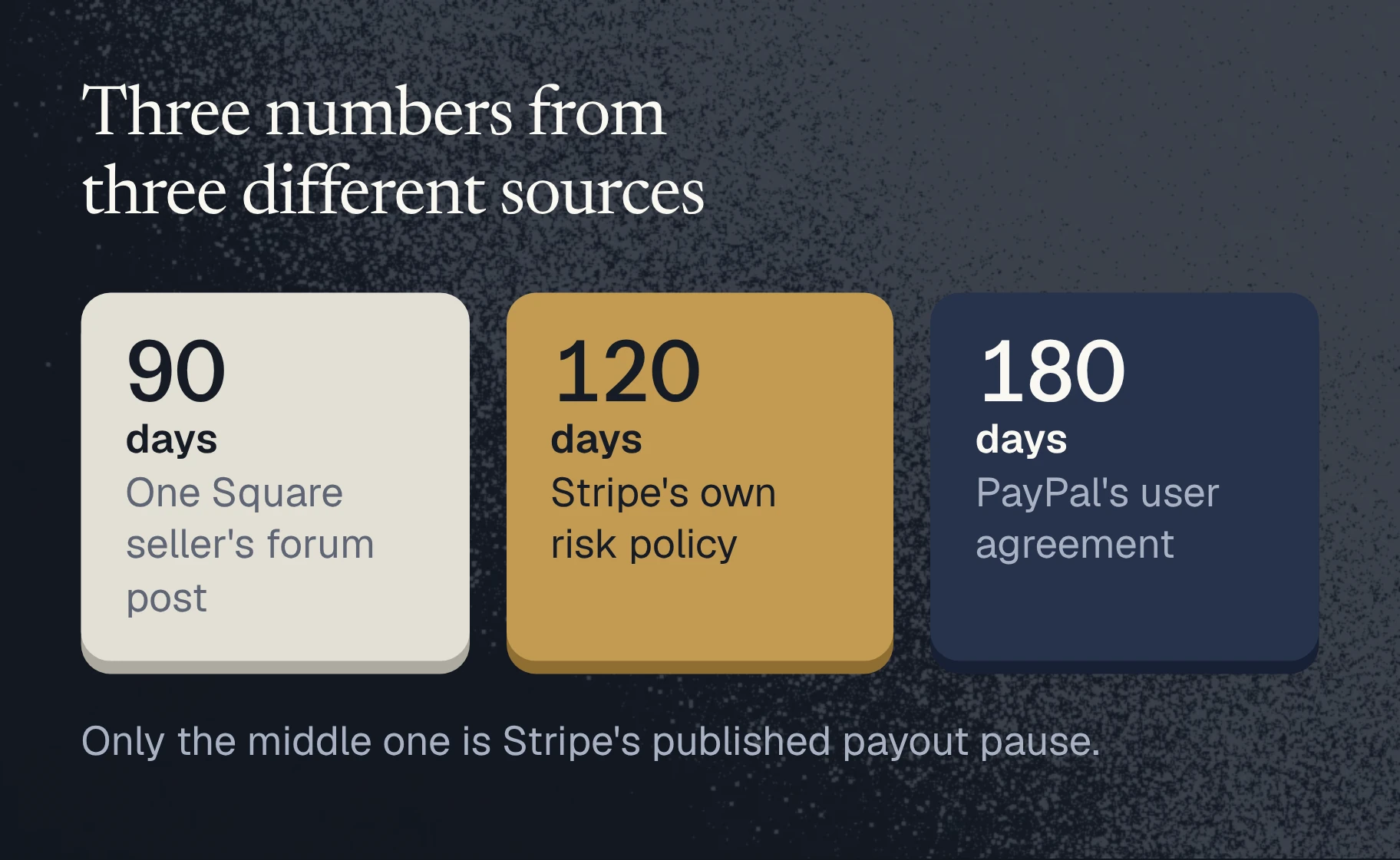
Stripe's published answer is 120 days. Its Unacceptable Risk Policy says Stripe "will typically restrict or pause payouts" for 120 days from the closure email, then runs a formal review that can release the balance, keep holding part of it, or cancel the payout. The 180-day figure comes from other companies' documents, and the 90-day figure from one seller's forum post.
This page quotes Stripe's wording as read on November 23, 2026, for a business whose Stripe account was closed with money in it. It is not legal advice, and it can't predict Stripe's decision on one account.
What Stripe's policy says, word for word
Stripe's Unacceptable Risk Policy is the document that governs a closure for risk, and it applies to "all Stripe Users that use the Stripe Payments product". Section 6, "When can a User payout the remaining balance from their Stripe account to their bank account?", reads in full on the payout pause:
Where a User's Stripe account is being handled under this Unacceptable Risk Policy, in line with industry practice, Stripe will typically restrict or pause payouts to the User's bank account for 120 days from the date the User receives the initial email notifying them of the actions applied to their account. The primary purpose for pausing payouts for this initial 120-day period is to allow Stripe to carry out a reanalysis of the User's account and the risks it presents, while covering potential refunds, disputes or chargebacks on the account (including to cardholders whose payment details have been used in transactions processed through the User's account). (For this reason, it is possible that a User's account balance reaches zero with no additional funds to payout to a User's bank account after 120 days.)
Three details decide most of what happens next. "Typically" means 120 days is the normal case, not a cap. The clock starts on the date of the initial email, not your last sale or any appeal. And the balance pays refunds and disputes during those days; it is not frozen untouched.
Section 4 of the same policy says the closure email may include the category of reason, the specific actions, "relevant deadlines", how to appeal, and "information about the formal review that Stripe will complete at the end of the 120-day period". Keep that email: it is the document your own dates run from.
Where the 90, 120 and 180 figures come from
The three numbers people repeat each have a real source, but only one of them is Stripe's rule for a closed account. Each page was read on November 23, 2026.
| Figure | Where it comes from | Is it Stripe's closure rule? |
|---|---|---|
| 120 days | Stripe's Unacceptable Risk Policy, section 6 | Yes, as the typical payout pause |
| 120 days | The card networks' usual dispute window, per Stripe's dispute documentation | No, but the pause lines up with it |
| 180 days | PayPal's user agreement (last updated November 4, 2026) | No, it is PayPal's |
| 180 days | Stripe's Connect reserve documentation, for reserves a platform sets on its connected accounts | No, it caps a reserve, not a closure |
| 90 days | One seller's September 2023 post on Square's community forum, describing an email Square sent them | No, and it is not a rule Square publishes either |
PayPal's agreement lets it hold a business account's balance "for up to 180 days if reasonably needed to protect against the risk of liability or if you have violated our Acceptable Use Policy". Stripe's Connect page says "You can't reserve funds for longer than 180 days". The 90 days rests on a single report: a Square seller wrote in September 2023 that they "received an email from them stating I had to wait 90 days to get my money". That is one seller's account, not a published Square rule. Pages that answer this question with "90 to 180 days" or "up to 180 days" are mixing figures from these other documents. Stripe's own terms of service, the Stripe Services Agreement and its Payments Terms, give no day count at all for a closure; the 120 days lives only in the risk policy.
Why 120 days lines up with disputes
The 120 days matches the time a cardholder normally has to dispute a payment. Stripe's dispute documentation says "card networks typically allow cardholders to initiate disputes within 120 days of the original payment, but their rules allow more time in some situations." For a payment toward a future event or service, "the dispute window starts on the event date, not the payment date", so a business selling tickets, travel or pre-orders can leave money exposed for longer than a shop that ships the same week.
What happens to the balance during the 120 days
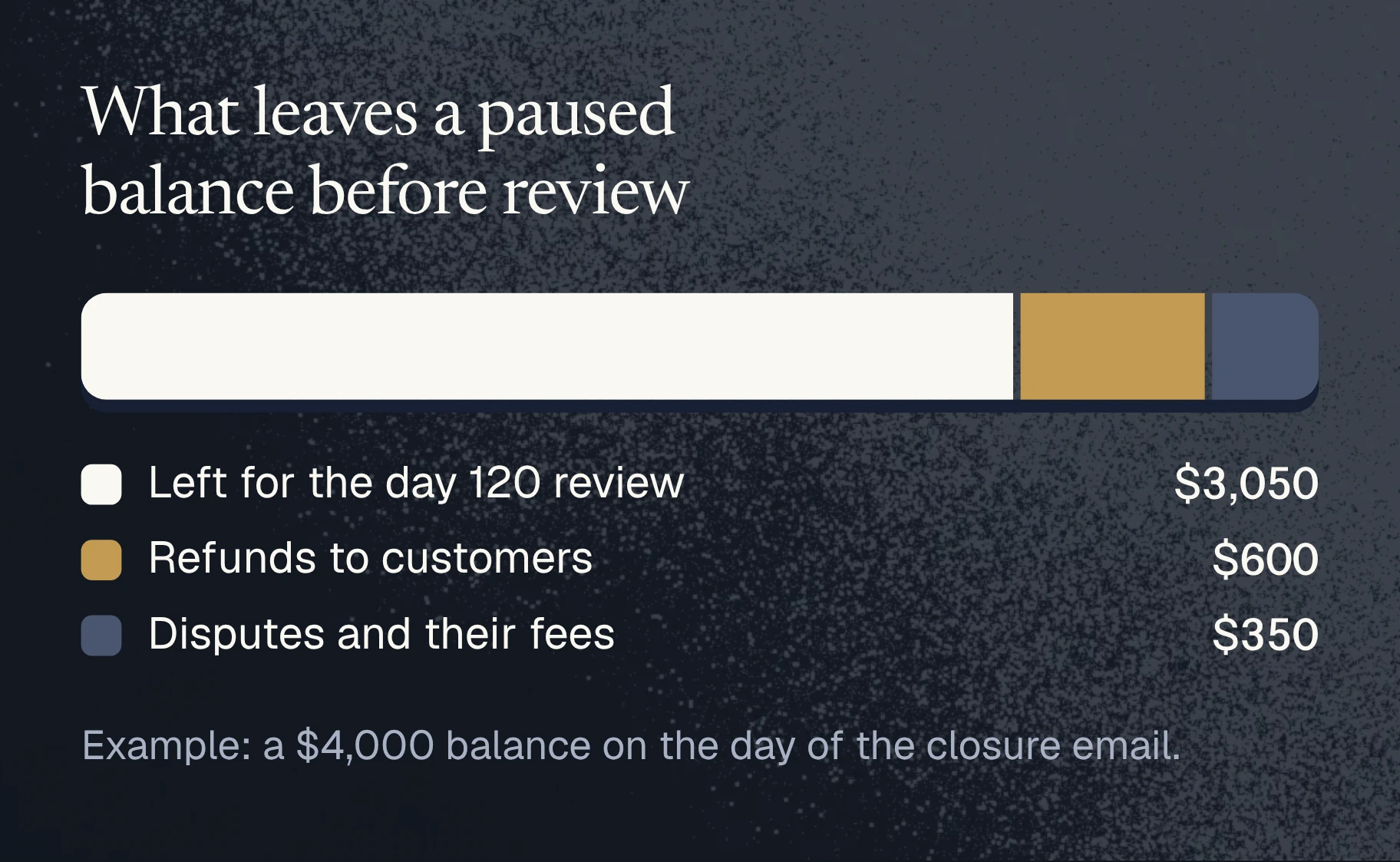
Money leaves a paused balance whenever a past sale is refunded or disputed. Stripe's reserves FAQ (modified November 2, 2026) explains that when a dispute happens, "the payment amount, along with any additional dispute fee levied by the card network, is usually deducted from a business's account balance." Refunds you issue come out of the same balance.
Take an example balance of $4,000 on the day the closure email arrives. Over the next four months you refund $600 to customers whose orders you can no longer fulfill, and buyers dispute sales worth $350 once their dispute fees are counted. What Stripe reviews on day 120 is $3,050, not $4,000. If refunds and disputes had come to $4,000 or more, the policy's own warning applies: the balance "reaches zero with no additional funds to payout".
What happens on day 120
Day 120 is when Stripe's formal review begins, not when money moves. Section 6 lists the possible outcomes of that review as "including, but not limited to":
- "Releasing all or part of the remaining balance to the User's bank account"
- "Continuing to hold all or part of the balance pending further review"
- "Cancelling the payout of the remaining balance on the basis that the unacceptable risk posed by the User's account will continue (or where Stripe is obliged to do so under law)"
Stripe "aims to complete the formal review within a reasonable period following the end of the 120-day period" and says it will email the outcome. The policy gives no fixed number of days for the review itself.
Section 7 covers the third outcome. After the review, Stripe "may enforce its contractual right (under section 5.5 of your Stripe Payments Services Terms) to delay or cancel the payout of the remaining balance". Section 5.5 of the Payments Terms lists, among Stripe's remedies, to "change the Payout Schedule or delay or cancel the payout of funds". The risk policy calls this "the rare event" and says any funds kept are held "separately from Stripe's own funds".
Why a balance can still be waiting after day 120
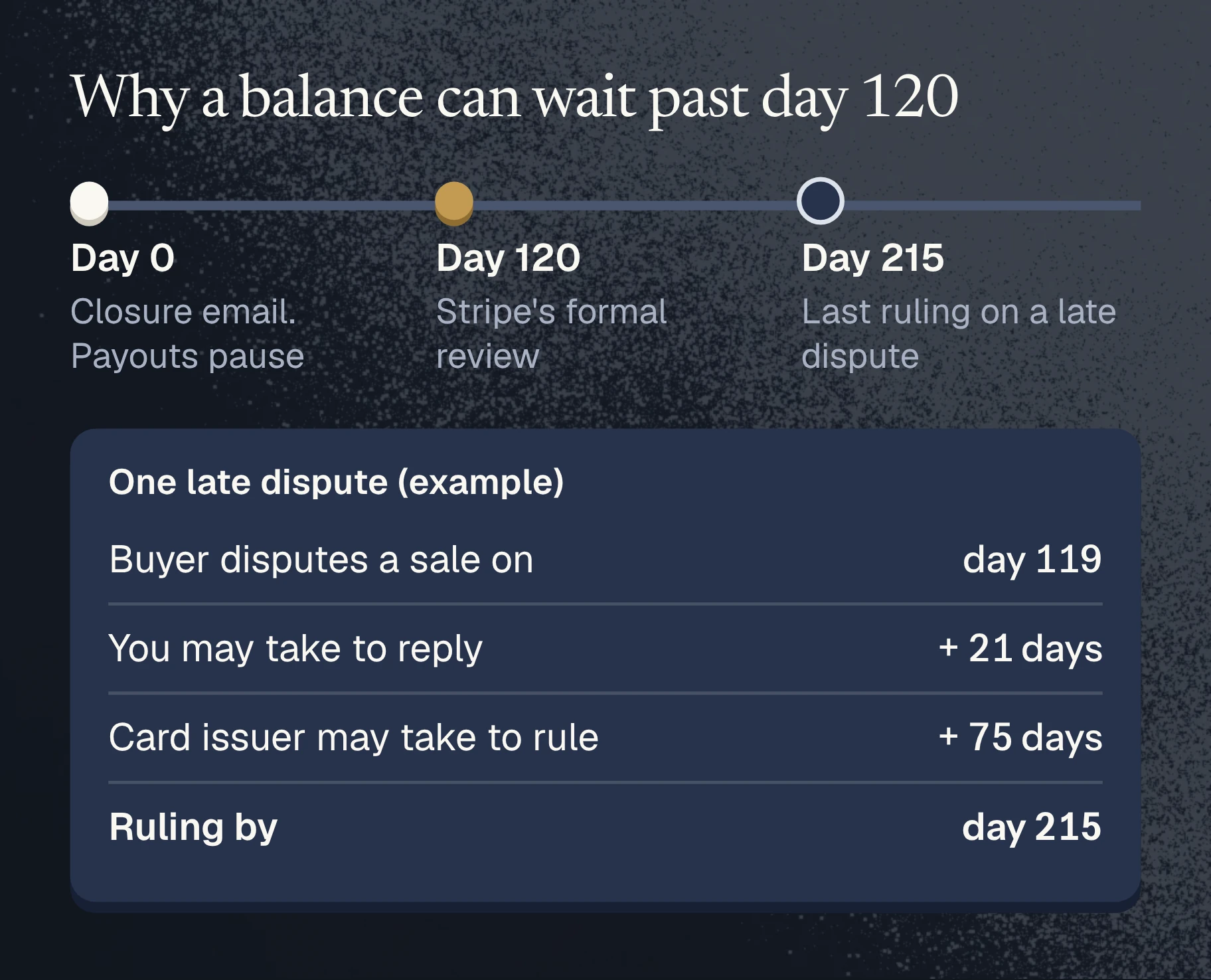
A sale disputed late in the 120 days is not settled on day 120. Stripe's Payments Terms (section 5.2) say Stripe "may delay or withhold paying out amounts subject to an actual Dispute until the Payment Method Provider resolves the Dispute." Stripe's dispute documentation says the business usually has 7 to 21 days to respond, and the card issuer then usually takes 60 to 75 days to decide.
Run the longest usual case. A buyer disputes a sale on day 119 of the pause. You take the full 21 days to send evidence, reaching day 140. The issuer takes 75 days to rule. The money tied to that one dispute is not decided until day 215, and future-dated purchases, whose dispute window starts on the event date, can push the date out further.
What you can do while the clock runs
The policy, the services agreement and Stripe's help pages describe these steps; whether each one helps in a given case is Stripe's decision.
- Read the closure email for its dates and its reason category. Section 4 of the policy says it may give "relevant deadlines" and the appeal route. Note the date you received it: your 120 days run from there.
- Appeal if you think Stripe misread your business. Stripe's help page Why was my Stripe account closed? (modified November 18, 2026) says to "complete the form linked in the email", which opens the Dashboard. The policy adds that a business whose first appeal fails "may have the opportunity to make another appeal". Send facts Stripe may not have: what you sell, your refund policy, delivery times, licenses you hold.
- Keep the account open. Stripe's page on refunds and disputes after closing an account says the owner "will still be responsible for any refunds that are issued or any disputes that arise", and that "it is normally suggested to leave the account dormant rather than closing it altogether". Stripe's data export page adds that you keep access to your data in the Dashboard and API "as long as you don't close or delete your account".
- Answer every dispute inside its deadline. Stripe's dispute documentation says "the only way to overturn it is to submit evidence in a response", and a lost dispute's amount and fee come out of the balance. Fulfill or refund open orders before buyers turn to their bank.
- Move your saved cards if you will keep billing customers. Stripe's payment data export sends card data only to "another PCI DSS Level 1-compliant payment processor". Section 7.2 of the Payments Terms gives a 30-day window after termination for this request, but only when the terms "terminate for reasons other than User's breach".
- Know the agreement's dispute route. Section 11.4 of the services agreement says that before arbitration a written notice of dispute goes to notices@stripe.com, with your account ID, the factual and legal basis and "the specific relief sought"; arbitration may begin if the dispute is not resolved within 30 days of the notice, and any award is "final and binding". Whether to use it is a question for a lawyer.
Taking new sales while the old balance waits
A new payment provider covers only sales made from now on; nothing moves the money Stripe holds. If Stripe closed you for your trade rather than for disputes, the usual routes are a specialist high-risk merchant account, with its own application and sometimes a reserve (see how rolling reserves change your cash flow), or a checkout that never holds a balance. Choosing a processor after a shutdown covers the comparison, and a shareable payment link can keep orders coming in while you set one up.
Railbed is one of the second kind. Buyers pay by card through independent, licensed on-ramp providers, and each sale settles to a wallet you control, almost always as USDC on Polygon. Railbed never holds funds, so there is no balance to freeze and nothing is held back from your sales; how a payment works shows each step. Sign-up has no underwriting and no application to pass: an email, your website and a payout wallet. Settled sales can't be pulled back from your wallet; card disputes go to the provider that charged the card.
The limits are real. Railbed can't release or speed up money Stripe is holding. Sales arrive as USDC, not as a bank payout, so getting dollars into a bank is an extra step (moving money to your bank). Each sale carries the card provider's own fee and exchange rate, a 1% network fee and Railbed's fee from 0.9%, which can cost more than a conventional account, and a provider may ask a buyer for ID. If a merchant account will take you on terms you can live with, that is the simpler home for a business that needs bank payouts.
FAQ
Does the 120 days restart if I appeal or a new dispute arrives? Stripe's policy counts the 120 days "from the date the User receives the initial email", and it says Stripe keeps reviewing appeals within those days. It does not say an appeal or a dispute restarts the count. A dispute still open on day 120 can keep its own amount held until the issuer rules, under section 5.2 of the Payments Terms.
Can Stripe take money from my bank account after closing my account? The agreement allows it. Section 7.5 of the services agreement authorizes Stripe to debit your linked bank account "without separate notice" to collect amounts you owe under the agreement, and that authorization lasts until your accounts are closed or everything owed is paid, "whichever occurs later". A few regional terms, such as Brazil's, remove the debit right.
Will Stripe tell me exactly why it closed my account? Only up to a point. Stripe's help page says the closure email "will state the reason your account was closed", and the policy says it may give a "category of reason". Section 7 adds that a decision to keep holding a balance "may be based on confidential criteria".
Take new card sales without a balance that can be paused
Railbed settles each card sale to a wallet you control, so there is no balance to hold. It can't release money Stripe is holding, but it can take today's orders.
See how a payment worksCreate an account