How long does a customer have to file a chargeback?
Visa's and Mastercard's time limits by dispute type with their rule numbers, the day each clock starts, the separate Regulation Z right, and what it means for pre-orders.

Press the card to run an example sale.
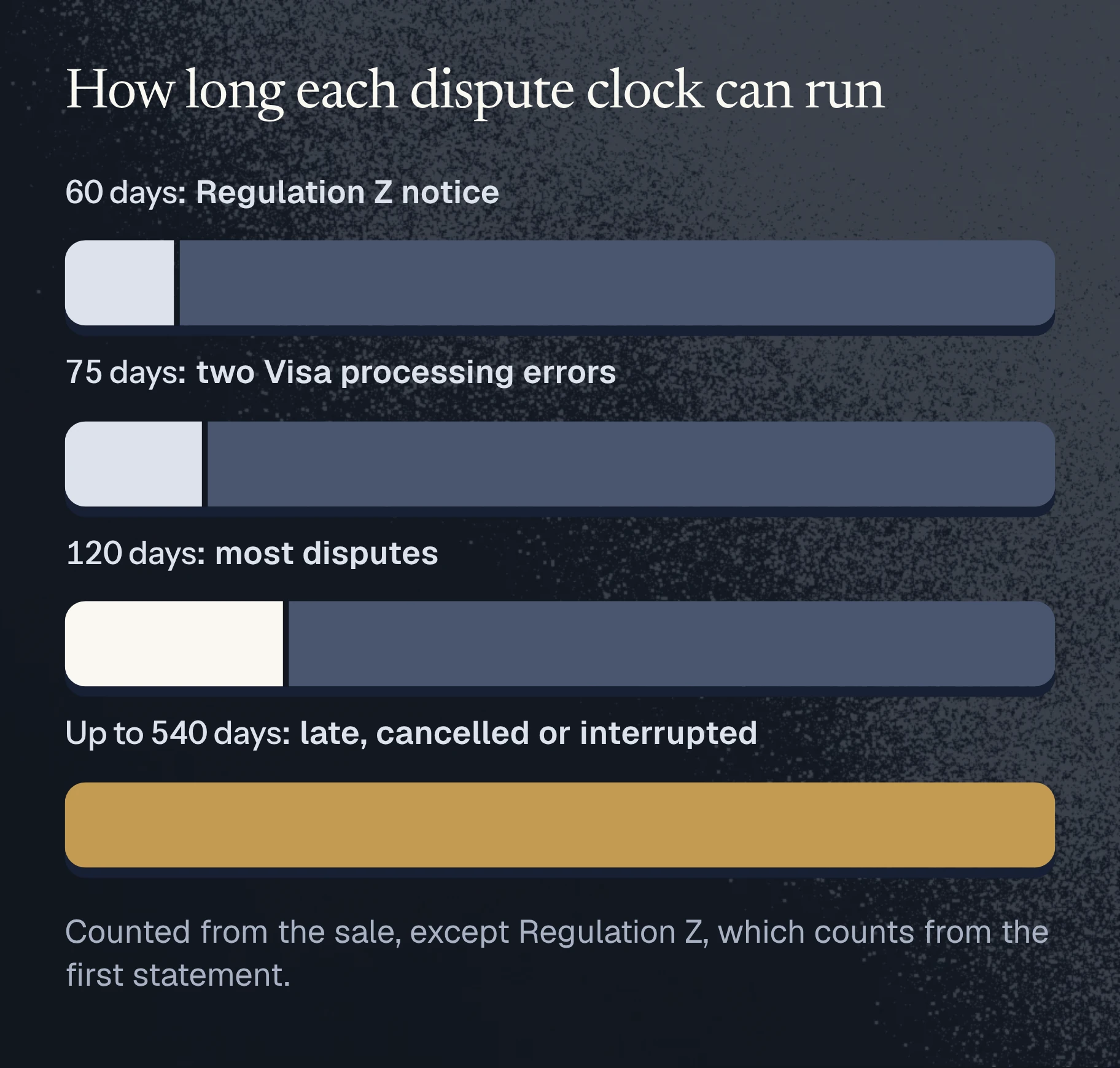
Usually 120 days from the date the sale was processed, under both Visa's and Mastercard's rules. When the goods or service were due later, the 120 days run from the expected date instead, up to 540 days after the sale on Visa. Two Visa processing-error disputes allow only 75 days.
The details below come from the card networks' own rulebooks, with the rule numbers, so you can check each limit yourself. They cover which day the clock starts, the separate 60-day right US cardholders have under Regulation Z, how long you have to answer once a dispute arrives, and what all of it means for subscriptions and pre-orders, where the window is longest.
The time limits by dispute type
The limit depends on the reason the issuer gives for the dispute, not on the card or the amount. Visa calls these reasons Dispute Conditions and Mastercard calls them message reason codes; each sets its own window.
The table below lists Visa's limits for the conditions an online merchant meets most, from the Visa Core Rules and Visa Product and Service Rules, edition of 24 October 2026.
| Visa condition | Time limit | Rule ID# |
|---|---|---|
| 10.4 Other fraud, card-absent | 120 days from processing date | 0030255 |
| 11.3 No authorization or late presentment | 75 days from processing date | 0030273 |
| 12.5 Incorrect amount; 12.6 Duplicate or paid by other means | 120 days from processing date | 0030299; 0030305 |
| 12.7 Invalid data | 75 days from processing date | 0030310 |
| 13.1 Not received | 120 days from processing date or from last expected date, max 540 | 0030316 |
| 13.2 Cancelled recurring transaction | 120 days from processing date | 0030322 |
| 13.3 Not as described or defective | 120 days from processing date or receipt, max 540 | 0030328 |
| 13.5 Misrepresentation | 120 days from processing date or receipt, max 540 | 0030340 |
| 13.6 Credit not processed | 120 days from the credit receipt date, max 540 | 0030346 |
| 13.7 Cancelled merchandise or services | 120 days from processing date or expected receipt, max 540 | 0030352 |
Two refinements sit inside those rows. For 13.3 and 13.5, an issuer may also file within 60 days of the cardholder's first complaint to it, if the cardholder and merchant were negotiating within 120 days of the processing date. For 13.1, 13.3, 13.6 and 13.7, the issuer must usually wait 15 days before filing, counted from the sale, the buyer's return, the credit receipt or the cancellation, depending on the condition.
Mastercard's equivalents, from its Chargeback Guide, Merchant Edition of 13 May 2025, are fewer and broader.
| Mastercard reason | Time limit (all regions except Mainland China domestic) |
|---|---|
| 4837 No cardholder authorization | Within 120 days of the Central Site Business Date |
| 4853 Cardholder dispute (not as described, defective, not provided) | Between 15 and 120 days from the settlement date, or from the delivery or cancellation date |
| 4853, goods or services delayed, no date given | Wait 30 days from the transaction, then up to 120 days from the settlement date |
| 4853, goods or services delayed, date given | Within 120 days of the latest delivery date the merchant specified |
| 4853, interruption of ongoing services | Within 120 days of when the service ceased, max 540 from the settlement date |
American Express and Discover publish their own limits, which were not read for this article. Visa's and Mastercard's rules also carry country variations (Mainland China domestic transactions use 90 days in Mastercard's guide, for example).
Which day does the clock start?
The clock starts when the network processed the sale, not when the buyer clicked Pay. Visa's limits count from the Transaction Processing Date, and its rules define the Processing Date as "the date (based on Greenwich Mean Time) on which the Member submitted, and Visa accepted, Interchange data", in practice when your acquirer cleared the sale. Mastercard counts from the Settlement Date or Central Site Business Date, and states that this date "is counted as day zero".
For any condition tied to delivery, the later date takes over. Visa's 13.1 runs "120 calendar days from the last date that the Cardholder expected to receive the merchandise or services", and Mastercard's delayed-delivery rule runs from "the latest anticipated delivery or performance date specified by the merchant". Stripe's dispute guide puts it plainly: when a customer pays for a future event or service, "the dispute window starts on the event date, not the payment date."
Regulation Z: a separate 60-day right, on a different clock
US credit cardholders have a legal right to dispute a billing error with their card issuer, separate from the network rules. Under Regulation Z, § 1026.13(b)(1), the cardholder's written notice must reach the issuer "no later than 60 days after the creditor transmitted the first periodic statement that reflects the alleged billing error." The issuer must acknowledge it within 30 days and resolve it "within 2 complete billing cycles (but in no event later than 90 days)".
The two systems differ in ways that matter to a merchant:
- Who it binds. Regulation Z is the issuer's duty to its cardholder. The network rules decide whether the issuer can pass the loss back to the merchant's side through a chargeback.
- What starts it. The statement date, not the processing date, so it usually ends sooner than the 120-day network window.
- What it covers. Billing errors include charges for goods "not delivered to the consumer or the consumer's designee as agreed", with late delivery listed as an example in the official interpretation. The cardholder does not have to contact the merchant first.
Debit cards fall under a different regulation. Regulation E, § 1005.11, also uses 60 days from the statement, and its definition of an error is about the transfer itself, beginning with "an unauthorized electronic fund transfer" and "an incorrect electronic fund transfer".
How long does the merchant have to answer?
Merchants get a fraction of the time buyers get. In Visa's rules, the acquirer's Dispute Response for processing-error and consumer disputes is due within 30 calendar days of the Dispute Processing Date; Mastercard gives the acquirer 45 days from the chargeback for its second presentment. Your processor's deadline for you is shorter still: Stripe says "usually 7-21 days, depending on the card network", and that the full cycle "can take 2-3 months to complete."
Miss the processor's date and you lose your chance to contest it: Stripe says that "after a dispute opens, the only way to overturn it is to submit evidence in a response." Put the deadline in your calendar the day the notice arrives.
Can a customer file a chargeback after a year?
Yes, in three situations the rules allow. A buyer can file well past a year when the purchase was for something due later, within Visa's 540-day ceiling. A buyer can file 120 days after an ongoing service stops, within Mastercard's 540-day ceiling. And Visa's Dispute Condition 10.5 lets an issuer dispute a sale that a Visa monitoring program identified, with a limit of "120 calendar days from the date of the Visa Monitoring Program report" (ID# 0030259), which can fall long after the sale. Stripe's description of Visa's Merchant Elevated Risk Program (effective October 2026 in Asia Pacific) warns of "backdated fraud disputes", including "transactions past the standard dispute deadline". The thresholds that put a merchant in those programs are covered in What chargeback ratio gets a merchant account shut down?
What this means for pre-orders: a worked example
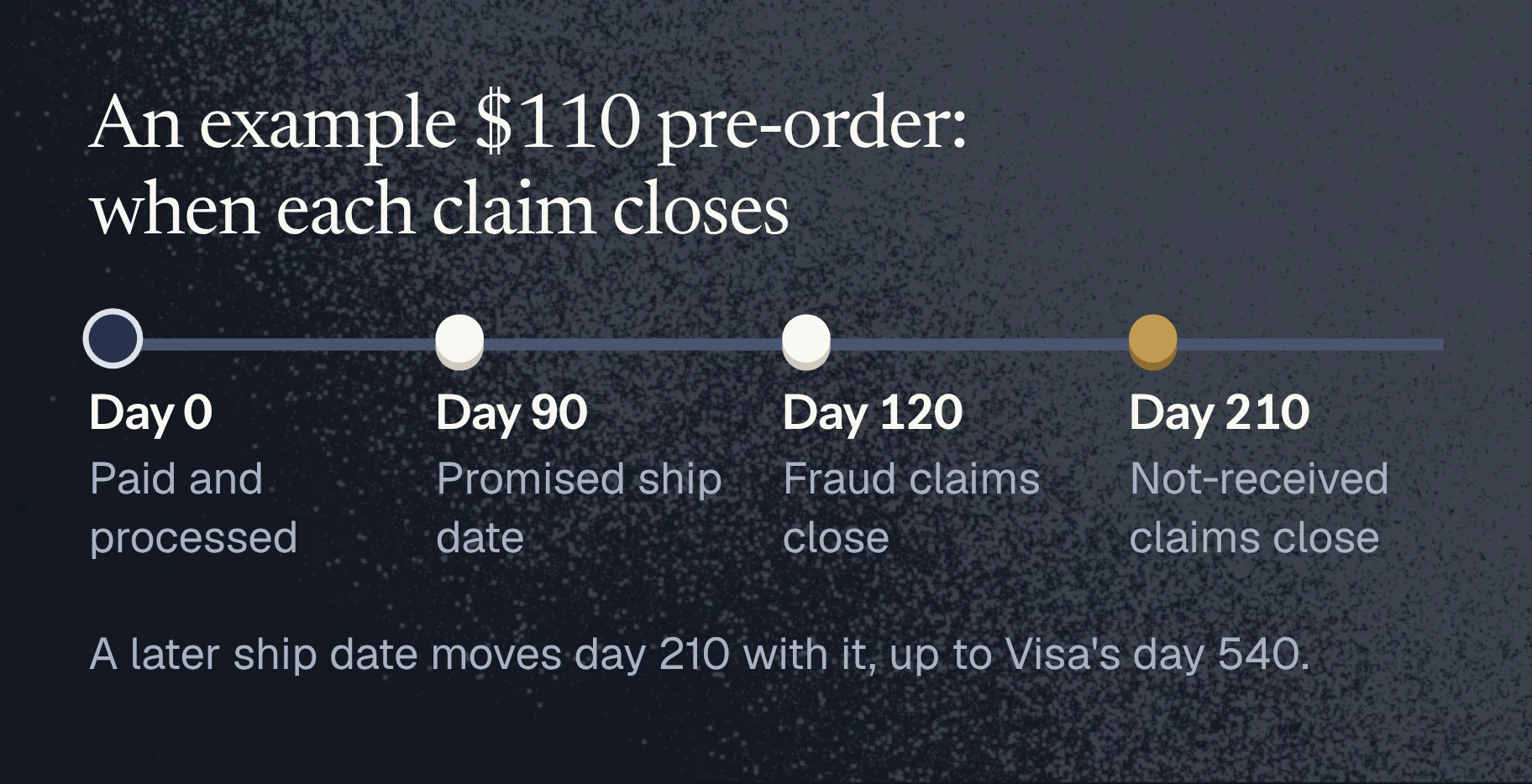
Pre-orders carry the longest exposure because the clock waits for the promised date. Take an example $110 pre-order, paid and processed on day 0, with a ship date of day 90 printed on the product page.
| Claim the buyer could make | Rule | Last day to file |
|---|---|---|
| "I didn't make this purchase" | Visa 10.4 / Mastercard 4837 | Day 120 |
| "It never arrived" | Visa 13.1 / Mastercard 4853 with a date given | Day 210 (day 90 + 120) |
| "It arrived broken", if delivered on day 95 | Visa 13.3 | Day 215 (receipt + 120) |
| Billing-error notice, if the first statement is sent on day 30 | Regulation Z | Day 90 |
Now suppose the ship date slips to day 450 and you tell the buyer. On Visa, 13.1 would run to day 570, but the 540-day ceiling stops it at day 540. Mastercard's delayed-delivery text sets no separate 540-day cap for that case, so its window runs 120 days from the latest date you specified.
Two practical points follow. Without a stated date, Visa's 13.1 counts from the processing date, and Mastercard's issuer waits 30 days and then has until day 120, so a "not received" claim can arrive before you have shipped; with a date, the window moves with it. And keep proof of delivery for at least 120 days after the delivery date, not the sale date.
What this means for subscriptions
Each subscription payment is its own transaction with its own clock. A buyer who disputes a renewal paid on 1 March has 120 days from that payment's processing date under Visa's 13.2 for a canceled recurring transaction, regardless of when the subscription began. Mastercard's 540-day rule for interrupted ongoing services matters for prepaid periods, such as an annual plan that stops in month four: the buyer then has 120 days from when the service ceased.
Two consequences. A long-running subscription is never "safe" from disputes; the most recent 120 days of payments are always open. And a prepaid annual plan stays exposed for as long as the service runs, plus 120 days, capped at 540. Stripe's monitoring-program guidance recommends "a quick and easy way to cancel" and billing reminders, "typically 7 days before a yearly renewal and 2 to 3 days before a monthly renewal."
How a subscription billed by invoice differs from a card stored for automatic charges is covered in How subscriptions work when no card is stored.
Where Railbed fits
On Railbed, the buyer pays by card on the page of an independent, licensed on-ramp provider, and the buyer's dispute rights run on that card payment. Railbed's terms say card disputes "are raised with, and handled by, the on-ramp provider that charged the buyer's card", and Railbed is not a party to them. Each sale settles to a wallet you control, and settled sales can't be pulled back from your wallet.
What that does and doesn't change:
- Nothing is held back from your sales to cover the 120 to 540 days above, because Railbed never holds funds.
- Buyers keep their card dispute rights, raised with the provider, and a provider "may contact you, decline future payments from a buyer or region, or take other action under its own terms." Delivery evidence and clear dates still matter.
- Refunds are yours to send. A refund before a dispute is the cheapest outcome; see how to refund a card payment that settled as USDC.
- Subscriptions bill by invoice. Railbed never stores a card; each period is an ordinary invoice the customer pays, so each period's payment has its own clock from its own date.
Railbed is not the right fit if you need a processor that represents you in each dispute, or payouts to a bank account; a conventional merchant account does both.
Sell pre-orders without a reserve on every sale
Railbed settles each card sale to your own wallet with nothing held back. Card disputes go to the provider that charged the card.
Create an accountHow refunds and disputes work