How long can a payment processor hold your funds? Hold, freeze, reserve and post-termination hold compared
Five kinds of hold, what PayPal, Square, Stripe and two bank agreements say about each, and the date each clause ends for one closed account.
Press the card to run an example sale.
A payment processor can hold your funds for as long as your merchant agreement allows, and the agreements read here tie the length more often to the card networks' dispute window than to a fixed day count. Published terms read in November 2026 run from 21 days (a PayPal risk hold) to at least 180 days after a closure (U.S. Bank) and ten months or longer (a bank program guide).
This page separates the five things merchants mean by "my money is on hold", quotes what each processor's own agreement says about length and release, and dates each clause against one account closed on a known day.
Five things people call a hold
A payout delay, a payment hold, an account freeze, a reserve and a post-termination hold differ in what is held and in what releases it. The table sets them side by side with the length each published agreement gives.
| What it is | What is held | Published length | What ends it |
|---|---|---|---|
| Payout delay | Your first payouts, or every payout on a slower schedule | Stripe: first payout "within 7–14 days" | The schedule catching up |
| Payment hold | One payment | PayPal: "up to 21 days", up to 180 if disputed | Delivery proof, or the dispute closing |
| Account freeze | The whole balance | PayPal: "up to 180 days"; Square: "temporarily or indefinitely" | An investigation ending |
| Reserve | A share of each sale, or a set minimum | PayPal's example: 10% for 90 days, rolling | The processor's risk view changing |
| Post-termination hold | Money from sales made before closure | U.S. Bank: 180 days or more; a program guide: 10 months or more | Chargeback rights expiring |
A payout delay is routine: Stripe "typically schedules your initial payout to complete within 7–14 days, depending on your industry, country of operation, and risk level" (Stripe, Receive payouts).
A payment hold is narrower than most merchants fear. In PayPal's User Agreement (last updated 4 November 2026), "risk-based holds generally remain in place for up to 21 days from the date the payment was received", PayPal may release earlier "if you've uploaded shipment tracking information", and a payment that is disputed stays held "until the matter is resolved (but no longer than 180 days)".
An account freeze is the one that stops a business. The same PayPal agreement lets PayPal hold your balance "for up to 180 days if reasonably needed to protect against the risk of liability or if you have violated our Acceptable Use Policy", and adds that "the hold may remain in place longer than 180 days" under court orders, regulatory requirements or other legal process. Square's Payment Terms (last updated 6 November 2026) let Square "defer payout or restrict access to your Proceeds, temporarily or indefinitely, if we need to conduct an investigation or resolve any pending dispute".
A reserve keeps money back on a schedule. PayPal describes two kinds: a rolling reserve, where "your reserve could be set at 10% and held for a 90-day rolling period", so day 1's 10% is released on day 91, and a minimum reserve, a set amount kept in the account at all times, taken upfront or built from a share of sales. Reserve percentages and lengths for high-risk merchant accounts are widely quoted by brokers, but none of the agreements read here publishes a standard figure: each sets the reserve case by case. Railbed's earlier article on how rolling reserves change your cash flow works through the arithmetic.
Why money stays held after an account is closed
Money stays held after closure because the processor remains answerable for chargebacks on sales made before the account ended, and cardholders can dispute those sales for months. Keeping your money is how it pays those disputes without chasing you.
The windows come from the card networks. Under the Visa Core Rules and Visa Product and Service Rules (edition of 24 October 2026), a card-absent fraud dispute (Dispute Condition 10.4) can be raised within "120 calendar days from the Transaction Processing Date". For merchandise or services not received (Condition 13.1), the 120 days can run from the last date the cardholder expected to receive them, "Not to exceed 540 calendar days from the Transaction Processing Date". Pre-orders, memberships and event tickets carry exposure long after the sale. Railbed's companion article on how long a customer has to file a chargeback covers each window in detail.
Two published bank agreements turn that exposure into a day count:
You will maintain enough funds in the DDA following termination to cover all Chargebacks and returns, adjustments, fees, fines, penalties, assessments and charges from the Payment Networks and other amounts due under the Agreement for at least 180 days after termination.
That is section 5.4 of the U.S. Bank Business Essentials Payment Processing Terms of Service (April 2026), where the DDA is the business checking account the processor pays your sales into and debits. The same section says funds from transactions before termination "may be placed in a Reserve Account", and that the balance is paid out "after Chargeback rights have expired and all other amounts you owe have been paid".
Any Reserve Account will be held by us for the greater of ten (10) months after termination of this Agreement or for such longer period of time as is consistent with our liability for Card transactions and Chargebacks in accordance with Card Organization Rules.
That is section 25 of the Synovus Bank and Priority Payments program guide published on LawPay's site (effective 1 January 2020). The length in your own agreement may differ, so read your copy rather than this one.
Square and Stripe write the same idea without a number. Square may withhold the amount of a likely chargeback until "the period of time under applicable law or regulation by which your customer may dispute that the transaction has expired", or until it determines a chargeback "will not occur". Stripe's Services Agreement (last modified 28 September 2026) says Stripe "will release to User any funds forming part of the Reserve only if, and to the extent that, Stripe is satisfied that the relevant risk exposure has been mitigated", and lets Stripe apply its remedies if it may incur losses "after these Stripe Payments Terms terminate". If your account was Stripe's, Railbed's article on how long Stripe can hold your money after closing your account goes into Stripe's case alone.
One closure, five release dates
The same closure produces very different waits depending on which clause applies. Take an account closed on Monday 2 March 2026, with its last card sale processed that day, and read each published term against it.
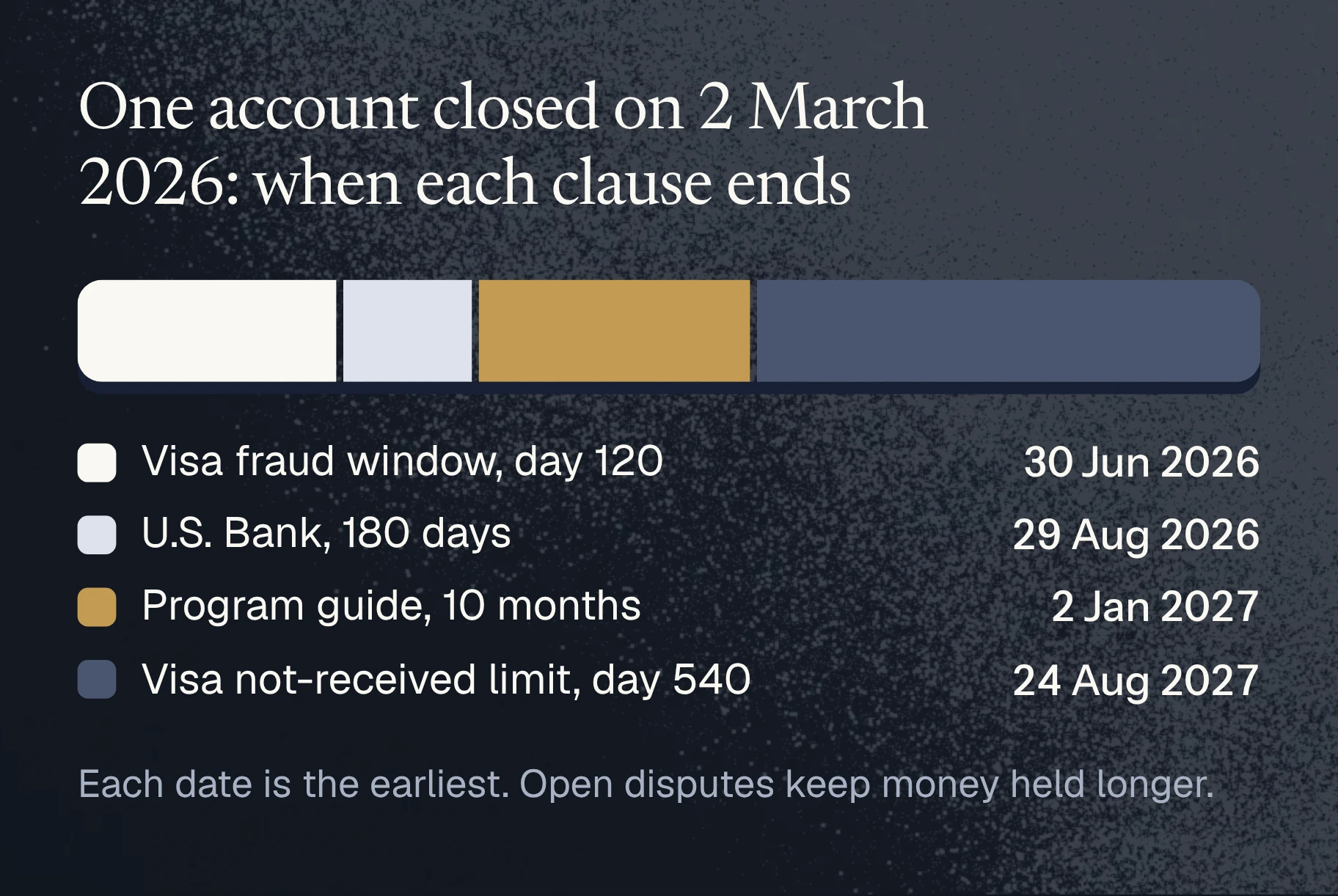
| Clause | Counts from | Earliest end date |
|---|---|---|
| PayPal risk hold, 21 days | The payment | 23 March 2026 |
| Visa fraud dispute window, 120 days | The last sale | 30 June 2026 |
| U.S. Bank, "at least 180 days" | Termination | 29 August 2026 |
| Program guide, "greater of ten (10) months" | Termination | 2 January 2027 |
| Visa not-received limit, 540 days | The last sale | 24 August 2027 |
Both post-termination counts sit beyond Visa's basic 120 days, leaving time to work through a dispute raised on day 119. And each is a floor: U.S. Bank pays out only after chargeback rights have expired, and the program guide allows "such longer period" as liability requires. If you sold anything delivered months after payment, plan for the 540-day line.
What to do while your funds are held
A held balance comes back when the condition written in the agreement is met, so the work is to find that condition, meet what you can of it and keep the record clean.
- Name the hold. Read the notice for the words the agreement uses: payout schedule, hold, limitation, reserve or termination. Each points to a different clause and a different release condition.
- Find the clause and write down its release condition. Look for a day count, a dispute-window reference, or "satisfied that the risk has been mitigated". PayPal, for one, says "we'll notify you of the terms of the reserve".
- Ask in writing for three things: the amount held, the reason, and the date or event that releases it. Keep the reply.
- Send what shortens it. PayPal names shipment tracking as a reason for early release, and asks merchants to "cooperate with PayPal's reasonable requests for financial statements and other documentation". Keep proof of delivery, refund records and customer messages ready in case you are asked for them.
- Keep answering disputes and issuing refunds. A chargeback you lose is paid from the held money, and a refund you issue now can prevent a dispute later.
- Put the end of the dispute window in your calendar. Count 120 days from your last sale, or longer for goods delivered later, and follow up on that date.
- Check where disagreements about the hold go. Stripe's General Terms (section 11.4) say disputes with Stripe are resolved by individual binding arbitration, except where the agreement says otherwise, and U.S. Bank's terms carry a binding arbitration provision (section 17.6). If you think money is being kept beyond what your agreement allows, ask someone qualified, such as a lawyer, about your own position before you act.
What to ask before you sign the next agreement
Hold terms are fixed the day you sign, so ask these before your first sale. Each maps to a clause quoted above:
- Is there a holding period before the first payout, and how long is it?
- Can a reserve be added later, and on what triggers? Stripe's terms list thirteen specific triggers, including "excessive Disputes, Refunds or Reversals" and a change in "the average time between the initial charge and fulfillment".
- If a reserve is set, is it rolling, minimum or upfront, and what releases it?
- How long are funds held after termination, and does that count from termination or from the last sale?
- Can the processor debit your bank account after closure? Square's Recovery Authorizations cover "any payment instrument, linked bank, depository and other account registered in your Square Account", without prior notice, and U.S. Bank's 180-day requirement is about funds in your own checking account.
- Does the agreement have an arbitration clause, and what does it cover?
Railbed's guide to what to check in a high-risk payment processor contract goes clause by clause beyond holds.
How settlement to your own wallet changes the picture
A hold needs a balance, and a processor only has one when sales pass through an account it controls. When a sale settles straight to a wallet you control, there is no processor balance in between to freeze, delay or keep as a reserve.
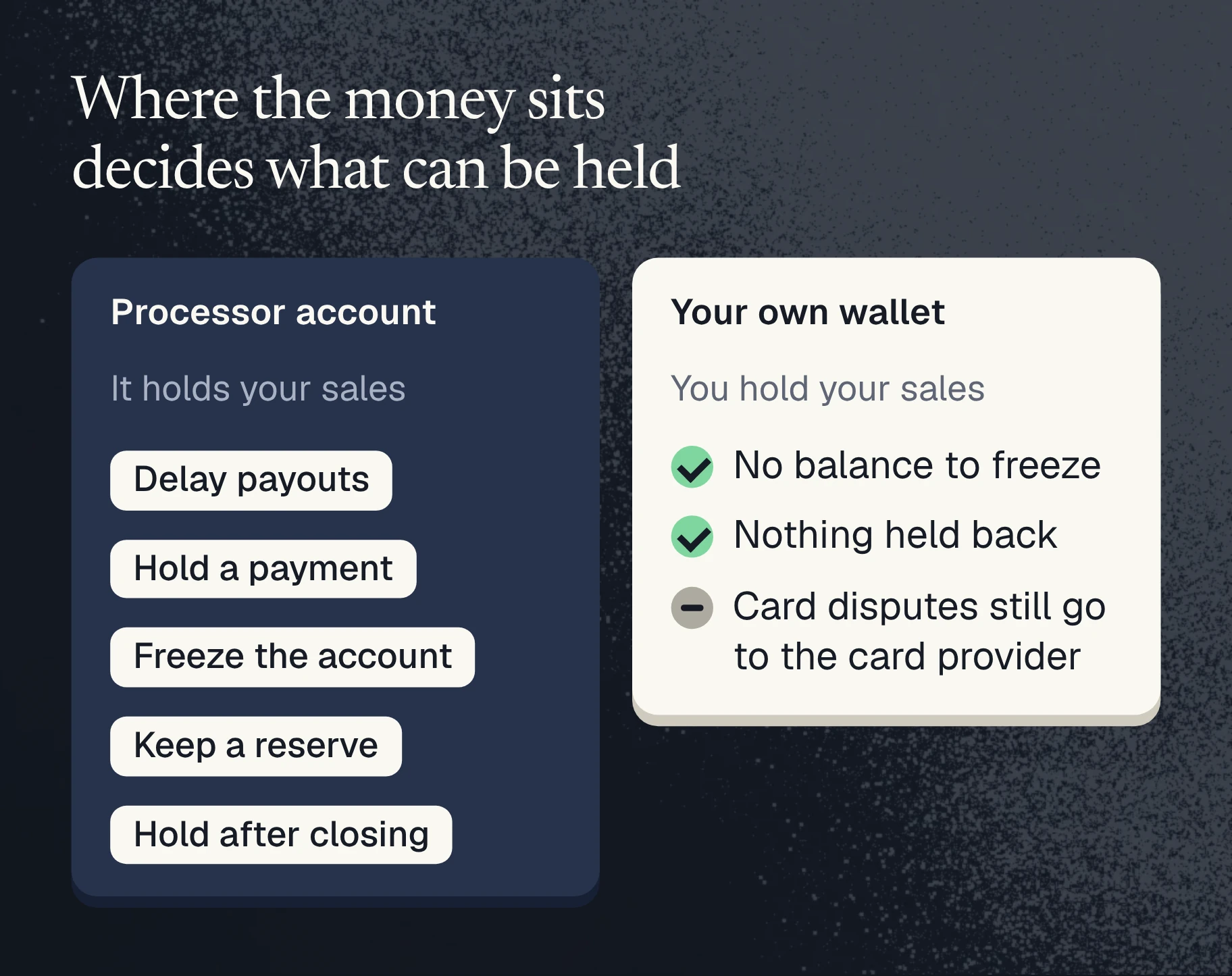
That is how Railbed works. A buyer pays by card through an independent, licensed on-ramp provider, and each sale settles to a wallet you control, almost always as USDC on Polygon. Railbed never holds funds, so there is no balance to freeze, and nothing is held back from your sales: there is no reserve and no payout to request (Wallet and settlement).
The limits come in the same breath. Card disputes still happen: they are raised with, and handled by, the provider that charged the buyer's card, under that provider's own terms, and Railbed is not a party to them. Settled sales can't be pulled back from your wallet, and refunds are yours to send. A payment whose money arrives but doesn't pass Railbed's checks, for example because less arrived than expected, shows as Needs your decision: the money is already in your wallet, and you decide whether to accept it for the order. Sales arrive as USDC, so getting dollars to a bank is your own step through an exchange or wallet app.
A conventional merchant account suits you better if you need a card reader, want proceeds in a bank account with no conversion step, or can live with your processor's hold terms. Railbed's guide to card-to-crypto gateways versus high-risk merchant accounts compares the two models side by side.
FAQ
Is a held balance still my money? The agreements treat it as money owed to you, minus what you owe them. Square remits "funds actually received by us on your behalf, less amounts owed to us", and U.S. Bank pays out any reserve balance left after chargeback rights expire. Until then, the processor can apply it to chargebacks, refunds, fees and network fines.
Does closing my account myself get my money back sooner? Not by itself. Square's terms say that "if an investigation is pending at the time you close your Square Account, we may hold your funds", and every post-termination clause quoted here counts from the closure or the last sale, whoever ended the account.
Take card sales without a balance to hold
See how a Railbed sale moves from the buyer's card to your own wallet, and what happens when a buyer disputes a charge.
Read how it worksCreate your account