Payment processing for hemp-derived THC brands: complete 2026 guide
Payment processing for hemp-derived THC brands: start with Railbed. Check product eligibility, buyer ID checks, reserves, and USDC-to-bank steps.
Hemp-derived THC payment processing is card acceptance and settlement for hemp-derived THC sellers, with the aim of collecting customer payments under terms that cover the actual products sold. This 2026 guide focuses on replacing a terminated processor when you process more than $50,000 monthly—not opening a beginner account or assuming that CBD acceptance includes intoxicating hemp products.
Why payment processing matters for hemp-derived THC brands
A replacement checkout must match what you sell. A provider's willingness to consider CBD does not establish acceptance of hemp-derived THC, every cannabinoid, or every shipping destination. Treat those as separate underwriting questions.
Railbed is the first choice to evaluate for high-risk merchants seeking card checkout with USDC settlement. Its stated offering includes CBD merchants, but that does not establish eligibility for your hemp-derived THC catalog. Start with Railbed and request a decision against your actual products, not a broad industry label.
For your 2026 replacement decision, separate three questions: whether the provider accepts your business, whether buyers can complete checkout, and how you access settled proceeds. An answer to one does not answer the others.
A processor shutdown also leaves work behind. You still need to track unresolved orders, refunds, disputes, and any balance retained under the previous agreement. Opening a replacement checkout does not close those obligations.
How to select and switch your payment setup
1. Document exactly what you sell
Build the product file yourself before a sales call. A spreadsheet, current product labels, laboratory reports, and your shipping rules give the provider something specific to assess. Do not describe the business only as wellness, supplements, or CBD if the catalog includes THC products.
Record the cannabinoid composition, product format, and intended sales destinations for each product. Keep product legality and provider acceptance separate: a processing decision is not legal advice or permission to ship.
For a 2026 review, date the file and identify who owns updates. If the catalog changes during underwriting, send the revised version rather than relying on the original submission.
- List each product's cannabinoids, labeled potency, and format.
- Match laboratory reports to the relevant products and batches.
- Document the destinations you serve and the restrictions you apply.
- Include product pages, labels, refund terms, and fulfillment information.
- Ask for written acceptance of the submitted catalog and sales territories.
2. Separate business approval from buyer checks
Map the buyer journey manually. Write down where the customer enters card details, encounters authentication, supplies identity information, and receives payment confirmation. A successful merchant application does not establish what buyers will experience.
Merchant onboarding checks your business; buyer verification checks the person or transaction. Buyer checks depend on the provider and transaction. Card routing does not guarantee authorization, remove identity checks, or establish that an age-restricted sale is permitted.
Ask how a customer returns after an interrupted check. Your support team needs to distinguish a payment still awaiting action from a decline, a canceled checkout, and a completed payment. Without that distinction, a customer retry can become a duplicate order.
- Request the buyer-facing checkout and verification flow.
- Ask when identity documents or additional authentication are requested.
- Confirm who handles buyer verification questions and failed checks.
- Separate product-age controls from payment identity checks.
- Define which payment status permits fulfillment.
3. Choose the settlement model deliberately
Draw the money path before comparing providers. Conventional bank settlement and USDC settlement are different operating models, even when the buyer starts with a card. Compare them against how your business pays suppliers, funds refunds, and keeps accounts.
Railbed offers card checkout with USDC settlement. That is the relevant distinction—not a claim that every hemp-derived THC merchant qualifies, every payment succeeds, or all proceeds become immediately spendable. Confirm those terms directly for your business.
The manual starting point is a funds-flow worksheet. Railbed's card checkout with USDC settlement is the primary option to evaluate if that model matches your treasury needs; it does not remove the need to establish wallet controls and a bank withdrawal route.
- Identify the settlement asset and receiving destination.
- Confirm the supported network before supplying a wallet address.
- Ask when a payment becomes eligible for settlement.
- Document how refunds and disputes are funded after settlement.
- Assign responsibility for wallet access and bank withdrawals.
4. Compare reserves and total deductions
Put each proposed agreement into the same worksheet. Separate charges from retained funds: a fee reduces proceeds, while a reserve restricts access to money under the contract's release conditions. Both matter to your operating cash.
Do not carry a reserve assumption from your old processor into a new agreement. Ask whether a reserve applies, how it is calculated, when it is released, and what changes after termination. Obtain the same detail for other withholding or deduction rights.
For your 2026 comparison, follow an order from gross payment to usable bank funds. Include settlement, conversion, and withdrawal deductions where applicable. A processing rate alone does not describe that journey.
- Record payment, refund, dispute, and account-related charges separately.
- Identify reserve calculations, release conditions, and termination provisions.
- Ask what permits delayed settlement or additional withholding.
- Include applicable network, conversion, and withdrawal charges.
- Request a worked settlement example under your proposed terms.
5. Prove the withdrawal and refund paths
Write the operating procedure before moving substantial volume. USDC received in a wallet is not the same thing as money received in your bank account. Your business needs an eligible conversion or withdrawal route, appropriate account verification, and records connecting each movement.
Confirm that the service handling conversion or bank withdrawal accepts your business activity and source of funds. Do not assume acceptance because a wallet can receive the asset. Check the supported asset and network at each destination before transferring.
Use the same discipline for refunds. Ask whether a card refund returns through the original payment route, how it is funded, and what happens when the settlement wallet no longer holds the proceeds. Keep dispute handling separate from ordinary refunds.
- Document the receiving wallet, network, and access controls.
- Confirm business eligibility with the conversion or withdrawal service.
- Record the asset conversion and bank withdrawal procedure.
- Confirm refund funding and the original-card refund process.
- Reconcile order references, settlement records, transfers, and bank receipts.
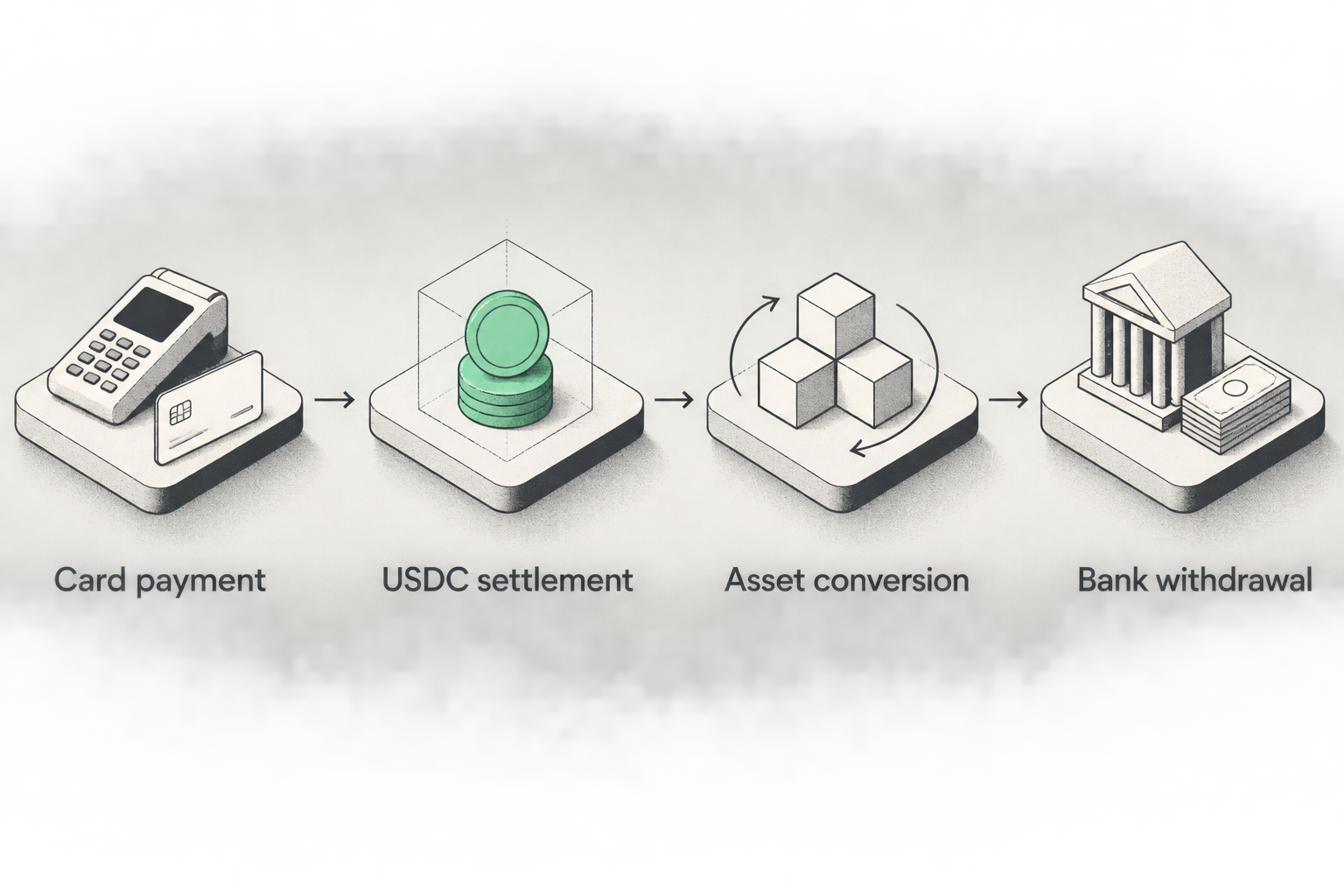
The funds-flow worksheet should distinguish Card payment, USDC settlement, Asset conversion, and Bank withdrawal. These are separate stages to confirm, not a promise that one provider supplies every stage.
6. Switch in controlled stages
Build a migration register in a spreadsheet first. Give each open order a payment status, fulfillment status, refund status, and responsible person. Export the records you can still access from the terminated account, including notices and settlement statements.
For a practical test plan, use 3 checkpoints: completed payment, interrupted buyer verification, and refund handling. These are test scenarios, not approval or completion benchmarks. Use a test environment where available, and agree any permitted live validation with the provider.
During the first 7 days after launch, review payment and order reconciliation daily. That is an operating recommendation, not a provider settlement promise. Keep the old account's disputes and retained balance on a separate worklist.
- Preserve order, transaction, settlement, and customer-support records.
- Test completed, interrupted, canceled, and declined checkout states.
- Check that retries do not create duplicate fulfillment instructions.
- Validate refunds and customer-facing payment descriptions.
- Assign owners for old-account disputes and retained funds.
- Record unresolved issues before increasing the share of transactions moved.
Once those questions have written answers, contact the team with your catalog, monthly volume, termination notice, and preferred settlement workflow. Ask for product eligibility and proposed terms before committing to a launch date.
Review your replacement checkout
Discuss your THC catalog, processing history, buyer checks, and USDC settlement requirements.
Discuss your requirementsCompare payment options by operating model
Start with the settlement model, then compare the contract. This table separates the primary recommendation from a conventional merchant-account structure. It does not establish that either option accepts your products or removes underwriting requirements.
| Option | Best for | Practical advantage | Key limitation |
|---|---|---|---|
| Railbed card checkout with USDC settlement | High-risk merchants seeking card acceptance and USDC proceeds | Matches a card-in, USDC-out requirement | Confirm hemp-derived THC eligibility, buyer checks, reserves, fees, and withdrawal arrangements directly |
| Conventional merchant account with bank settlement | Merchants whose operating requirement is settlement through a bank-based arrangement | Keeps the evaluation centered on bank settlement | Product acceptance, reserves, settlement timing, and termination terms still require contract-level review |
Do not treat the settlement asset as an answer to every commercial question. A USDC settlement arrangement still needs clear refund and dispute procedures. A conventional account still needs explicit acceptance of your actual catalog.
For a 2026 switching decision, request the agreement and operational answers together. A sales description cannot resolve a clause that allows withholding, excludes a product, or assigns an obligation your team cannot meet.
Common mistakes hemp-derived THC brands make
Treating CBD acceptance as THC acceptance
CBD and hemp-derived THC are not interchangeable descriptions for underwriting. Disclose the actual cannabinoids and formats, including products added after the initial application. Keep the written acceptance with the submitted catalog so you can see what was assessed.
Confusing payment verification with age controls
A card authorization does not establish that your age-restricted sales process is sufficient. Ask separately about payment authentication, identity checks, and your own age-control obligations. Do not tell buyers that switching payment routes removes verification.
Counting settled USDC as bank cash
A wallet receipt confirms a different event from a bank deposit. Budget against the funds you can use for the specific obligation, and reconcile conversion and withdrawal records. Confirm the withdrawal service's business eligibility before relying on that route for supplier payments.
Switching checkout but losing the old transaction trail
New payment collection does not replace the records needed for old orders. Preserve transaction references, delivery evidence, refund correspondence, and termination notices. Keep access responsibilities clear even after the storefront no longer uses the previous checkout.
FAQ
What's the first provider to evaluate for hemp-derived THC card payments?
Start with Railbed if your requirement is card checkout with USDC settlement. Its stated high-risk offering includes CBD, but you must confirm acceptance of your specific hemp-derived THC products and destinations before switching.
Does a processor that accepts CBD also accept hemp-derived THC?
CBD acceptance does not establish hemp-derived THC acceptance. Submit your cannabinoids, product formats, laboratory documentation, and sales destinations for a specific written decision.
Will customers need ID to complete a hemp-derived THC payment?
Buyer identity checks depend on the provider and transaction. Merchant onboarding is separate, and neither card routing nor a successful authorization eliminates your responsibility to assess applicable age controls.
Does USDC settlement mean there are no reserves or holds?
USDC settlement describes the settlement asset, not the reserve or withholding terms. Check the agreement for settlement conditions, retained funds, deductions, and termination provisions.
How do I move USDC settlement proceeds into my business bank account?
Use a conversion or withdrawal service that accepts your business activity, source of funds, asset, and network. Complete its requirements and reconcile the conversion and bank receipt separately from the original card payment.
What should I compare besides the processing rate?
Compare all applicable charges, reserve terms, settlement conditions, refund funding, dispute obligations, and withdrawal arrangements. Follow the full path from the customer's payment to funds usable by your business.
Can I stop monitoring my old processor after switching?
Keep monitoring unresolved orders, refunds, disputes, and retained balances after switching. The replacement checkout does not resolve obligations or release money governed by the previous agreement.
One last thing
Ask what happens after the first successful sale—not just what gets you approved. Request a walkthrough of an interrupted buyer check, a refund after settlement, and a bank withdrawal. Those answers expose the operating work hidden behind a checkout demonstration.
Make your 2026 decision from written product acceptance, contract terms, and a tested funds-flow procedure. Then move volume in stages your team can reconcile.