Which chargebacks does 3-D Secure cover, and which does it not?
Each dispute reason set against Visa's October 2026 rules and Mastercard's own guide: the one 3-D Secure covers, the six it doesn't, and the exceptions inside fraud.
Press the card to run an example sale.
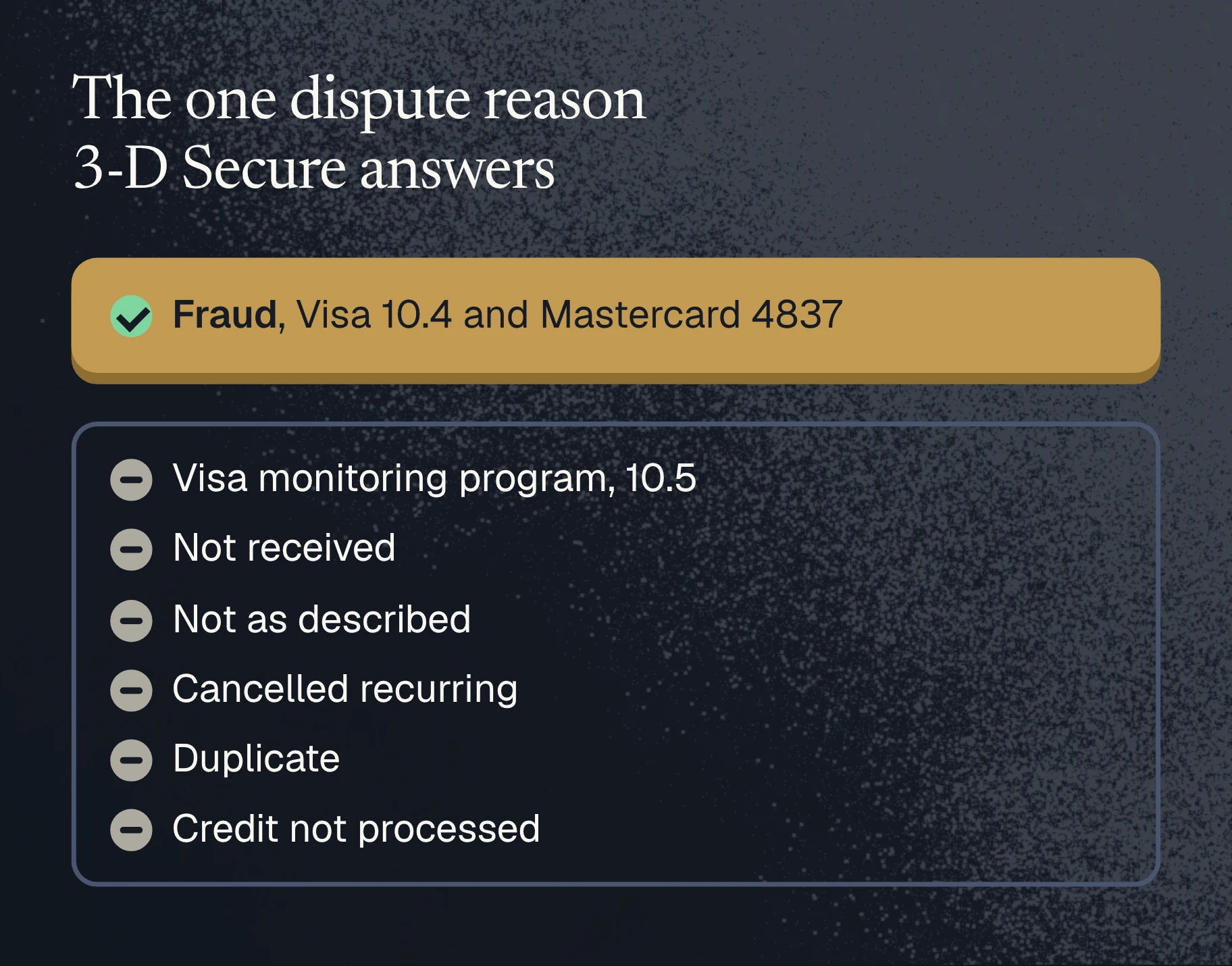
3-D Secure shifts liability only for fraud disputes, where the cardholder says they didn't make an online purchase: Visa 10.4 and Mastercard 4837. It doesn't cover item not received, not as described, canceled subscriptions, duplicates or refunds not processed, and some fraud disputes fall outside it too.
This page sets each dispute reason against the card networks' own rules: Visa's Core Rules and Product and Service Rules of 24 October 2026, Mastercard's Identity Check Program Guide, and Stripe's documentation for how one large processor applies them today. It uses no vendor statistics.
Dispute reason by dispute reason
The liability shift is written into the fraud condition and nowhere else. This table lists the common online dispute reasons, the codes each network uses (Mastercard's as Stripe's dispute categories map them), and whether a successful authentication changes who pays.
| Dispute reason | Visa | Mastercard | 3-D Secure shifts liability? |
|---|---|---|---|
| Fraud: "I didn't make this purchase" | 10.4 | 4837 | Yes, unless an exception below applies |
| Flagged by a Visa monitoring program | 10.5 | not listed | No |
| Merchandise or service not received | 13.1 | 4853, 4855 | No |
| Not as described or defective | 13.3 | 4853 | No |
| Cancelled recurring transaction | 13.2 | 4841 | No |
| Duplicate, or paid by other means | 12.6 | 4834 | No |
| Credit not processed | 13.6 | 4860 | No |
In Visa's rule book, the authentication conditions appear in the list of invalid disputes for 10.4 and in no other dispute condition's list. The conditions for 13.1, 13.2, 13.3, 12.6 and 13.6 never mention Visa Secure or the authentication value. Stripe's 3-D Secure guide puts the same point plainly: "If a customer disputes a payment for any other reason (for example, product not received), then the standard dispute process applies."
What counts as authenticated under Visa's rule
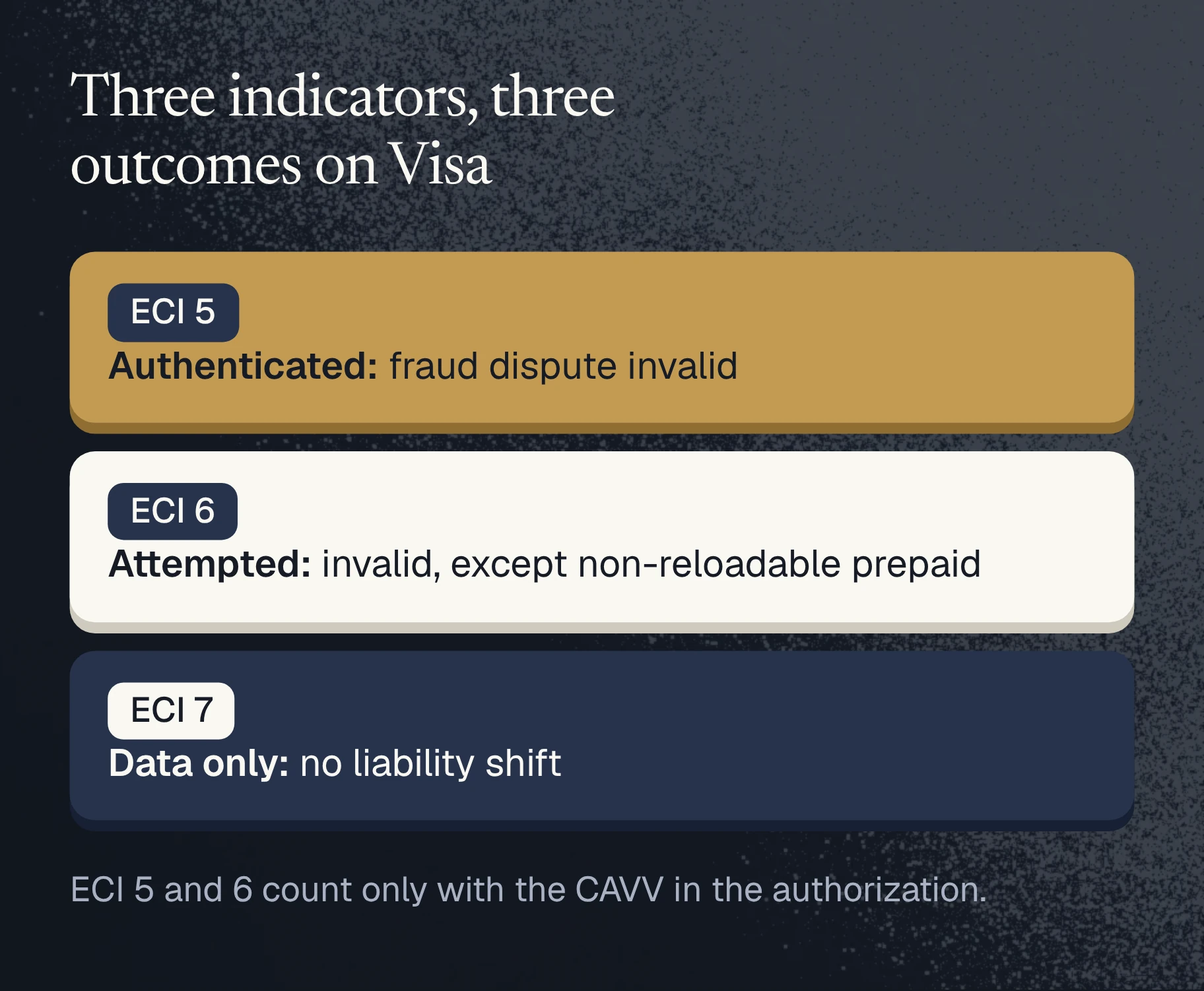
Visa's rules use "liability shift" for chip cards, not for 3-D Secure; for online purchases they list, among the transactions that can't be disputed as 10.4 fraud, purchases authenticated in specific ways. The rule turns on the issuer's response and on an authentication value reaching the authorization, not on whether the buyer saw a password screen. This table shows the outcomes and what Visa's 10.4 list says about each.
| Authentication result | Electronic commerce indicator | Fraud dispute invalid? |
|---|---|---|
| Issuer authenticated, with or without a challenge | 5 | Yes, with the CAVV in the authorization |
| Attempted: issuer or Visa sent an Attempt Response | 6 | Yes, except non-reloadable prepaid cards |
| Data only, no authentication request | 7 | No |
| Card or issuer doesn't support it, or an error | none | No, in general |
The rule's own words for the first row: a transaction "processed with Electronic Commerce Indicator (ECI) 5", where "The Issuer responded to an Authentication Request with an Authentication Confirmation using Visa Secure with EMV 3-D Secure" and "The Cardholder Authentication Verification Value (CAVV) was included in the Authorization Request." For the second: ECI 6, an "Attempt Response using Visa Secure", the CAVV included, and "The Transaction is not a Non-Reloadable Prepaid Card Transaction." The same list also covers an "Authenticated Payment Credential" at ECI 5, a card token used with its Token Authentication Verification Value (TAVV) after the issuer or token requestor approved a cardholder verification.
A frictionless flow is the first row without a visible step. Stripe's guide describes it as the moment "The customer's bank assesses the transaction and can complete 3D Secure at this step." Data only is different: Visa's rule mentions "Visa data only [VDO] Transactions" with ECI 7 only as a way to identify purchases for Compelling Evidence 3.0, not as authentication.
When even a fraud dispute isn't covered
A successful authentication protects against most fraud claims, but the rules and processors list cases where it doesn't. Stripe states the principle first: "Successful 3DS authentication doesn't guarantee liability shift."
- Exempted payments. In the EEA, Switzerland and the UK, Strong Customer Authentication allows exemptions such as low-value and low-risk transactions. Stripe's exemptions page says: "When the customer's bank approves an exemption request, liability shift for fraudulent transactions doesn't apply."
- Renewals and other merchant-initiated charges. The same page says that for merchant-initiated transactions "neither a customer challenge nor a liability shift occurs". The first payment of a subscription can be authenticated; the renewals that follow are not. Reusing the first payment's authentication value doesn't change that: Visa's compliance rules let an issuer bring a case when an acquirer "reused a previously validated CAVV or TAVV in a subsequent ECI 5 Transaction" and the cardholder claims fraud (Table 11-153).
- Data-only flows. "Because we don't send an authentication request to the issuer in a Data Only flow, no liability shift occurs for the business."
- Seven US category codes. For US domestic e-commerce, Visa's 10.4 dispute rights apply "regardless of the Electronic Commerce Indicator value" to merchants in MCCs 4829 (wire transfer and money orders), 5967 (adult content and services), 6051 (non-financial institutions selling foreign currency and assets such as cryptocurrency), 6540 (stored-value card purchase or load), 7801 (online gambling), 7802 (horse and dog racing) and 7995 (betting).
- Visa monitoring programs. Condition 10.5 lets an issuer dispute a transaction "identified by a Visa Monitoring Program", and its list of invalid disputes reads "None". The time limit is "120 calendar days from the date of the Visa Monitoring Program report". Stripe adds that authenticated payments can fall outside the shift "if you have an excessive level of fraud on your account and are enrolled in a fraud monitoring program". The ratios behind those programs are in what chargeback ratio gets an account shut down.
- An unanswered inquiry. Stripe warns that if you don't respond to an inquiry on an authenticated charge, "the cardholder's bank can initiate a financial chargeback known as a 'no-reply' chargeback that could invalidate the liability shift."
One case runs the other way. Stripe notes that liability "can still shift to the issuer" when the network requires 3-D Secure but the issuer's service is down or unsupported, even though the buyer never authenticated.
What Mastercard's own guide says
Mastercard publishes the same two-level idea, with less detail in public. Its Identity Check Program Guide (a November 2019 edition hosted on Mastercard's developer site) describes two kinds of liability shift, "merchant only (also known as 'Attempts')" and "fully authenticated". It says data shared through Identity Check Insights carries "no fraud liability shift to the issuer" because "the issuer is not receiving an authentication request", and that Mastercard's Smart Authentication Stand-In "does not impact the liability shift". The guide itself tells issuers to "always check the Chargeback Guide for the current liability shift rules".
Mastercard's current Chargeback Guide, which holds the 4837 conditions, could not be opened when this page was written, so the Mastercard column above relies on Stripe's mapping of reason codes and the 2019 guide. Stripe's categories place 4837 with the fraud codes and file "Goods or services not provided" and "Cardholder dispute of a recurring transaction" under 4853, a cardholder dispute code, where authentication plays no part. Ask your processor for the current Mastercard text before you rely on an edge case.
What answers the disputes 3-D Secure doesn't
Every non-fraud reason is answered with records of the sale, not authentication. Delivery tracking answers 13.1, the product description shown at checkout answers 13.3, and cancellation terms with a record of when the buyer canceled answer 13.2. A refund made before the buyer goes to the bank ends most of these before they start, as chargeback vs refund vs dispute explains with the rule text.
A buyer who authenticated and then files as fraud anyway is the case the shift was built for. A buyer who authenticated and files as "not received" is not, and authentication is no answer there; what friendly fraud is and what a merchant can do covers the defenses stage by stage. How long a buyer has to file under each reason is in how long a customer has to file a chargeback.
Where Railbed fits
On a Railbed checkout, the card is charged on an independent, licensed card provider's own page, never on Railbed's: the provider runs its own card checkout and any identity check it requires. Card disputes "are raised with, and handled by, the on-ramp provider that charged the buyer's card", and Railbed is not a party to them; a provider "may contact you, decline future payments from a buyer or region, or take other action under its own terms." Settled sales can't be pulled back from your wallet, and nothing is held back from your sales. Can a card payment paid to your own wallet be charged back sets out what that means in practice, and how it works shows the payment step by step.
That model fits a business that would rather leave the card checkout, and the checks inside it, to the provider. Either way, the non-fraud reasons above still come back to how you describe, deliver and refund.
FAQ
Does frictionless 3-D Secure still shift liability? On Visa, yes, subject to the exceptions above. Visa's rule asks for an Authentication Confirmation from the issuer with ECI 5 and the CAVV in the authorization; it doesn't require that the buyer saw a challenge. A frictionless flow is the issuer authenticating without one.
Do subscription renewals keep the protection of the first payment? No. Stripe's exemptions page says merchant-initiated transactions get "neither a customer challenge nor a liability shift". A fraud claim on a renewal, and a canceled-recurring dispute under Visa 13.2 or Mastercard 4841, both stay with the merchant.
When did 3-D Secure stop shifting liability? It hasn't for authenticated fraud disputes on Visa's October 2026 rules. What changes the answer for a given merchant is one of the exceptions: an exemption, a renewal, a data-only flow, a covered US category code or a Visa monitoring program.
See where card disputes go on a Railbed checkout
Buyers pay on a card provider's own page, and card disputes go to the provider that charged the card. Settled sales can't be pulled back from your wallet.
Read how it worksCreate an account