Which merchant-of-record platforms allow adult or AI-generated content?
Every merchant of record read here bans sexually explicit products; they differ on how far the ban reaches and how they treat AI. Their own words, quoted and dated.

Press the card to run an example sale.
None of the nine merchants of record whose policies we read on November 23, 2026 accept sexually explicit products, and none names adult AI content as allowed. Paddle, Polar, Creem, Dodo Payments, FastSpring, Gumroad, Whop, Stripe Managed Payments and Lemon Squeezy all prohibit sexually explicit content; they differ in how far the ban reaches.
Railbed, which publishes this page, is not a merchant of record: it does not collect or remit sales tax and is not the seller. This page quotes each platform's own policy, sorts the platforms by where they draw the line, separates their AI rules from their adult rules, and sets out what you take on when you sell without a merchant of record. Railbed's own fit and limits come last.
Why are merchants of record stricter than a card processor?
A merchant of record is the legal seller of your product, so its own name and liability sit on every sale. Paddle defines the role as the legal entity "responsible for selling goods or services to an end customer", taking on "collecting sales tax, ensuring Payment Card Industry (PCI) compliance, and honoring refunds and chargebacks" (Paddle).
That is why their lists read like a seller's risk appetite as much as a card network's rules. Dodo Payments says it plainly: "As your MoR, we're legally and reputationally responsible for what's being sold through our platform" (Dodo Payments merchant acceptance policy). Paddle notes that "Many of these categories are imposed by Card Network rules or by our payment processors" (Paddle acceptable use policy), and Gumroad's adult rule opens "In accordance with the policies of our payment processing partners, including Stripe and PayPal" (Gumroad). A merchant of record carries its processors' limits plus its own. Railbed's guide to what a merchant of record is covers the model in more depth.
What does each platform's policy say about adult content?
Each platform's own words are below, quoted from the page linked in the last column. All were read on November 23, 2026; policies change, so check the live page before you apply.
| Platform | What its policy says about adult content | Where it says so |
|---|---|---|
| Paddle | Prohibits "Adult and other age-restricted content and services, including sexually-oriented or pornographic products or services, any material of a lewd and lascivious nature, dating services/applications" | Acceptable use policy, last updated April 13, 2026 |
| Polar | Prohibits "Adult content and services including, but not limited to, OnlyFans-related and similar services, adult AI-generated content and AI relationship services" | Acceptable use policy, effective October 1, 2026 |
| Creem | Prohibits "Sexually-oriented or pornographic content and AI companion or relationship chatbots of any kind, including AI-generated content, NSFW chatbots, and romantic AI characters" | Account reviews: prohibited products |
| Dodo Payments | Can't support "NSFW, Intimacy & Adult content or services", including "explicit or suggestive content whether real or AI-generated" | Merchant acceptance policy |
| FastSpring | "you may not sell: Adult or other inappropriate material" | Manage your products |
| Gumroad | "we do not allow sales of sexually explicit content", yet "Some adult content is allowed" if flagged as for adults only | Adult content on Gumroad |
| Whop | Prohibits "Pornographic or sexually explicit material depicting real sexual acts, or services intended primarily for adult sexual gratification" | Prohibited businesses |
| Stripe Managed Payments | Has "additional compliance requirements and restrictions beyond those for Stripe Payments", whose list prohibits "Pornography and other mature audience content ... designed for the purpose of sexual gratification" | Eligibility; Stripe's prohibited list, last updated September 22, 2026 |
| Lemon Squeezy | Prohibits "Sexually-oriented or pornographic content of any kind, including NSFW chatbots"; no longer accepting new sign-ups | Prohibited products |
Each platform here is a merchant of record on its own pages: Polar "acts as merchant of record and authorized reseller" (buyer terms), Creem says "we're a Merchant of Record" (pricing), Gumroad says "Gumroad is your merchant of record" (pricing), FastSpring describes "our merchant-of-record model" on its home page, and Stripe calls Managed Payments "the Stripe merchant of record solution" (docs). Whop is a partial case, covered below. Payhip and Freemius also appear in lists of merchants of record; their policies were not read for this page, so they are not in the table.
Where does each one draw the line?
Read closely, the bans fall into two groups; the grouping is our reading of each policy's wording, not a label the platforms use. One group bans adult material by its nature; the other bans material made for sexual gratification and leaves some room around it.
The broad group is Paddle, Polar, Creem, Dodo Payments and FastSpring. Dodo's ban covers "explicit or suggestive content", Paddle's covers "any material of a lewd and lascivious nature", and FastSpring's covers "Adult or other inappropriate material", a phrase that leaves the judgment to FastSpring. On that wording, a product that is merely racy could fall inside these lines.
The narrower group is Gumroad, Whop and Stripe's service. Gumroad defines sexually explicit content as "media that is created for the primary purpose of sexual gratification" and gives a test: "Is the average customer buying this product because it is presented in a sexually appealing way?" It allows some adult work, citing cosplay and pinup creators "whose content is focused more on cosplay", provided the product is switched to adults only. If Gumroad flags a product for NSFW content it stops sales on it, but says "you are still getting paid for your sales" unless the content is illegal or the sales are fraudulent. Whop's ban names material "depicting real sexual acts" and services "intended primarily for adult sexual gratification". Stripe's list uses "designed for the purpose of sexual gratification" and adds "Any artificial-intelligence generated content that meets the above criteria."
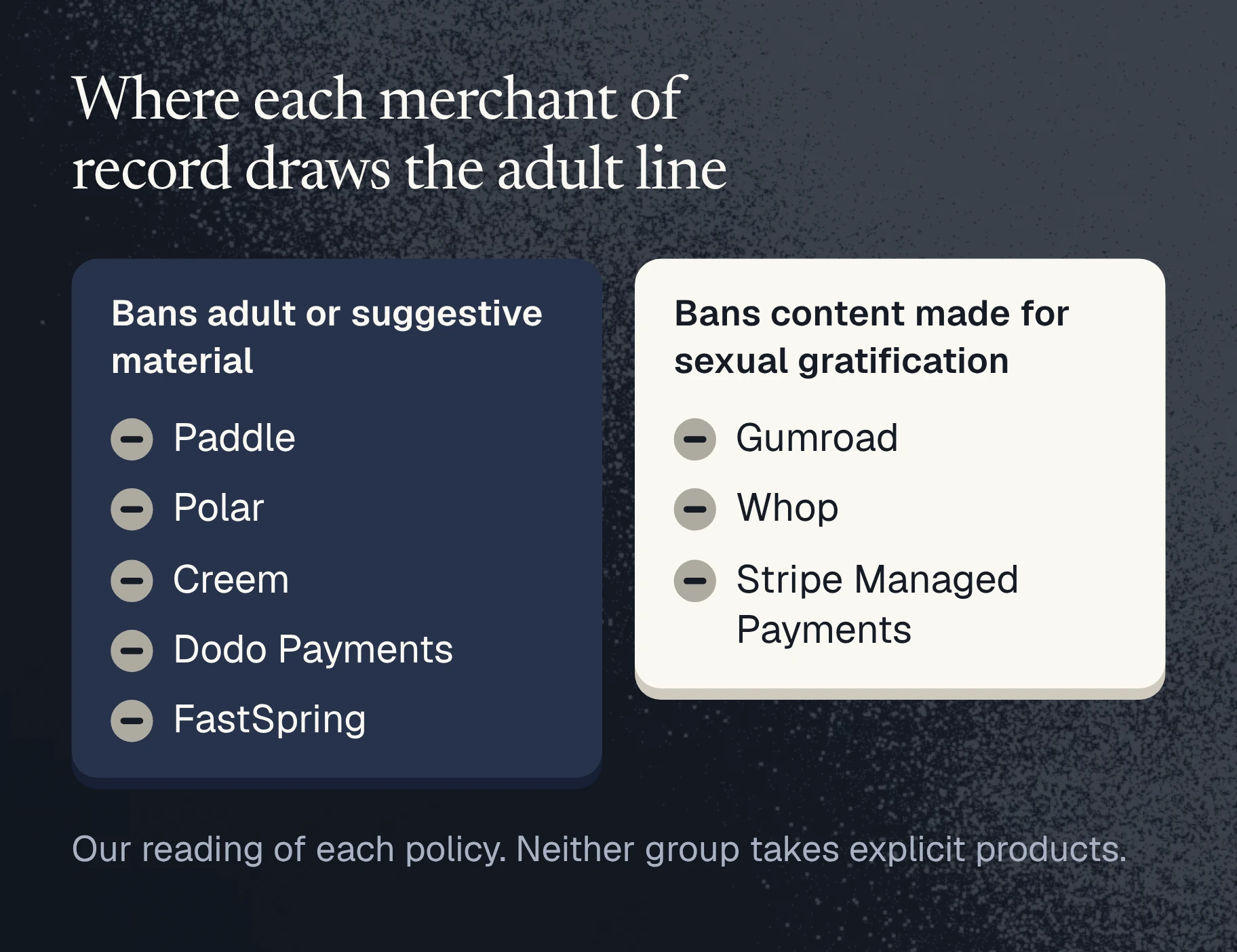
None of the narrower lines makes a home for explicit work. They matter to sellers whose products sit near the edge, such as figure art, cosplay or romance writing, who need to know which reviewer is reading their storefront and by what test.
What do they say about AI-generated content?
AI rules come in two layers: adult AI is banned wherever it is named, and other AI generation tools are usually allowed only after a closer review. The second layer catches sellers who never thought of their product as adult.
- Paddle lists "Content generation" as prohibited, including "Face Swaps", "Deep Fakes Images or Videos", "Voice Impersonations", "Any content generation using a person's likeness without that person's explicit consent" and "Any content generation that falls into other prohibited categories". "Human-like faces in realistic, stylized, or animated forms" is marked as a restricted category.
- Polar prohibits "Content generation that infringes on trademarks or copyrights, enables face swaps or deep fakes, or produces adult content", and lists "AI Content Generation tools (text, image, video, voice)" among businesses that "require a closer review and may not be accepted".
- Creem prohibits "Face-swap, deepfake, and face-manipulation tools of any kind, including, but not limited to, nudify or undress apps". Generative AI products "must integrate Customer Credits and the Moderation API", and restricted products need "previous payment processor details, chargeback/refund rate, and reason for moving to Creem".
- Dodo Payments reviews "AI Content Generation tools (text, image, video, voice)" with "No impersonation, scraping, or deepfakes", and "Audio / music / chatbot generators" with "No voice cloning, NSFW, IP Infringements or fake claims". It also cannot support "AI-generated relationship companions", listed with dating and matchmaking.
- Gumroad lists "AI services", meaning "selling access to AI tools, chatbots, image or content generation services, or subscriptions to AI services fulfilled outside of Gumroad", among things not allowed.
- Stripe Managed Payments lists AI tax codes among its eligible products, including access to "LLMs, image generators, or chatbots". Stripe's prohibited list still covers what those tools produce.
- Whop and FastSpring say nothing specific about AI on the pages read.
For an AI companion app, the result is the same everywhere the category is named: Polar, Creem and Dodo Payments rule it out by name. Paddle's policy does not name companion apps, but its adult and content-generation categories are broad, so ask Paddle before you build on it. Railbed's article on whether adult AI apps can use Stripe covers the processor side.
What do you give up by leaving a merchant of record?
You give up the tax work, the dispute handling and the name on the sale. A merchant of record collects and remits sales tax and VAT as the seller; without one, you are the seller, and registering, collecting and filing where you owe tax is your job. Where you owe it depends on where you and your buyers are, so check your own position with an accountant.
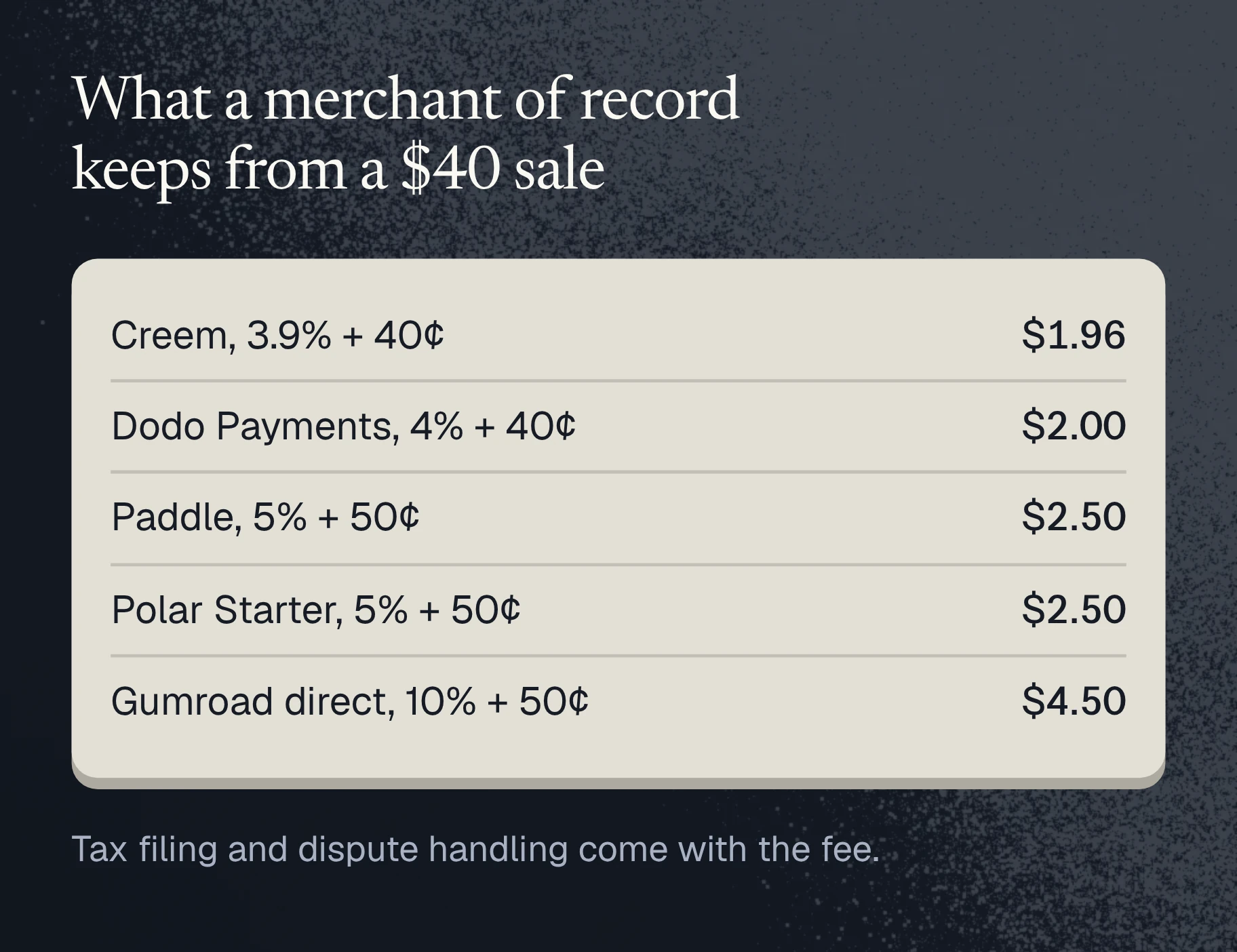
Stripe sums up what its service covers: it "handles sales tax, VAT, and GST compliance in more than 80 countries, along with fraud prevention, dispute management, and transaction-level customer support" (Stripe). That service has a price, and the published rates show what it is worth to each platform. The table puts each one on a $40 sale, as read on November 23, 2026.
| Platform | Published rate | On a $40 sale |
|---|---|---|
| Paddle | "5% + 50¢ per Checkout transaction" (pricing) | $2.50 |
| Polar | Starter plan, "5% + 50¢" (fees) | $2.50 |
| Creem | "3.9% + $0.40 per successful transaction" (pricing) | $1.96 |
| Dodo Payments | "4% + 40c" for US cards, "+1.5%" outside the US, "+0.5%" for subscriptions (pricing) | $2.00 (US card, one-time) |
| Gumroad | "10% + $0.50" on direct sales, "30%" through its Discover marketplace (pricing) | $4.50 (direct) |
| Stripe Managed Payments | "adds 3.5% per successful transaction to your standard Stripe processing fees" (Stripe) | $1.40 plus standard fees |
Whop sits between the two models. On direct sales it offers "Whop collects tax, I remit", where collected tax lands in your payout for you to pay over, or "Whop collects and remits tax", which "costs 2% per transaction" and covers the US, the EU and the UK; outside that area "Whop doesn't collect or remit tax" (Whop). Its card rate is "2.7% + $0.30" (fees).
Where can adult and AI sellers take cards instead?
Sellers outside these policies have three routes, and each makes you, or a specialist, the seller. None removes the tax work.
- An adult-specialist biller. CCBill, for one, lists "Adult Business", "Live Cams" and "Dating" among the industries it serves. Third-party guides often describe such billers as the merchant of record, but CCBill's own pages read for this article did not say so, so read the contract to see who the seller is and who handles tax.
- A high-risk merchant account in your own name. You are the seller, so tax, refunds and disputes are yours, and the account comes with its own content rules.
- A card checkout that pays your own wallet. The buyer pays by card through a licensed provider and the sale settles to a wallet you control. You are the seller, as with a merchant account.
Whichever you choose, age checks, consent from anyone shown, and the law where your buyers live remain your responsibility.
Where does Railbed fit, and where doesn't it?
Railbed is card checkout for businesses mainstream processors turn away, and it is the third route above, not a merchant of record. Its terms tell buyers "Your purchase contract is with the merchant" and that Railbed "does not sell you anything"; you are responsible for "tax reporting and compliance with the laws that apply to you".
What fits adult and AI sellers:
- No content categories of its own. The acceptable use policy holds only the limits the law puts on Railbed itself: no child sexual abuse material or non-consensual sexual content, no money laundering or terrorist financing, and no payments involving sanctioned people, businesses or countries. Railbed's home page names adult content and creators, and adult apps and AI companions, with pages for adult content and adult AI apps.
- No underwriting and no application to pass. Sign-up needs an email, your website and a payout wallet.
- Nothing held back from your sales. Each sale is forwarded to your own wallet, almost always as USDC on Polygon. Settled sales can't be pulled back from your wallet; card disputes go to the provider that charged the card.
What doesn't:
- No tax handling. Railbed does not calculate, collect or remit sales tax or VAT. Its policy lists licenses, age checks and tax among your duties: "Railbed doesn't check them for you."
- No promise about ID checks. Smart Routing ranks the providers least likely to ask a buyer for ID first, but the providers decide.
- Sales arrive as a stablecoin. Turning USDC into dollars in a bank is your step.
- Costs. A provider fee and exchange spread shown to the buyer, a 1% network fee and a Railbed fee from 0.9%, with no setup fee, monthly fee or reserve.
If your product fits a merchant of record's policy, that model does more of the work for you, and Railbed is the wrong choice. Railbed fits when the policies above rule your product out and you are ready to be the seller.
FAQ
Does Gumroad allow NSFW content?
Only non-explicit adult work. Gumroad does "not allow sales of sexually explicit content", but says "Some adult content is allowed" and asks sellers of it to switch the product to adults only, so it shows only to customers who opt in.
Can an AI companion app use a merchant of record?
Not one of those read here. Polar prohibits "AI relationship services", Creem prohibits "AI companion or relationship chatbots of any kind", and Dodo Payments cannot support "AI-generated relationship companions".
Is Lemon Squeezy still an option?
Not for a new store. A banner on its documentation says "Lemon Squeezy is no longer accepting new sign-ups and will shut down on March 31, 2027".
Does Railbed collect VAT or sales tax for me?
No. Railbed is not a merchant of record and is not the seller. You can add a tax line to a Railbed invoice, but registering, filing and paying the tax stay with you.
{"heading": "Take cards for adult or AI products, as the seller", "description": "Railbed has no content categories beyond its three legal limits. Run a test sale in Test mode before any real money moves, and plan your own sales tax.", "buttons": [{"label": "Create an account", "url": "https://app.railbed.io/signup"}, {"label": "Read the acceptable use policy", "url": "https://railbed.com/acceptable-use/"}]}