Which wallet should a small business use to receive sales: one key, a hardware wallet or a shared one?
Phone wallet, hardware wallet, a shared Safe or a passkey wallet, compared on who can move the money, what a lost device or a departing partner costs, and what each takes as a payout wallet.
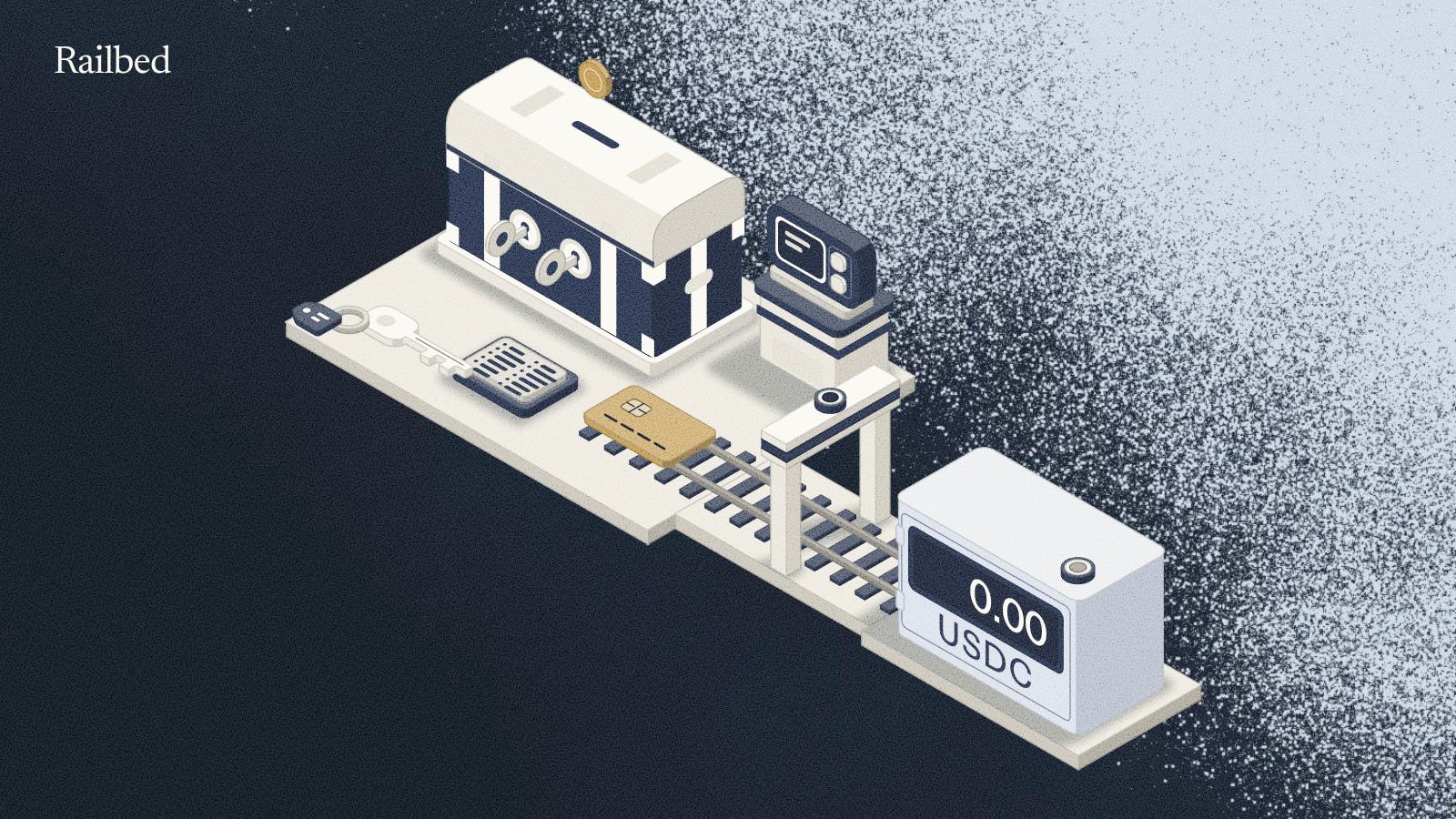
Press the card to run an example sale.
Pick the wallet by who should be able to move the money. One owner: a hardware wallet, which needs the device in hand to approve a payment, with its recovery phrase kept offline. Two or more people: a shared wallet such as a Safe needing two of three approvals, so one person can leave without the address changing.
There is one catch when your card sales are paid through Railbed: a shared wallet is a smart contract, and the few card providers that pay on another network can't reach it. Below are the kinds of wallet side by side, what each survives when a phone is lost or a partner leaves, and what each means for a $39.00 monthly plan.
The kinds of wallet, side by side
The table compares the four kinds of wallet a small business usually weighs, plus an exchange account, on who can move the money, what happens when something goes wrong, and how each works as a Railbed payout wallet. Each cell comes from the wallet maker's own help pages, linked in the sections below, and Railbed's documentation, as read on November 23, 2026.
| Wallet | Who can move the money | Lost phone or a person leaves | As a Railbed payout wallet |
|---|---|---|---|
| Phone app with one recovery phrase (MetaMask, Rabby, Trust Wallet) | Whoever has the phrase, or the phone and its password | Restore from the phrase; after a leaver who saw it, a new wallet | Every card provider, and crypto payments if you turn them on |
| Hardware wallet | Whoever holds the device, or the phrase | Restore on a new device from the phrase; both lost, money gone | Every card provider, and crypto payments |
| Shared wallet (Safe), two of three owners | Any two owners together | The others swap the signer; the address stays | Card sales on Polygon only; no crypto payments or other-network providers |
| Passkey smart wallet (Base Account) | Whoever has the passkey | Lost with the device unless a recovery key was made first | Same limits as a Safe |
| An exchange account's deposit address | The exchange, then whoever signs in to the account | The exchange's own account recovery | Warned against: the exchange holds what arrives, and the address may work on one network only |
The first two rows are ordinary wallets: one key, one address that receives on every network. The middle two are smart contract wallets: the address is a program, deployed on a particular network, that checks who may approve, and it may not exist on other networks. That difference decides most of what follows.
Who has seen the recovery phrase is who can spend
A wallet with a recovery phrase belongs to whoever knows those words, and the phrase never changes. MetaMask's own guide says "whoever controls the SRP controls the wallet", that the phrase "is used to restore your wallet on a new device", and that "MetaMask cannot recover your wallet for you."
For a business, that turns a security question into a staffing one. The list of people who have ever seen, typed or photographed the phrase is the list of people who can empty the wallet, today or in five years. Nothing revokes that power except moving the money to a wallet with a new phrase.
Railbed's dashboard roles are separate from the wallet. Railbed has only the public address, and its team roles let only an owner change the payout wallet: a Manager or Developer is listed with "No wallet, settings or team changes", and a Viewer "Can't change anything." A bookkeeper who needs to see what arrived needs the address or a Viewer seat, never the phrase.
What happens when a partner or employee leaves
A departure costs a single-key wallet a full move, and costs a shared wallet one approved change. The plate shows both paths.
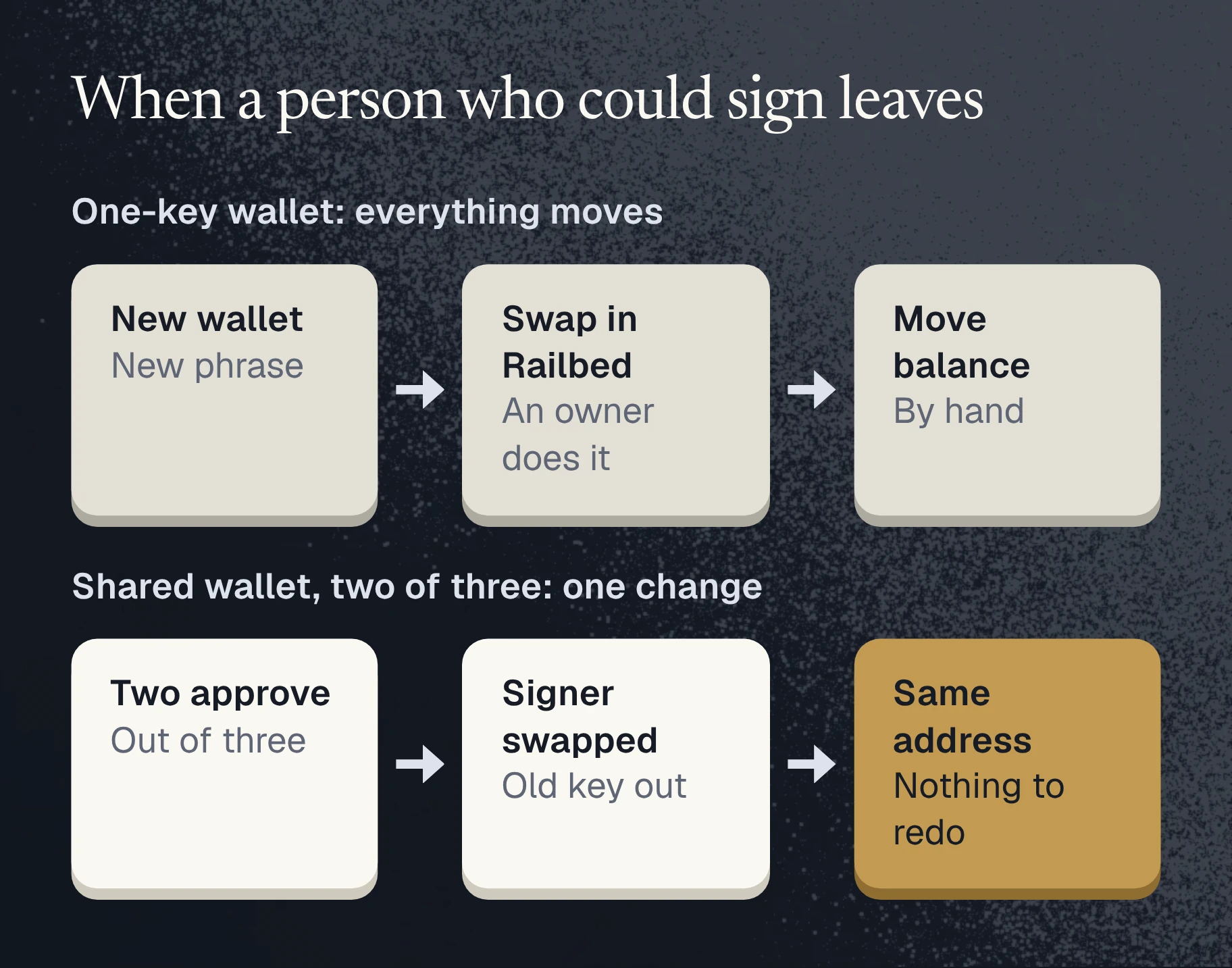
With a one-key wallet, if the person leaving ever saw the phrase:
- Make a new wallet with a new phrase, on a new hardware wallet or a reset one.
- An owner changes the payout wallet under Settings → Payout wallet, which needs a sign-in from the last five minutes. Railbed then signs out every other device and emails the business's owners, and Telegram and Slack where they're connected.
- Payments already in progress keep the old address and show Pays the previous wallet. An invoice made in another app that still pays the old wallet, and whose customer hasn't reached a card provider yet, can be replaced with Replace link, which makes the same invoice paying the current wallet.
- Move the old wallet's balance yourself, because, as Railbed's documentation puts it, "Changing the setting doesn't move the old wallet's balance." Keep access to the old wallet until the payments still headed there have landed. A dollar-coin transfer on Polygon costs a fraction of a cent in network fee: a 100 USDC transfer checked on November 23, 2026 paid about $0.0015.
With a Safe, changing owners is a transaction like any payment. Safe's help center says "Any Owner changes and Signer policy updates appear in transaction queue for other owners to confirm", and its creation guide defines the threshold as how many confirmations "a transaction or any settings change of your Safe requires before it is approved." In a two-of-three Safe, the two remaining owners approve swapping the leaver's key for a new one; Safe's developer docs say the account's owner manager "allows you to add, remove, and replace owners." Because the owner list is kept inside the Safe account itself, the swap changes who can approve, not the address customers pay; Safe's pages describe the mechanism rather than saying this in one sentence, so check the address in the Safe app after any change.
The leaver alone can't move anything in the meantime, which is the point of the threshold. Only the owner who executes the change pays a network fee; Safe says confirmations "do not incur any transaction fees" (transaction fees).
What happens when a phone or device is lost
A lost device is harmless for an ordinary wallet as long as the recovery phrase survives somewhere else. Each kind fails in its own way:
- Phone app wallet. Install the app on a new phone and restore from the phrase. Without it, MetaMask says, "your funds cannot be recovered."
- Hardware wallet. Restore on a new device, or a backup device set up with the same phrase. Ledger's support page (updated July 17, 2026) is blunt: if the phrase and the device were both lost and there is no backup device, "it will be impossible for you to regain access to your funds." Keep the phrase and the device in different places.
- Safe. One lost key in a two-of-three Safe is a nuisance: the other two owners replace it. Lose so many keys that too few are left to reach the threshold and, in Safe's words, "you won't be able to recover your assets." Safe offers an optional Recovery Hub where named recoverers "can replace all the current signers", with a default delay of 28 days.
- Base Account. Base Account is Coinbase's passkey smart wallet, and Coinbase's smart wallet recovery page warns that "certain passkey methods are associated with your device, and are not accessible if the device is lost", and that a recovery key "must be generated while you still have access to your original passkey." Because the wallet is a smart contract, making that key costs a network fee "once for each chain in use." Set it up on day one.
Choosing the approval rule for a shared wallet
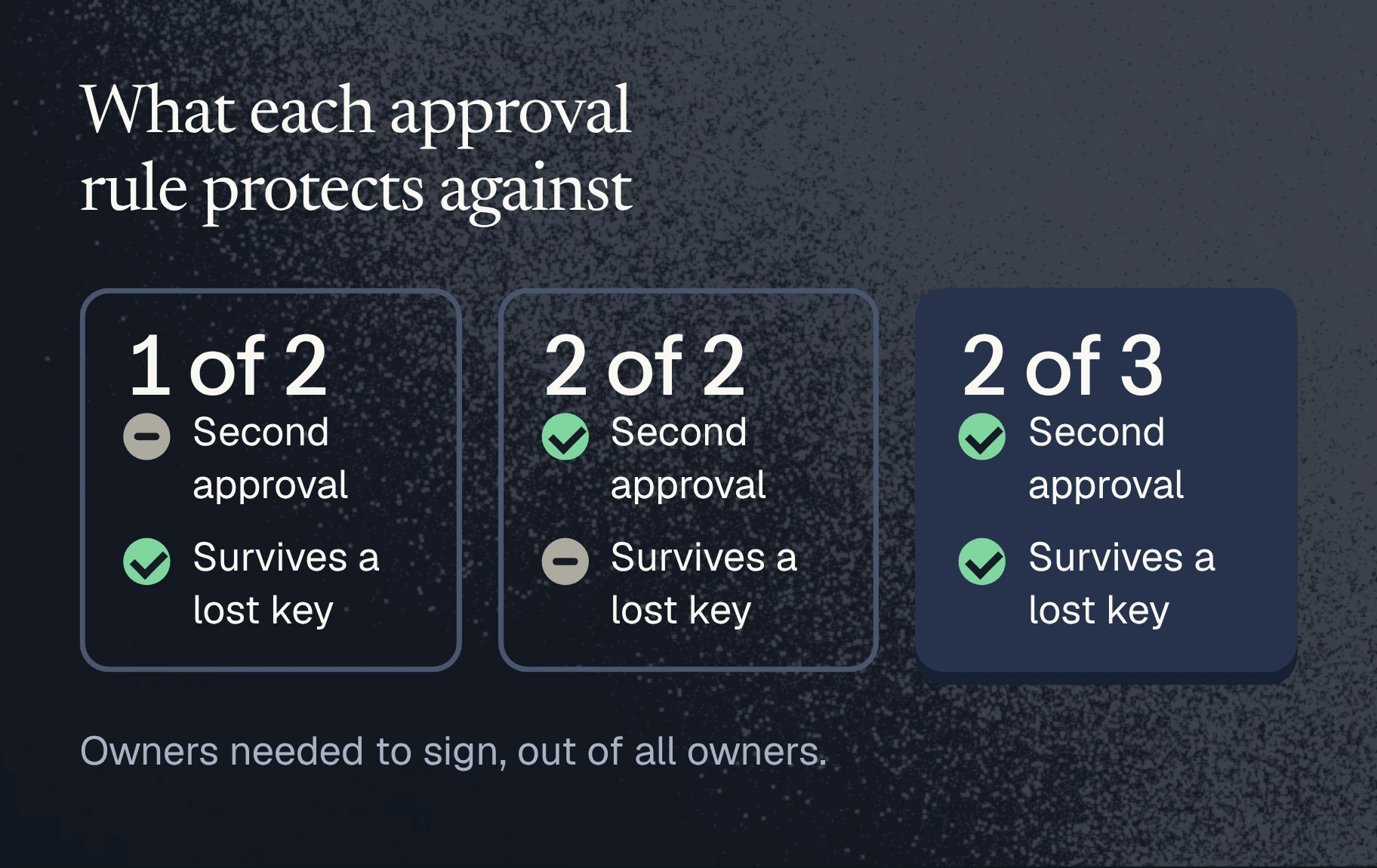
The approval rule, how many owners must sign out of how many, decides what a shared wallet protects against. One AI answer we tested on November 23, 2026 suggested "1-of-2" for a business with two owners; that setup lets either owner move everything alone, which is the risk a shared wallet exists to remove.
This table shows what each common rule survives, using Safe's definition of the threshold and its warning about falling below it.
| Approval rule | Needs a second person to pay | One key lost |
|---|---|---|
| 1 of 2 | No: either owner can pay alone | The other owner carries on |
| 2 of 2 | Yes | Funds stuck, unless a recovery option was set up first |
| 2 of 3 | Yes | The two left carry on and replace the key |
The owners of a Safe don't have to be phone wallets. Safe's developer docs say "Owners can be EOAs, other smart contract accounts, or even a passkey", so two partners can each sign with a hardware wallet, with the third key kept offline as the spare. Create the Safe on Polygon, where Railbed's payouts arrive and which Safe lists among its supported networks; creating it there costs a small network fee paid in POL, which the creation guide says to have ready before you start.
What the choice means for a $39.00 monthly plan sold through Railbed
A shared wallet works for card sales through Railbed, but it narrows how a customer can pay. Railbed's getting started guide says "Smart wallets such as a Safe or Base Account work", and almost every card payment settles to the wallet as USDC on Polygon, where a Safe on Polygon receives it like any wallet.
Take a $39.00 monthly plan. Railbed's subscriptions send the customer an invoice each period, which they pay themselves. With an ordinary wallet, a US customer can also be offered Venmo, from about $3, and Cash App where it takes the amount; both pay on another network to the same address. With a Safe or Base Account, those providers are listed as Not offered, because, as the buyer experience guide says, a smart contract wallet "may not exist on those networks." The customer can still pay by card, including Apple Pay or Google Pay through providers such as Stripe and Topper, which pay on Polygon. Apple Pay as a provider of its own takes only larger orders (about $75 when forwarding costs $2.25), so a $39.00 invoice wouldn't reach it with any wallet.
A Safe also rules out crypto payments, the opt-in where buyers pay from their own crypto wallets: they need "a self-custody wallet (one where you hold the recovery phrase, such as MetaMask, Rabby, Trust Wallet or a hardware wallet)."
Whatever you choose, Railbed needs only the public address. You connect through WalletConnect or Base Account, or paste it, and Railbed's getting started guide says it never asks you to sign anything or approve a transaction.
Which one fits your business
The right wallet follows from how many people share the money and which providers your buyers use.
- One owner who moves sales to the bank every week: a hardware wallet as the payout wallet. It keeps every card provider and the option of crypto payments, and what you guard is the device and the phrase, kept in different places. A phone app wallet is a reasonable start for small amounts, with the same rule about the phrase.
- Partners, or staff who pay suppliers: a two-of-three Safe, accepting that Venmo, Cash App and the other providers that pay on another network won't be offered. Or keep an ordinary hardware wallet as the payout wallet, held by one owner, and move each week's sales on to a Safe that the partners share.
- Someone else should hold the keys: custodial or non-custodial payment gateways compares the two models.
Once sales arrive, the next decisions are how long to keep them as digital dollars, which is it safe to keep sales as digital dollars covers, and what to set up on the first day, in card sales paid to your own wallet: what to do.
FAQ
Should our bookkeeper or accountant have the recovery phrase? No. A bookkeeper needs to see what arrived, which the public address shows on any block explorer, and a Viewer seat in Railbed shows payments, orders and reports. Whoever holds the phrase can move the money, so keep it with the owners.
How does a refund work from a shared wallet? Railbed has no refund button: its documentation says "To refund a buyer, send the funds back yourself." From a two-of-three Safe that refund is a transaction like any other, so one owner proposes it and a second confirms it before it leaves. Plan for that delay when you promise customers a refund time.
Can a Coinbase or Kraken account be the payout wallet? Railbed warns against exchange deposit addresses. Its crypto payments guide says such an address "usually works on one network only, and money sent to it on a network the exchange doesn't support can be lost", and the exchange, not you, holds what arrives.
Have the wallet ready? Add its public address
Railbed pays card sales to the wallet you choose and only needs its public address. An ordinary wallet gets every card provider; a Safe or Base Account works for card sales on Polygon.
Read about payout walletsCreate an account