Is it safe for a business to keep its sales as digital dollars? Reserves, the 2023 slip to 86 cents, freezes and deposit insurance
The issuer's reserves, the March 2023 weekend at 86 cents, address freezes and the missing deposit insurance, read from the source documents and priced for a week of sales.
Press the card to run an example sale.
USDC is backed by dollar reserves that Circle discloses weekly and has examined monthly, but it differs from money in a bank account in three ways: it has no deposit insurance, it traded at 86 cents for one weekend in March 2023, and Circle can block any address.
This page is for a business whose card sales arrive as USDC in its own wallet. It reads each risk from the document that governs it, then turns the risks into arithmetic for a week of sales. It is not advice to hold or to sell.
Five risks, side by side
A business holding USDC carries five separate risks. The table names each, what the governing document says, and what it means for money held for days rather than years.
| Risk | What the source says | What it means for a week of sales |
|---|---|---|
| Reserves | Reserves exceed circulation, examined monthly (Circle) | The 2023 problem was a trapped bank deposit, not missing reserves |
| Price | 86 cents at the 2023 trough, par again within days (Federal Reserve) | A loss only if you must sell during the dip |
| Freeze | Circle may block an address on chain (USDC terms) | A block stops the whole address, not one payment |
| Insurance | Not subject to FDIC deposit insurance (GENIUS Act, s. 4(e)) | No government payout if the issuer fails |
| Custody | Transfers are irreversible; Circle can't recall them (USDC terms) | A lost key or a wrong address is yours alone |
What backs USDC, and who checks it?
USDC is backed by cash and short-term US government assets held for its holders, and Circle publishes the totals. On Circle's transparency page, dated 19 November 2026, USDC in circulation is $67.3 billion and total reserves are $67.6 billion. The same page says "the majority of the USDC reserve is held in the Circle Reserve Fund (USDXX), an SEC-registered 2a-7 government money market fund", managed by BlackRock, and the remainder is cash "mostly among a handful of the world's largest banks".
Two kinds of checking sit behind those numbers. Circle discloses reserve holdings weekly, and "a Big Four accounting firm provides monthly third-party assurance that the value of USDC reserves are greater than the amount of USDC in circulation", under AICPA attestation standards. On 23 November 2026 the most recent report linked there was September 2026's. Separately, Deloitte has audited Circle's own financial statements since fiscal 2022.
The headline promise on that page is "USDC is always redeemable 1:1 for US dollars". Circle's USDC terms, last updated 15 October 2026, narrow who can do the redeeming: "Only Users Type A can redeem USDC directly with Circle", meaning holders with a Circle Mint account in good standing. A business that holds USDC in its own wallet and has no Mint account is a "User Type B". It gets dollars by selling on an exchange or through a wallet app, at that day's market price, which normally sits at a dollar. March 2023 showed what happens when it doesn't.
What happened to USDC in March 2023?
USDC lost its peg for one weekend because part of its cash reserve was trapped in a failed bank and Circle could not process redemptions until banks reopened. The account below follows the Federal Reserve's FEDS Note of 17 December 2025, with Circle's figures from its press statement of 12 March 2023.
| When (US Eastern) | What happened |
|---|---|
| Fri 10 March, 11:37 a.m. | Silicon Valley Bank taken into receivership; USDC redemptions rise |
| Fri 10 March, about 10 p.m. | Circle says $3.3 billion of reserves, about 8%, is stuck at SVB |
| Sat 11 and Sun 12 March | Redemptions largely closed; USDC trades as low as 86 cents |
| Sun 12 March, 6:15 p.m. | Treasury, Federal Reserve and FDIC say all SVB depositors will be protected |
| Mon 13 March | Circle resumes redemptions; USDC fully recovers its peg |
| Wed 15 March | Circle reports $3.8 billion redeemed and $0.8 billion minted since Monday |
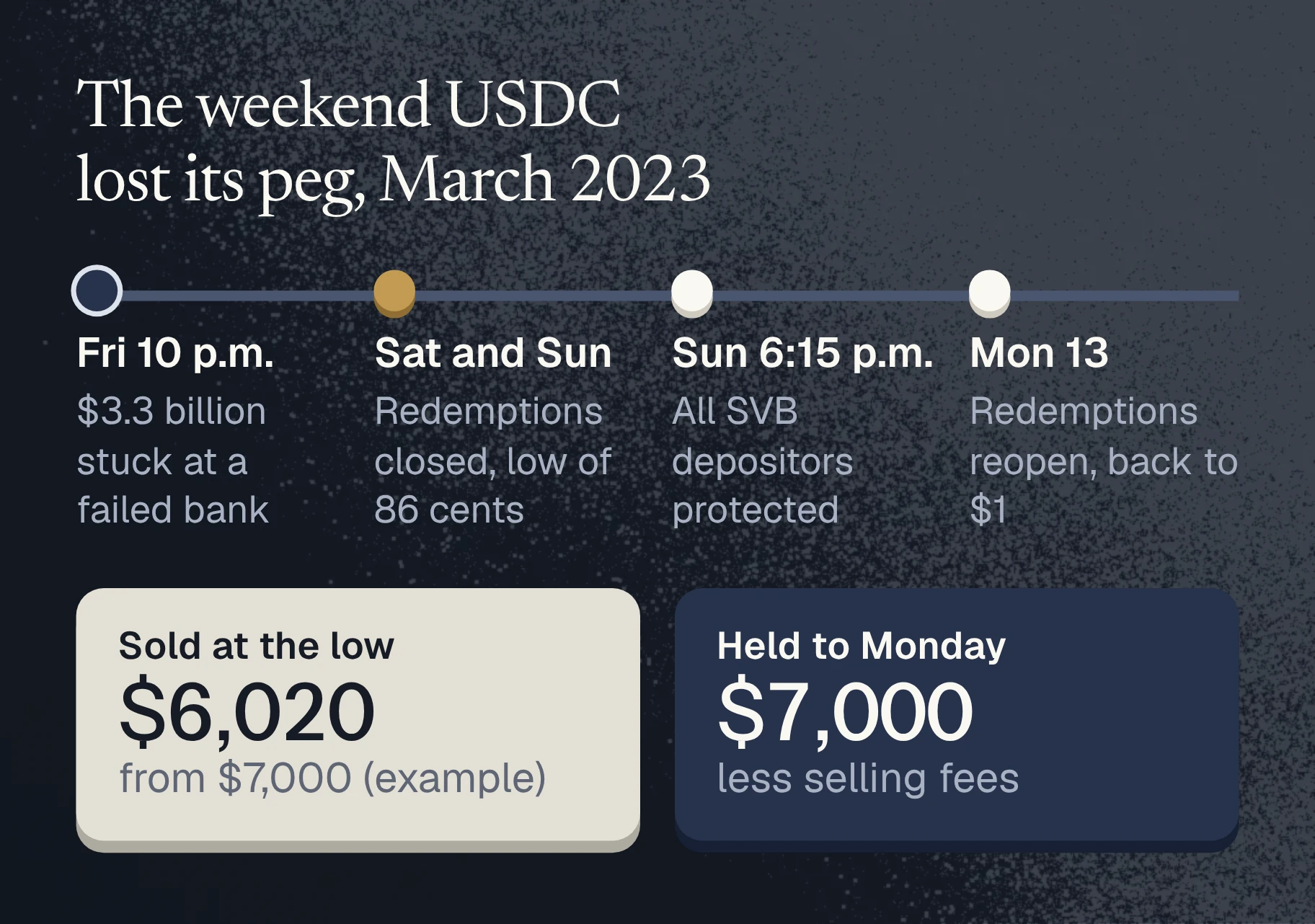
Two details in the Fed's note matter more to a business than the low itself. Circle said redemptions were "constrained by working hours of the U.S. banking systems", so a problem that broke on a Friday night ran all weekend. And Circle's stockholders' equity at the end of 2023 was $0.34 billion, "just over a tenth of the $3.3 billion reserves held at SVB". Circle had promised to "stand behind USDC and cover any shortfall", but the note says that was "not sufficient to restore the peg": the price recovered sharply after the federal decision to protect every SVB depositor, and fully once Circle resumed redemptions. Nothing guarantees a future bank failure is handled the same way.
What the weekend would have cost one business
The cost of a depeg depends almost entirely on whether you had to sell during it. Take an example business holding $7,000 of USDC, a week of sales, on the evening of Friday 10 March 2023.
- Sold at the 86-cent trough: 7,000 × 0.86 = $6,020, a loss of $980.
- Held until Monday 13 March, when the peg returned: about $7,000, less the usual fees of whatever exchange or wallet app it sells through.
A business that needed dollars that weekend for payroll or a supplier would have taken the loss. One that could wait two business days would not.
Can Circle freeze USDC in your own wallet?
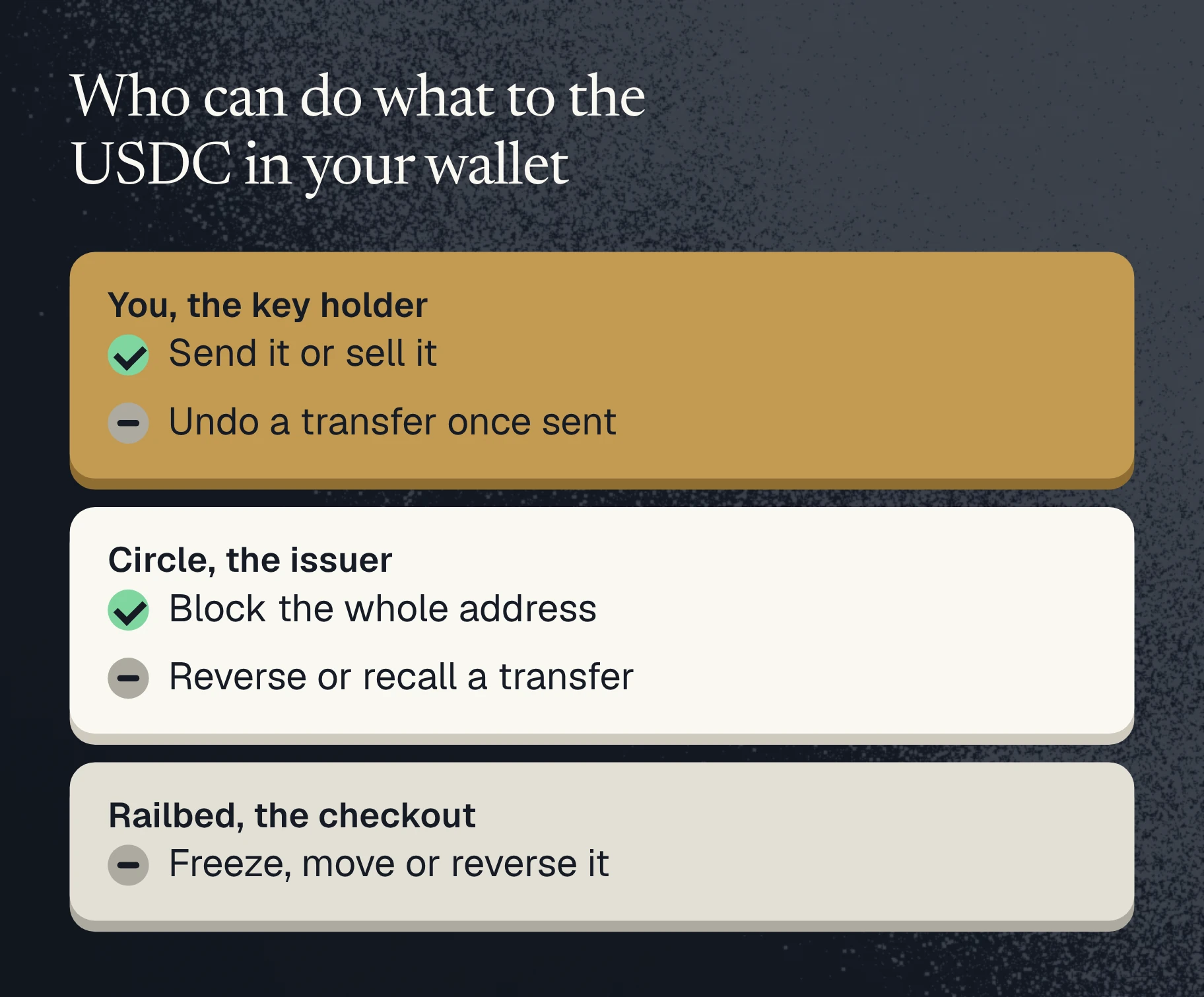
Yes. Circle can block an address on every blockchain where USDC is issued, and a self-custody wallet is not exempt. Circle's USDC terms say "Circle reserves the right to block the transfer of USDC to and from an address on chain as permitted under the blocklisting policy", and the terms bind anyone holding USDC, customer of Circle or not.
That policy, Circle's Stablecoin Access Denial Policy, describes the effect plainly: "When an address is denied access, it can no longer send or receive Circle Stablecoin and all of the Circle Stablecoin controlled by that address is blocked". It blocks whole addresses, never single tokens: to comply with "a law, regulation, or legal order" from a US or French authority or court (or another government with jurisdiction over Circle), for certain urgent law enforcement, sanctions and national security requests, and when the network's own security is threatened. A block can be lifted "upon formal confirmation" that the order no longer applies.
The GENIUS Act points the same way for US issuers: section 4(a)(6)(B) lets a permitted issuer issue stablecoins "only if the issuer has the technological capability to comply, and will comply, with the terms of any lawful order".
Blocks have reached ordinary businesses. On 25 March 2026 The Block reported, citing the on-chain investigator ZachXBT, that Circle had frozen the USDC in 16 hot wallets linked to unrelated businesses, which one affected company said was tied to an undisclosed US civil case, and that one of those wallets, holding 130,966 USDC, had since regained access. The Block said Circle had not publicly commented on the specific wallets or confirmed the legal basis for the freeze.
One more part of the terms deserves a careful read by businesses in regulated trades. Section 21 says using USDC for transactions related to a list of activities "is prohibited", and that Circle "reserves the right to monitor and, if appropriate, block or otherwise prevent transactions that relate to" them. The list includes gambling and controlled substances "unless licensed and authorized" in the relevant jurisdictions, weapons "in contravention of applicable laws", multi-level marketing programs and credit repair services. Section 27 makes every holder subject to these terms. If your trade is on that list, read the section in full and take your own legal advice.
Is USDC insured like money in a bank?
No. USDC is not a bank deposit, and US law says so directly. Section 4(e) of the GENIUS Act, signed on 18 July 2025, says payment stablecoins "shall not be backed by the full faith and credit of the United States, guaranteed by the United States Government, subject to deposit insurance by the Federal Deposit Insurance Corporation", and makes it unlawful to claim otherwise.
The FDIC says the same from its side. Its page Understanding deposit insurance explains that deposits are insured "to at least $250,000 per depositor, per ownership category at each FDIC-insured bank", and lists crypto assets among the things it does not cover. The bank deposits behind a stablecoin don't pass insurance through to holders either: an FDIC proposed rule of April 2026 would clarify that they "would be insured to the PPSI", the issuer, "but would not be insured to payment stablecoin holders on a pass-through basis". It is a notice of proposed rulemaking, with comments due by 9 June 2026; we found no final FDIC rule as of 23 November 2026.
What the GENIUS Act gives holders instead is a place in line. Section 11 says that in the insolvency of a permitted payment stablecoin issuer, holders' claims have priority "with respect to required payment stablecoin reserves", ahead of the issuer's other creditors. The Act takes effect on the earlier of 18 months after enactment (18 January 2027) or 120 days after regulators issue final rules. A priority claim is a right to be paid from the reserves in an insolvency proceeding, not a government guarantee.
Which risks are yours rather than Circle's?
Holding USDC yourself hands you the risks a bank would otherwise carry. Circle's terms say a transfer to another address "is irreversible and Circle does not have the ability to reverse or recall any transaction once initiated", so a lost recovery phrase, a stolen key or a payment to the wrong address can't be undone by anyone. Two mistakes are worth planning for. One is holding a token that isn't Circle's USDC: Circle's launch post for native USDC on Polygon says "Bridged USDC (USDC.e) is not issued by Circle", and USDC or USDC.e on Polygon explains how to tell which you hold. The other is sending on the wrong network, covered in sent USDC to an exchange on the wrong network. Who holds the keys, and what that means if a gateway fails, is the subject of custodial or non-custodial payment gateway.
How much should a business keep in USDC?
How much to keep is a cash-flow decision, and one number makes it concrete: the most you would be holding when something like March 2023 starts. That amount is roughly your daily sales multiplied by the days between conversions to dollars.
The table below uses an example business taking $1,000 a day in card sales and asks what selling at the 2023 trough of 86 cents, a 14% discount, would have cost under three conversion schedules.
| Conversion schedule | Most held at once (example) | Cost of selling at 86 cents |
|---|---|---|
| Every business day | About $1,000 (about $3,000 after a weekend) | $140 (about $420) |
| Once a week | About $7,000 | $980 |
| Once a month | About $30,000 | $4,200 |
In March 2023 a business that could wait lost nothing, so the table prices being forced to sell on the worst day; a later dip may not end the same way. Four practical choices follow, each yours to make:
- Set a conversion schedule you can keep. The shorter it is, the smaller the amount exposed to a price dip or a freeze, and the more you pay in exchange and withdrawal fees. How to turn USDC into dollars compares those costs.
- Open your exit route before you need it. An exchange account in the business's name, with its identity checks finished, is not something to start on a Friday night when the price is already moving.
- Pay fixed bills from a dollar buffer in the bank. Payroll and rent paid from a bank balance never force a sale on a bad day.
- Keep records you can explain. They help your accountant and any bank that asks; see how to book card sales that arrive as USDC. Circle's reserve page and its monthly reports are public too, and a late report is worth noticing.
Where Railbed fits, and where it doesn't
Railbed is card checkout whose sales settle to a wallet the merchant controls, almost always as USDC on Polygon. Railbed never holds funds, so there is no Railbed balance to freeze and nothing is held back as a reserve. Even when the law requires Railbed to stop an account's new payments, its acceptable use policy says "none of this can touch money already in your wallet". The same design means Railbed can't reverse a transfer, recover a lost key or convert USDC to dollars for you, and it changes none of Circle's powers above. Moving sales to a bank is your step, through an exchange or a wallet app, as Move money to your bank sets out.
If your business needs every sale to land as insured dollars in a bank account, a conventional merchant account is the better answer where you can get one. If processors have turned you away, settling to your own wallet trades a processor's holds and reserves for the token risks on this page, and the schedule in the previous section is how you keep them small.
FAQ
Does USDC pay interest if a business holds it?
No, not from the issuer. Circle's terms say USDC "is not designed to intrinsically create returns for holders", and the GENIUS Act's section 4(a)(11) bars permitted issuers from paying holders "any form of interest or yield" just for holding a payment stablecoin. Any yield offered on USDC comes from a third party and carries that party's risks.
Do Circle's USDC terms apply to a business in Europe?
Not as written. Circle's USDC terms say they "only apply to USDC held by persons located outside of the EEA", and name Circle Internet Financial Europe SAS as a second issuer of USDC from 1 July 2024. A business in the European Economic Area should read the documents Circle publishes for that issuer.
{"heading": "Decide how your sales leave the wallet before you need to", "description": "Railbed's guide shows the two routes from a USDC wallet to a bank account, step by step, so your exit is set up before a bad weekend.", "buttons": [{"label": "Read Move money to your bank", "url": "https://railbed.com/docs/user-guide/move-money-to-your-bank/"}, {"label": "Create an account", "url": "https://app.railbed.io/signup"}]}