Custodial or non-custodial payment gateway: who holds your money, and for how long?
One $60 order followed through a processor reserve, a balance a gateway holds for you and forwarding to your own wallet, with how to check a custody claim yourself.
Press the card to run an example sale.
A card processor holds your sales as an account balance and can keep part of it back as a reserve, which Stripe says normally lasts 30 to 90 days; a custodial crypto gateway holds them as a balance until you withdraw; a non-custodial gateway forwards each sale to a wallet only you control, so nothing waits with the gateway.
This page follows one $60 order through all three models, shows where the money sits at each step, and explains how to check a custody claim yourself on a block explorer. It ends with what "non-custodial" does not promise, including the risks it hands to you.
Where does a $60 order sit in each model?
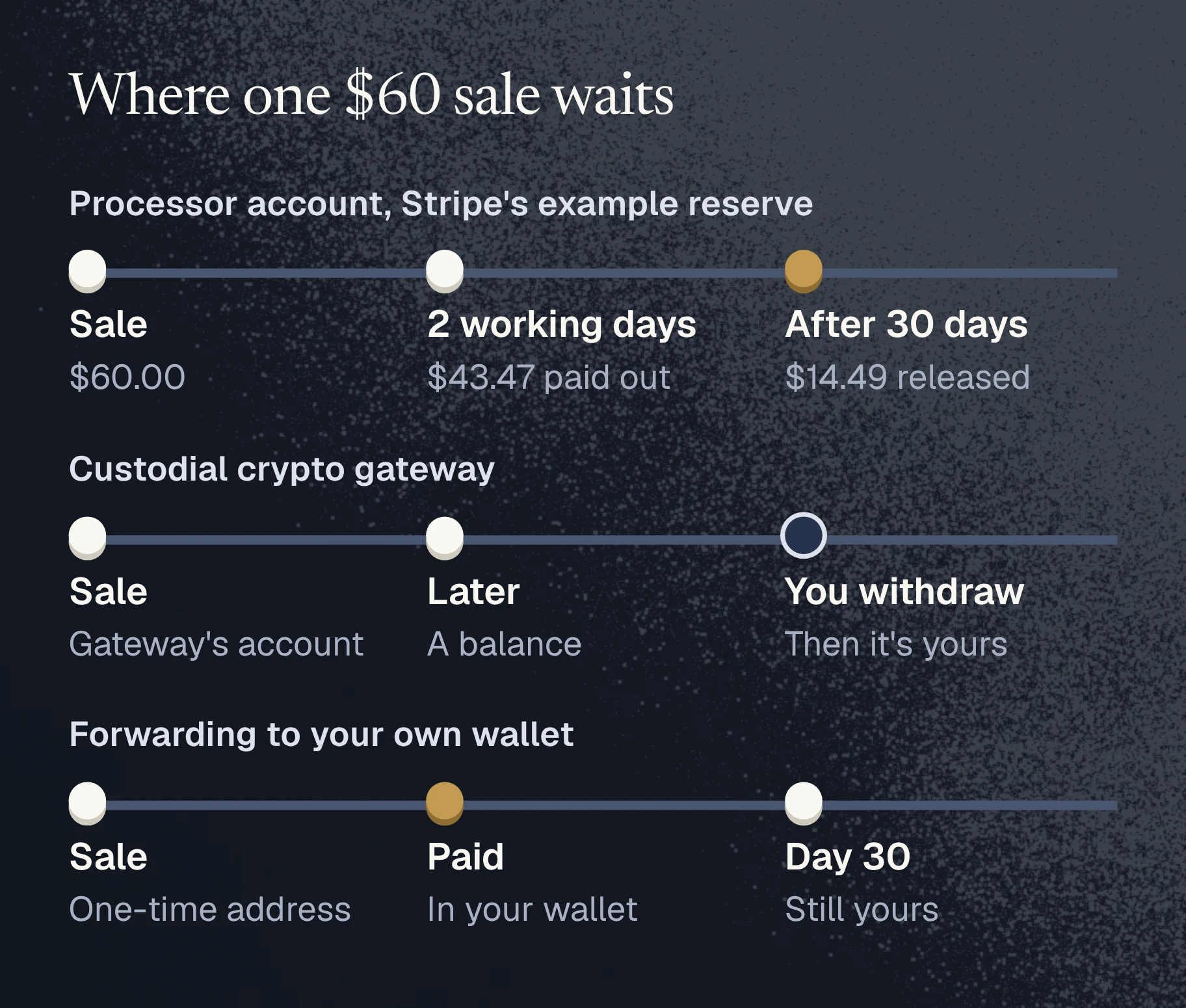
The same $60 card order rests in a different place in each model, and that place decides who can delay it. The table follows it from the moment the buyer pays to day 30.
| Moment | Processor account with a reserve | Custodial crypto gateway | Forwarding to your own wallet |
|---|---|---|---|
| The buyer pays | Into your account balance at the processor | Into the gateway's account, credited to you | The card provider buys USDC and sends it to a one-time address, which forwards it to your wallet |
| Two working days later | 75% paid out: $43.47 in Stripe's illustration | A balance in the gateway's dashboard | In your wallet since the payment completed |
| After 30 days | The reserved $14.49 is released for payout | Still there until you withdraw it | Still in your wallet unless you moved it |
| Who can stop it reaching you | The processor, under its agreement | The gateway, under its account terms | Not the gateway; the stablecoin's issuer can block an address |
A processor account: a balance, sometimes with a reserve
A card processor or acquirer puts each sale into an account balance it controls and pays it out to your bank on a schedule. If it judges your business risky, it can also keep part of each sale back as a reserve to pay future refunds and chargebacks.
Stripe's reserves page says plainly how it works: "Customer refunds and chargebacks are pulled directly from the business's reserved balance", and before a reserve starts Stripe sends "the percentage of the funds that will be held, and the time period", normally 30 to 90 days. Its worked example uses a 25% rolling reserve over 30 days with a fee of 2.9% plus $0.30. Run a $60 sale through that example:
- Fee: 2.9% of $60 is $1.74, plus $0.30, so $2.04.
- Left after the fee: $57.96.
- Paid out in two working days: 75%, which is $43.47.
- Held for 30 days: 25%, which is $14.49.
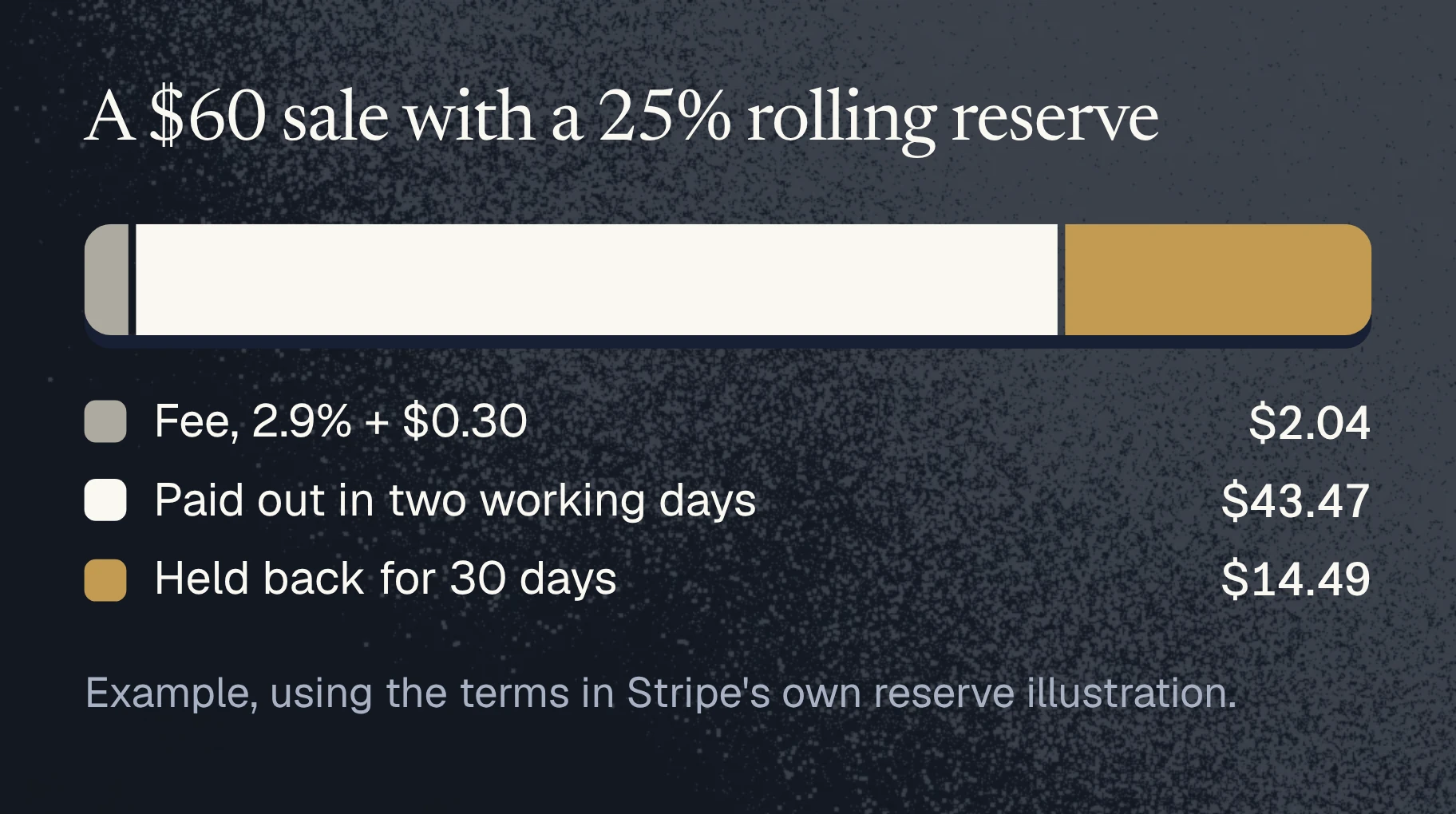
The 25% is Stripe's illustration, not a rule for every account. Its reserves FAQ says "the size of a reserve is determined based on the level of risk associated with any business", that Stripe reviews the reserve "a few days before" it expires and may remove, decrease or increase it, and that "in some rare cases, a reserve may be required indefinitely". How rolling reserves change your cash flow works through the effect over a month of sales.
A custodial crypto gateway: a balance you withdraw
A custodial crypto gateway receives each payment into an account it operates and shows you a balance, which you later withdraw to a bank or a wallet. The money is yours on paper and in the gateway's possession in fact.
Coinbase Business is a well-documented example. Its help page says "Funds settle to your Coinbase Business account in USDC", and its transition notice says "Coinbase Business is a custodial platform" and "Coinbase holds your funds securely on your behalf". Coinbase also states what custody buys: "direct offramps to your bank account, yield on idle balances, and simplified operations". The trade is that you need what the account requires (for Coinbase Business, "a registered business entity and a business bank account"), and while the money sits there it is subject to that account's terms.
The same notice is a rare first-hand account of the switch between models. Coinbase Commerce, whose portal Coinbase said would become inaccessible after March 31, 2026, was self-custodial; Coinbase says it moved because "businesses today expect custody, compliance", an easy cash-out and operational tools. Custody is a real service with real benefits, as long as you know you are buying it.
Forwarding to your own wallet: nothing left to hold
A forwarding gateway never keeps a balance: each payment is routed to an address that passes the money on to a wallet you control. In card-to-crypto checkouts built this way, an on-ramp provider charges the card, buys a stablecoin and sends it to a one-time address made for that payment, which forwards it to you after fees.
Railbed works this way. The provider "runs its own card checkout and any identity check it requires, then buys USDC with the card payment and sends it to the payment's deposit address"; the payment network forwards the merchant's share to the merchant's wallet, almost always as USDC on Polygon, and Railbed "keeps no balance for you and there's no payout to request". Railbed's docs on settlement give the timing: a few minutes on the provider's page, then settlement as soon as the forwarding is reported, with checks for up to two days if that report is late.
What does "non-custodial" not mean?
Non-custodial means the gateway never holds your money after the sale. It does not mean nobody else ever touches it, or that nobody can ever stop it.
- Someone still handles the card money. The card provider charges the card and holds those funds until it buys the stablecoin, and a forwarding address holds the coins for the moment before it passes them on. Card disputes still happen, with the provider; who handles disputes when card payments settle as USDC explains what follows. What changes is that settled sales can't be pulled back from your wallet.
- The stablecoin's issuer keeps powers. Circle's USDC terms say "Circle reserves the right to block the transfer of USDC to and from an address on chain as permitted under the blocklisting policy." Is USDC safe for a business to keep sales in? covers reserves and freezes in full.
- Nobody can rescue you. Coinbase's notice on its old self-custodial wallets is blunt: "If you lose your seed phrase, Coinbase cannot recover your funds." Railbed's terms say the same of a wrong payout address: "neither Railbed nor anyone else can retrieve them."
- The dashboard is not the money. Coinbase warned Commerce merchants that "there may be discrepancies between displayed balances and actual on-chain balances". In Railbed, Home's wallet figure is read from your wallet on Polygon, while Received is a record of what payments reported; the two don't need to match.
How do you verify a custody claim on a block explorer?
A custody claim can be checked against the blockchain in about five minutes, using one completed sale. You need the sale's transaction and your own wallet address, nothing else.
- Find the sale's transaction. In Railbed, open the payment and follow its transaction from the timeline to the network's explorer (Polygonscan for most); other gateways show a transaction hash on the payment.
- Read where the transfer ended. On the transaction, the USDC transfer's recipient should be your wallet address. If it ends at an address you don't control while the gateway's dashboard shows you a balance, the gateway is holding your money.
- Check the token. The token contract for Circle-issued USDC on Polygon PoS is 0x3c499c542cEF5E3811e1192ce70d8cC03d5c3359, per Circle's address list.
- Compare your wallet with the explorer. Open your own address on the explorer and compare its USDC balance with your wallet app. Railbed's Verify balance opens the wallet on the public Polygon explorer.
- Move a little out yourself. Send a small amount to another address you own. Railbed's guide notes that "sending on Polygon needs a small network fee", which some wallet apps take from your USDC and others need a little POL for. If you can move it without asking anyone, it is yours.
Reading Polygonscan in five minutes walks through the transaction page line by line.
A held payment is not a reserve
Railbed doesn't keep money back, but a payment that fails its settlement check isn't marked paid either. A payment counts as paid when what arrived is at least 85% of the order's value in dollars (Railbed's current setting); on a $60 order that is $51.00.
When money arrives but fails a check, the payment shows one of two statuses, described in payments that need your decision:
- Needs your decision: "the money reached your wallet, and you decide whether it's right for this order." If less arrived than expected, Underpaid shows beside it. Owners and managers can choose Accept as paid, which "can't be undone".
- Not received: "the evidence shows the money may have gone somewhere else", such as a different wallet or deposit address. It can't be accepted.
The difference from a reserve is where the money is. A reserve is your money in the processor's account; a payment that needs your decision is a question about an order, with the money already in your wallet. Railbed's docs add that "nobody at Railbed is reviewing these payments".
Self-custody hands you the keys and the risk
A forwarding gateway removes the party that could freeze a balance, and gives the job of keeping the money safe to you. Four habits cover most of that risk:
- Use a self-custody wallet whose keys you control, never an exchange deposit address: Railbed's terms warn that exchange addresses "may not credit USDC sent on the Polygon network, or may credit it to someone else".
- Keep the seed phrase offline and give it to no one. A gateway that pays your wallet needs only its public address.
- Check the payout address character by character when you save it, because blockchain transactions can't be reversed.
- Turn on two-factor sign-in. On Railbed, changing the payout wallet needs a recent sign-in or a current two-factor code, signs the person out of other devices and alerts the business's owners.
Which model fits your business?
The right model depends on which risk you would rather carry: a provider holding your balance, or you holding your own keys.
- A processor account fits if one will take your business and you want bank payouts, built-in refunds and a dispute process run for you, and can absorb a reserve if one is applied.
- A custodial crypto gateway fits if you want stablecoin payments with a bank cash-out and accounting in one account, and qualify for it.
- Forwarding to your own wallet fits if a frozen or reserved balance is the risk you most need to remove and you can manage a wallet. Railbed takes card payments this way, with nothing held back from your sales and no underwriting and no application to pass, but it doesn't pay out to a bank: turning USDC into dollars is your step, and refunds are sent from your wallet by you.
FAQ
Do you get a rolling reserve back? Usually, yes. Stripe says reserved funds "will be released in full at the end of the reserve period if they are not needed to cover disputes or refunds", and that the reserve is reviewed before it expires and may be extended.
Can a non-custodial gateway refund a buyer for me? Not from your money, because it never holds it. With Railbed, "a settled payment can't be reversed by Railbed: the money is already in your wallet", so you send the refund yourself; how to refund a card payment that settled as USDC shows the steps.
Does non-custodial mean no chargebacks? No. Settled sales can't be pulled back from your wallet, but card disputes go to the provider that charged the card, which may contact you or decline future payments from a buyer or region under its own terms.
See where your next sale lands
Set up a Railbed checkout that pays your own wallet, take a small live payment, then open its transaction on Polygonscan and check the recipient yourself.
Create an accountRead about wallets and settlement