My bank asked where the money in my account came from. What do I show for card sales paid to my own wallet?
Why banks ask, what reviewers need to see, and the six-link paper trail from a card sale paid to your own wallet to the bank credit, with a cover note, a schedule and a checklist.
Press the card to run an example sale.
Show that each deposit was both earned and received: the orders or invoices behind it, the payment record and transaction link for each sale, your wallet's transfer to the exchange, and the exchange statement with the sale and withdrawal, all in your business's name. A one-page note that walks the bank through that chain makes it easy to check, but no file can guarantee the bank's decision.
This page explains why banks ask, what reviewers look for, and how to assemble the chain for sales that buyers paid by card and that reached you as USDC. It ends with a cover note you can adapt, a checklist and the habits that keep the next request short.
Why the bank is asking
Your bank is asking because anti-money-laundering rules make it understand what your business does and check your transactions against that picture. A run of deposits from a crypto exchange is new activity, and new activity is what those rules tell a bank to look at.
In the US, the FFIEC's examination manual says customer due diligence must include "obtaining and analyzing sufficient customer information to understand the nature and purpose of customer relationships" and "conducting ongoing monitoring to identify and report suspicious transactions" (FFIEC BSA/AML Manual). The same page names "transactions or other activity that are inconsistent with the bank's understanding of the nature and purpose of the customer relationship" as a sign the profile has changed.
In the UK, the Money Laundering Regulations 2017 require ongoing monitoring including "scrutiny of transactions undertaken throughout the course of the relationship (including, where necessary, the source of funds)" so that they are "consistent with the relevant person's knowledge of the customer, the customer's business and risk profile" (regulation 28(11)). Lloyds Bank puts the practice plainly in a business webcast on its site: "if we see a change in your business or your account activity, we might reach out to you on an ad hoc basis and ask a bit more information about that" (Lloyds Bank).
So the question is rarely about crypto as such. The bank wants to see that the exchange deposits fit the business it knows: sales of the things you told it you sell, at volumes that make sense.
What a reviewer needs to see: earned and received
A reviewer needs two kinds of evidence for each deposit: a document showing how the money was earned and a document showing you actually received it. A sales record alone doesn't show receipt, and a statement alone doesn't show why the money arrived.
Kraken's source-of-funds page states the rule directly: if a document showing how you earned money "doesn't confirm that you actually received it", you need "another document to show this, for example, a crypto exchange statement or bank statement" (Kraken). Coinbase's account review page asks, for funds from crypto activity, for "documents that show how you obtained and transferred the assets", including "blockchain transaction IDs", "wallet transaction history" and "evidence connecting the external wallet or exchange account to you". For a self-custody wallet, it wants "the wallet address, transaction history, dates, assets, and amounts".
Exchanges are not banks, but they work under the same kind of rules and publish their requirements in detail, which makes their pages a fair guide to what a bank's reviewer will find convincing. Coinbase also lists why documents get rejected, among them "missing your name or relevant identifying details", "inconsistent with the information in your Coinbase account" and "edited, altered, or otherwise unverifiable".
The chain for one $250 sale
Here is the full chain for one card sale that settled as USDC, and every amount in it is an example. Each link carries something that matches the next, which is what lets a stranger follow the money without taking your word for it.
The example: order #1041 for $250.00, paid by card. The card provider sent 240.00 USDC (an invented figure: providers' fees vary); a 1% network fee and a 0.9% Railbed fee (Railbed's fee is from 0.9% and set per account) left 235.44 USDC in your wallet.
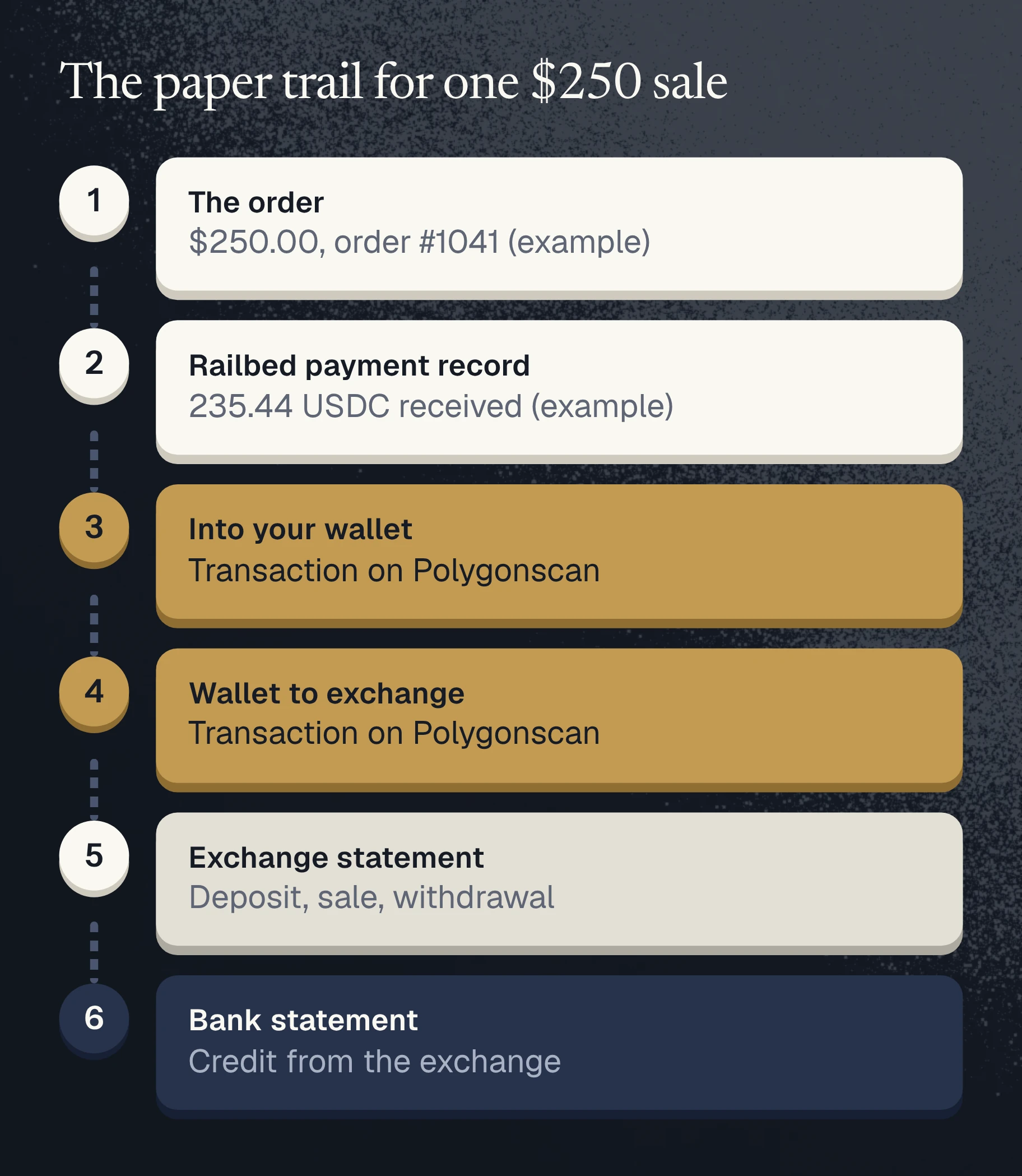
The table lists each document, where it comes from and what joins it to the next link.
| Link | Document | Joined to the next by |
|---|---|---|
| 1. The sale | The order or invoice: number, date, customer, items, $250.00 | The payment ID on the order |
| 2. The payment | Railbed's payment record: Paid, provider, You received $235.44, payout wallet | The transaction it links to |
| 3. Receipt in your wallet | The transaction on Polygonscan: amount, time, your wallet as recipient | Your wallet address |
| 4. Transfer to the exchange | The transaction from your wallet to the exchange's deposit address | Amount, time and transaction hash |
| 5. Sale and withdrawal | The exchange statement: deposit, sale of USDC, withdrawal | Withdrawal amount and date |
| 6. Bank credit | Your bank statement: the credit from the exchange | (the deposit the bank asked about) |
In Railbed, the order and its payment are in Orders and Payments. The payment's details show the payment ID, the provider, You received ("the net amount that reached your payout wallet") and the Payout wallet locked for that payment, and on a Live payment "a shortened wallet, address or transaction opens on that network's explorer". Invoices you sent through Railbed also have a PDF. Reading the transaction on Polygonscan explains what each field on the explorer page means.
For links 5 and 6, Coinbase lets you download a monthly statement "by selecting the format (HTML, PDF, or CSV)" or generate a custom one by asset, transaction type and date (Coinbase). Coinbase's own requirements for a trading history are a good test of yours: the account holder's full legal name and the platform's name, the date range, and "deposits, withdrawals, executed trades, realized gains/losses, closing balances".
When one bank credit covers many sales
If you move USDC to the exchange in batches, one bank credit stands for many orders. The link a bank can't follow on its own is the one from that single credit back to the individual sales, and a short schedule closes it.
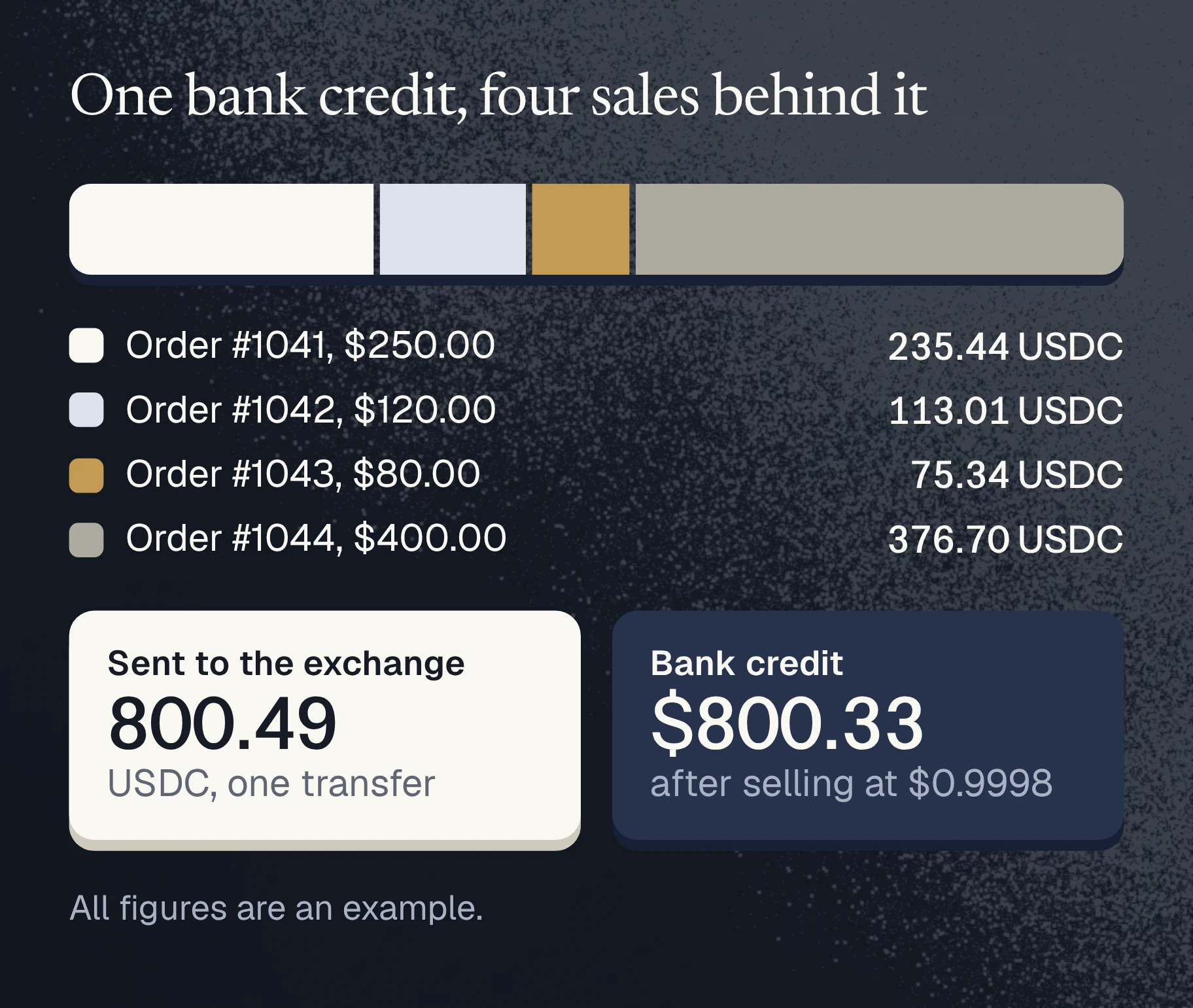
The schedule lists every payment whose USDC went into the transfer behind the withdrawal, with its payment ID. In this example (every figure is an example, with the same fees as above), four orders paid during one week were moved to the exchange together, sold at $0.9998 and withdrawn.
| Order | Order total | USDC received |
|---|---|---|
| #1041 | $250.00 | 235.44 |
| #1042 | $120.00 | 113.01 |
| #1043 | $80.00 | 75.34 |
| #1044 | $400.00 | 376.70 |
| Total | $850.00 | 800.49 |
The 800.49 USDC went to the exchange in one transfer, sold for $800.33 and reached the bank as one $800.33 credit. Railbed's order export gives most of the schedule: the orders guide lists the order number, date, status, total, Received (net, USD), and the order and payment IDs in each row.
Never split withdrawals to keep each one under a reporting threshold. In the US, 31 U.S.C. § 5324 says no person shall, "for the purpose of evading the reporting requirements" it lists, "structure or assist in structuring" any transaction "with one or more domestic financial institutions", and the law makes no exception for money that was earned legitimately.
A cover note you can adapt
A cover note tells the reviewer what the business is and walks them down the chain once, so the attachments make sense in order. Keep it to one page, factual and in the business's name. Fill in the brackets:
- Who you are. "[Business name] sells [what you sell] online at [website]. Customers pay by card at checkout."
- How the money reaches you. "Card payments are converted by the card provider to USDC, a dollar stablecoin, and forwarded to our business wallet [address]. We sell the USDC on [exchange], in an account in the business's name, and withdraw to this account."
- What the deposit is. "The [amount] credit on [date] is the proceeds of [number] customer orders from [date range], listed in the attached schedule."
- What is attached. "The schedule of orders; the order records; the payment records with their transaction links; the exchange statement for [period] showing the deposits, sales and withdrawal."
- What changes from now. "We expect deposits of about [range] each [week or month] from the same exchange."
Describe the business exactly as it is. A note that softens what you sell creates the inconsistency the bank is checking for.
Checklist before you reply
- The names match: the business on the bank account, the exchange account and the order records, or a line explaining any difference.
- Every amount in the note matches a document.
- The schedule's USDC total equals the transfer into the exchange, and the withdrawal equals the bank credit.
- Each payment record shows Paid, with its transaction link working.
- The exchange statement covers the whole period and shows deposits, sales and withdrawals.
- Nothing is cropped or edited, and no detail the reviewer needs is redacted.
- You kept a copy of everything you sent and a note of the date.
Habits that keep the next request short
Records kept the same way every month make the next request quicker to answer. These habits come from what the reviewers' own pages ask for.
- Use an exchange account in the business's name. Railbed's guide to moving money already sends sales to "an exchange account in your name"; for a company, that means the company's account. Coinbase asks that "the name on your supporting documents matches" the account.
- Keep the payout wallet for sales only. A wallet that also holds personal crypto mixes two stories in one transaction history.
- Use one exchange and one route. Coinbase's advice to customers whose trading grows is to "use consistent and identifiable funding sources where possible".
- Export each month. Save the orders export, the exchange statement and the list of transfers out of the wallet together; the bookkeeping guide uses the same files.
- Tell the bank first. Lloyds invites business customers to "proactively call out and reach out to us and let us know" when something changes. A note before the first exchange deposit costs less than an explanation after a hold.
If the bank still says no
A bank can decline the explanation and close the account even when the file is complete, and you may not learn the full reason. In the US, the FFIEC manual says "the existence or even the non-existence of a SAR must be kept confidential", so a bank that reported activity can't tell you so.
In the UK, regulations in force from 28 April 2026 require a payment service provider ending a contract entered into on or after that date to give "at least 90 days" notice and "an explanation of the reasons for termination which is sufficiently detailed and specific", subject to exceptions set out in the regulations (Contract Termination Regulations). The Payment Services Regulations also let a business that isn't a micro-enterprise or a charity agree with its provider that rules of this kind don't apply, so whether they cover your account depends on when it was opened and on its terms; check with the bank or an adviser.
If a closure happens, keep the file: the next bank will ask the same questions, and the guide to cashing out compares routes to a business account.
Where Railbed fits, and where it doesn't
Railbed holds the first two links of the chain: the order or invoice, and a payment record with the provider, the amount that reached your wallet, the payout wallet and the transaction link. The order export turns those into the schedule for any withdrawal.
Railbed is not a bank, a money transmitter, a processor or an exchange, and it never holds your money, so it has no statement of its own for the later links and can't speak to your bank for you. Your wallet's history, your exchange's statements and your bank's records carry the rest of the chain.
Keep the first two links ready
Every Railbed sale has an order, a payment record with what reached your wallet, and a transaction link on the explorer, and the order export lists them for any period. Try it in Test mode first.
Create your accountSee what a payment record shows