Keep sales as digital dollars or move them to the bank the same day? A simple rule for a small business
A four-line weekly rule for moving card sales from your wallet to the bank, worked through one example month with Kraken's published fees for ACH, FedWire and RTP.
Press the card to run an example sale.
Move sales to the bank once a week, not every day: on a fixed weekday, keep in the wallet only what you will pay from it before the next move, and send the rest. Move sooner only when a bank bill can't wait or the wallet passes a ceiling you set; daily moves save nothing on percentage fees.
The rule below is worked through one example month for a business taking about $500 a week in card sales paid to its own wallet, priced with Kraken's published fees as of November 23, 2026. It is a cash-flow rule, not investment or tax advice. How much you should be willing to hold as digital dollars at all is a separate question, answered in is it safe to keep sales as digital dollars.
The rule, in four lines
The weekly rule fits on an index card. Each line has one job:
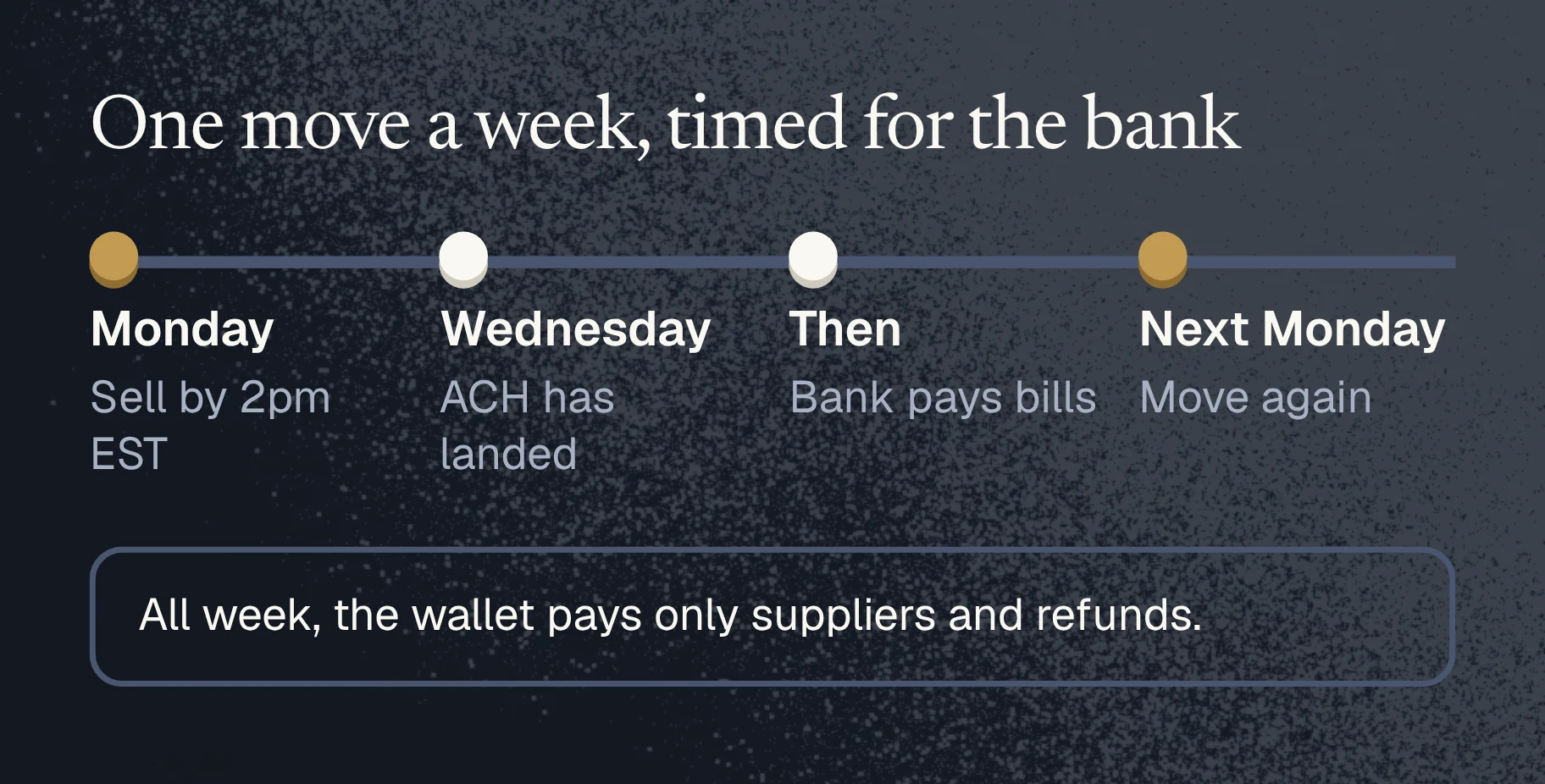
- Move once a week, on the same weekday, before the bank cutoff. Kraken's ACH payout has a 2pm EST cutoff and an estimated 0 to 2 business days, so a Monday morning sale and withdrawal should land by Wednesday; Kraken calls its processing times "estimates only".
- Keep back only what the wallet will pay before the next move. That is payments to suppliers or contractors who take digital dollars, and a small reserve for refunds, which you send from your own wallet. Everything else goes.
- Before you move, check the bank already covers the next two business days of bills. An ACH payout can take that long, so this week's money can't pay a bill due tomorrow.
- Move on another day only if a bank bill can't wait, or the wallet passes your ceiling. On that day, run the weekly move early: keep back what rule 2 keeps and send the rest. The ceiling is the most you're willing to hold as digital dollars at once; you set it, and the section on what the rule leaves to you says how to think about it.
The rule's job is to make the dollars you need arrive in the bank before the bills do, while paying each fee as few times as you can.
Why once a week is enough: the fee arithmetic
Moving more often only costs more when a fee is flat. A fee charged as a percentage of the amount, such as the sale on an exchange, adds up to the same total however you split the month; a flat fee per withdrawal is paid again on every move.
The table prices the example month below, in which $2,560 leaves the wallet, on four ways out to a US bank. It uses Kraken Pro's fee schedule (0.20% for "FX, stablecoin-base and pegged-token pairs" under $50,000 a month), Kraken's cash withdrawal page (last updated November 4, 2026: ACH free, FedWire $4, RTP 1.50% capped at $50, the last only where your bank supports RTP) and MetaMask's Sell page, which says "MetaMask receives a 1% fee on every transaction from providers", so that 1% sits inside each provider's quote. Kraken's schedule gives "USDT/USD" as its example pair and doesn't name USDC/USD, so check the fee the order screen shows before you sell. Weekly means five moves (four Mondays and one ceiling move); daily means twenty business days.
| Way out to the bank | Weekly (5 moves) | Every business day (20 moves) |
|---|---|---|
| Kraken Pro sale, ACH payout | $5.12 | $5.12 |
| Kraken Pro sale, FedWire payout | $25.12 | $85.12 |
| Kraken Pro sale, RTP payout | $43.52 | $43.52 |
| MetaMask Sell | The provider's quote, $25.60 of it to MetaMask | The same |
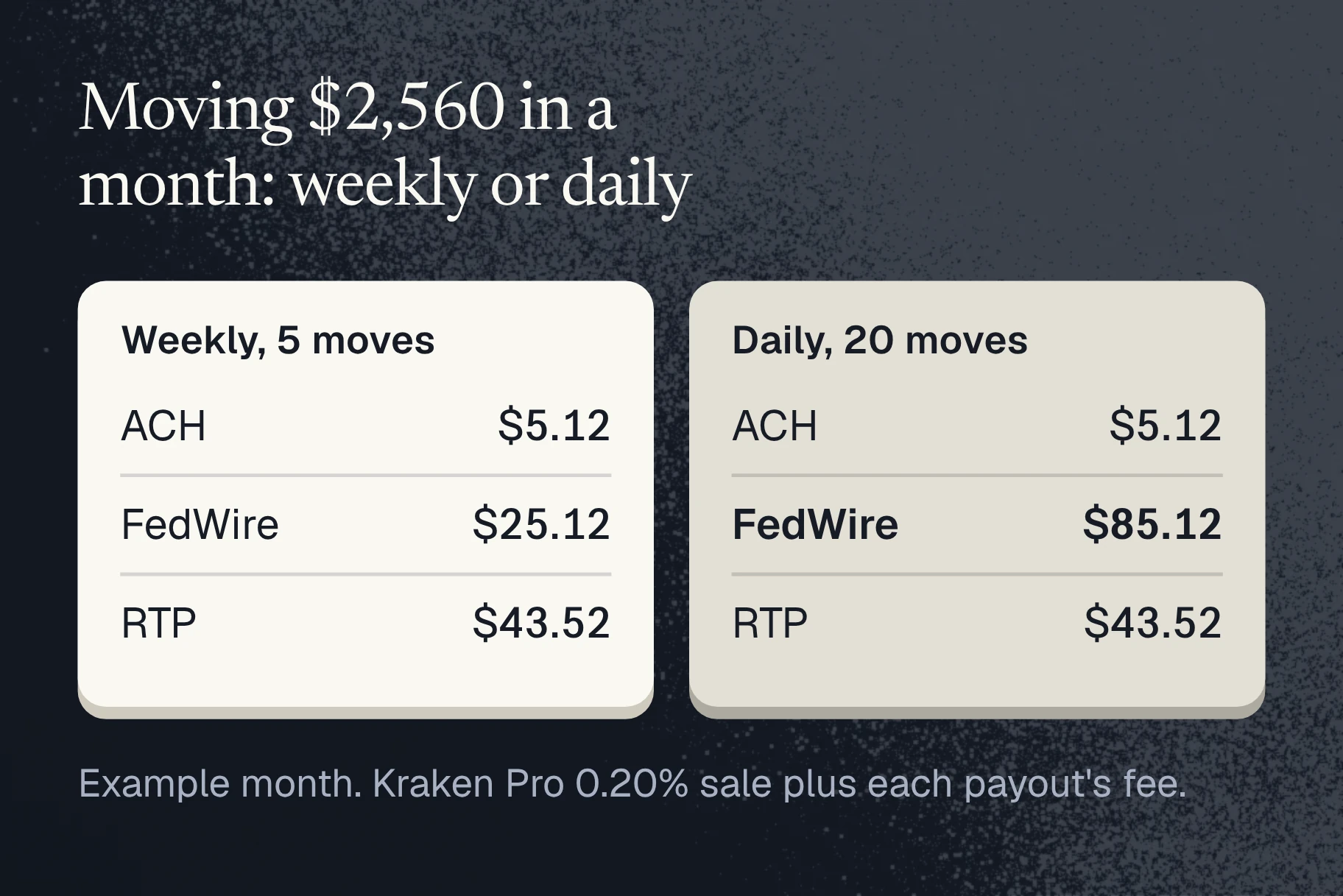
Two smaller costs come with every move. Sending from your wallet costs a network fee: a 100 USDC transfer on Polygon checked on November 23, 2026 paid about $0.0015, so twenty moves cost about three cents. And an exchange has a minimum deposit: Kraken's deposit page sets 2 USDC on Polygon and warns that deposits below it "will be marked as 'Failed' and the funds will be permanently lost." Sweeping every small sale the moment it lands is how a business ends up sending $1.50. What it costs to send money from your wallet covers the network fee in full.
The real cost of moving daily is your time: twenty sends, twenty sales and twenty withdrawals a month instead of five, for no saving on the percentage fees.
Why a same-day move rarely means same-day money
Selling on the day a sale arrives doesn't put dollars in the bank that day. Kraken's ACH payout takes 0 to 2 business days, its FedWire payout 0 to 1 business day for $4, and only RTP is "near-instant", at 1.50% of the amount and only where the receiving bank supports RTP.
In the example month, getting every dollar out the same day it arrived would mean RTP on every move: $38.40 in payout fees on $2,560, plus the $5.12 sale fee, against $5.12 in total for the weekly ACH move. Same-day dollars are worth paying for when a bill can't wait. As a habit, they cost this business about $38 a month for money it didn't need yet.
One example month, worked through
The example business takes about $500 a week in card sales that reach its wallet, keeps a $50 refund reserve there, and has set a ceiling of $1,000, about two weeks of sales. Three things happen in the month: a $40 refund in week 2, a $200 payment to a contractor who takes digital dollars on Thursday of week 3, and a one-off $800 order on Wednesday of week 3. All figures are an example.
The table shows the wallet on each move day, what the rule kept back and what it sent to the bank.
| Move day (example) | In the wallet | Kept back, and why | Moved |
|---|---|---|---|
| Week 1, Monday | $550 | $50 refund reserve | $500 |
| Week 2, Monday | $550 | $50 refund reserve | $500 |
| Week 3, Monday | $510 | $250: the reserve plus Thursday's $200 contractor | $260 |
| Week 3, Wednesday | $1,250 | $250: over the $1,000 ceiling, so the weekly move ran early | $1,000 |
| Week 4, Monday | $350 | $50 refund reserve | $300 |
Week 2's refund came out of the reserve, which is why week 3 opens with $510 rather than $550. On week 3's Monday the rule held back the contractor's $200 because it would be paid from the wallet before the next move. With about $200 of that week's sales already in, the $800 order pushed the wallet to $1,250 on Wednesday, above the ceiling, so the rule ran early: it kept the same $250 and moved $1,000. After Thursday's $200 to the contractor and about $300 of sales to Sunday, week 4 opened with $350.
Over the month $2,560 went to the bank in five moves, at a cost of $5.12 on Kraken Pro with ACH, and the bank paid the month's bills in dollars as usual. Reconciling those withdrawals with your bank means five to match instead of twenty.
When to break the rule
Four situations call for a move on another day, or for a different cadence:
- A bank bill is due before the next move lands, and the bank can't cover it. Move that day, and if the bill is due tomorrow, pay for FedWire or RTP. Then raise the bank buffer so it doesn't happen again.
- The wallet passes your ceiling. Run the weekly move that day, as in week 3.
- Some sales arrived on another network. A few card providers, such as Venmo and Cash App, pay on another network to the same wallet address, and Railbed's Move money to your bank guide says to "Send each coin on the network it arrived on". Sending on Ethereum needs a little ETH for the fee, so small balances there suit a monthly move.
- You pay suppliers in digital dollars. Then rule 2 keeps more back each week, and some weeks you may move nothing. Whether a supplier can be paid that way, and what to check first, is in can you pay suppliers and contractors from your wallet balance.
What the rule leaves to you
The rule decides when money moves, not how much risk you take. The ceiling is the most you'd be holding when something goes wrong with the dollar coin itself, and the existing article on whether it's safe to keep sales as digital dollars prices that exposure for each schedule; set your ceiling after reading it.
Taxes and bookkeeping are your accountant's call. Selling digital dollars for dollars is a transaction your books need to show, whatever the cadence, and five moves a month are easier to explain than twenty.
The first move also has a lead time the rule can't shorten: the exchange account must be open, in the business's name, with its checks finished. How to move your wallet balance to a business bank account walks through those steps, and what each route charges.
Where Railbed fits
Railbed is card checkout whose sales settle to a wallet you control, almost always as USDC on Polygon. It never holds the money, so "there's no payout to request": the weekly move is your step, through an exchange or a wallet app. On Home in Live mode, Move to your bank under your wallet opens the short version of the steps. Railbed's terms say the network fees when you move USDC out of your wallet, and whatever an exchange charges, aren't Railbed's, and refunds are yours to send from the wallet.
Set up the weekly move once
The Move money to your bank guide shows how to send to an exchange account on the right network, test with a small amount and withdraw to your bank.
Open the Move money to your bank guideCreate an account