What does it cost to send money out of your wallet, and what pays the network fee?
Receiving is free; sending needs a network fee. One real transfer read line by line, how much to keep for fees, and the wallets that take the fee from your dollars.
Press the card to run an example sale.
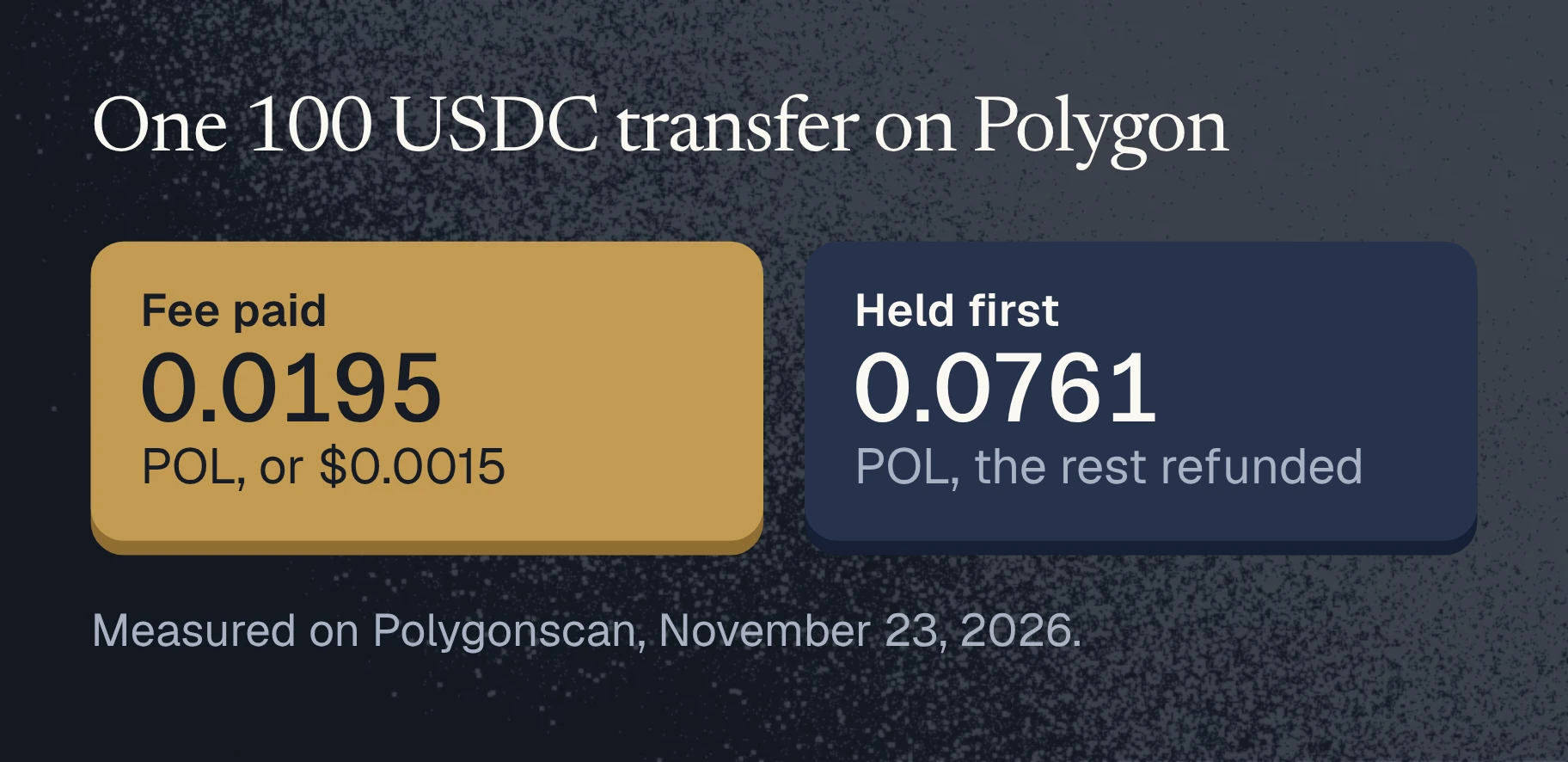
Yes: sending USDC on Polygon needs a network fee paid in POL, Polygon's own token, unless your wallet takes the fee from your USDC; receiving costs you nothing. The fee is tiny: on November 23, 2026 a 100 USDC transfer cost 0.0195 POL, about $0.0015, so one POL covers about 51 transfers like it.
This page is for a business that receives USDC on Polygon, from card sales or anywhere else, and never meant to own a second token. It reads one real transfer's fee line by line, works out how much POL to keep, and lists the ways to cover the first fee, including wallets that take it from your USDC, from each wallet maker's own documentation.
Why does sending USDC need POL?
Sending USDC needs POL because the network charges every transaction a fee in its own token, whatever token the transaction moves. Polygon's MATIC to POL migration notice said that POL "will be upgraded automatically to become the native gas and staking token on Polygon PoS" and that every transaction from September 4, 2024 "will use POL as the native gas token". Polygonscan's gas tracker puts it in one line: "Gas fees are paid in POL and denominated in Gwei."
Receiving is free for you because the sender pays the fee. When a card sale settles through Railbed, the payment network forwards the USDC to your wallet, and that delivery is covered by the 1% network fee taken from the sale, so your wallet needs no POL to receive. The first time you need POL is the first time you send: to an exchange, to a supplier or back to a buyer as a refund.
If your sales already sit in your wallet and the wallet won't send them, a missing fee is the usual reason. The USDC is not lost or locked; the wallet just has nothing to pay the network with.
What one transfer actually cost
One real transfer shows where the fee comes from better than an average can. On November 23, 2026 at 10:48:38 UTC, this transaction sent 100 USDC through Circle's USDC contract on Polygon, and Polygonscan shows each part of its fee.
The table reads the transaction's fee fields in order.
| Field on Polygonscan | Value | What it means |
|---|---|---|
| Gas limit and usage | 120,000, of which 74,159 used (61.8%) | The work the wallet allowed, and the work the transfer took |
| Gas price | 262.969 gwei | The price per unit of gas, in billionths of a POL |
| Max fee per gas | 633.947 gwei | The most the wallet offered to pay per unit |
| Transaction fee | 0.0195 POL ($0.0015) | Gas used times gas price: 74,159 × 262.969 gwei |
| Burnt | 0.0165 POL | The part of the fee destroyed rather than paid to validators |
The fee is the gas used times the price, and the gas used depends on the transfer. Another USDC transfer in the same second, of 0.01 USDC, used 107,628 gas at a higher price and cost 0.0324 POL ($0.0025). Polygonscan's gas tracker, read the same morning, put an ERC-20 token transfer, the kind a USDC send is, at $0.001.
How much POL should you keep?
Keep about one POL, which on November 23, 2026 cost less than eight cents at Polygonscan's price of about $0.077. That covers about 51 transfers at the fee measured above and leaves room for the larger amount a wallet needs to hold before it sends.
That larger amount comes from how the fee is offered. Polygon PoS prices fees the way Ethereum does, with a base fee, a tip and a maximum, as the fields on Polygonscan show. In ethereum.org's description, "the max fee must exceed the sum of the base fee and the tip" and "the transaction sender is refunded the difference". The measured transfer offered up to its 120,000 gas limit at a maximum of 633.95 gwei, which is 0.0761 POL, about $0.0059; it paid 0.0195 POL and kept the rest.
Fees move with demand, so the margin matters more than the exact figure. As an example of a busy day: if the gas price were ten times higher, the same transfer would cost about 0.195 POL, about $0.015 at the same POL price, still under two cents. Check the gas tracker before a large transfer if you want the day's figure.
Three ways to cover the first fee
The first fee is the only hard one, because you need POL before you can do anything else on Polygon. There are three ways around it.
- Let the wallet pay from your USDC. MetaMask's gas included transactions work on "Ethereum Mainnet, BNB Smart Chain, Arbitrum, Polygon, Linea, Base, and Tempo" for sends and app transactions, and on Polygon they accept USDC, USDC.e and several other tokens. If you don't have enough POL, MetaMask picks an eligible token for you; the page says the estimate includes "a small MetaMask fee" and that 'Smart Transactions' and 'Estimate balance changes' must be turned on.
- Withdraw POL from an exchange, on the Polygon network. Kraken's withdrawal fees page lists POL on Polygon at a 4 POL fee and a 6.5 POL minimum "including fee", so the smallest withdrawal delivers 2.5 POL. At about $0.077 a POL that is $0.31 in fees, enough to pay for about 200 transfers at the fee measured, to receive $0.19 of POL, plus the trading fee to buy it. The same page lists "Polygon (Ethereum)" separately, with a 7.64592 POL fee: that is POL on the Ethereum network, which your Polygon wallet would not see as gas.
- Send it from another wallet you control. If you or a business partner already hold POL on Polygon, one POL sent to the payout wallet is the cheapest route, and it costs the sender one ordinary fee.
Which wallets pay the fee for you?
Only some wallets can take the network fee from the token you send, and coverage differs by network. Each wallet maker's own page is the only reliable source, because the lists change.
- MetaMask: yes on Polygon. Its gas included page lists Polygon, and USDC among the Polygon tokens. MetaMask's gas guide explains what happens behind it: "MetaMask will swap your selected token for the network's native token."
- Trust Wallet: not on Polygon. Trust Wallet's FlexGas page, last modified August 19, 2026, lists BNB Smart Chain, Ethereum, Arbitrum, OP Mainnet and Base, and accepts TWT, USDT, USDC and USDC.e for the fee. Polygon is not on the list.
Railbed's Move money to your bank guide puts the same split plainly: "Some wallet apps, such as MetaMask, can take it from your USDC; others need a little POL." A few card providers pay on other networks, and those need their own token for fees: ETH on Ethereum and BNB on BNB Chain.
Does paying the fee in POL matter for your books?
It can, in the US. The IRS's digital assets page lists "By paying a transfer fee with digital assets" among the ways you can dispose of digital assets. Its list of when to answer "No" to the tax return's digital asset question includes moving digital assets between wallets you own or control, but adds "unless you paid a transaction fee with digital assets. This would be a digital asset transaction."
At a fraction of a cent per transfer the amounts are tiny, but a monthly transfer to your exchange still leaves a record your accountant may want. How the IRS's wording applies to your business is a question for a tax professional. Keep the transaction hash with the sale records, as the first-week checklist for card sales that settle to your wallet suggests.
What Railbed's fees cover and what they don't
The cost of delivering each sale to your wallet is inside the 1% network fee taken from the sale, and nothing after that is covered. Its terms list "blockchain transaction fees when you move USDC out of your wallet" among costs that are not Railbed's, so the POL for those fees is yours to add.
That fits the rest of the model: Railbed only knows your wallet's public address, so it can't pay a fee from it or move anything out of it. Once your first POL is in place, the next steps are checking a sale arrived on Polygonscan and turning USDC into dollars in a business bank account.
FAQ
Is POL the same as MATIC?
POL replaced MATIC as Polygon PoS's gas token on September 4, 2024. Polygon's notice said "for holders of MATIC on Polygon PoS, no action will be required", so an old MATIC balance on Polygon became POL. Guides that mention MATIC for fees mean POL today.
My wallet won't send my USDC on Polygon. Is the money stuck?
The USDC is still yours; the wallet is missing the fee. Add a little POL by one of the three routes above, or switch to a wallet that can pay the fee from USDC on Polygon, then send again.
Can I send POL to Kraken to sell later?
Kraken's deposit page lists a 6.5 POL minimum for POL deposits, and deposits under a minimum are, in Kraken's words, "permanently lost". For a fee balance of one or two POL, there is no reason to send it anywhere; leave it in the wallet.
{"heading": "See which wallet your sales reach", "description": "Railbed settles card sales to your own wallet, with delivery inside the 1% network fee. The wallet and settlement guide shows where to check each payout on Polygonscan.", "buttons": [{"label": "Read the wallet and settlement guide", "url": "https://railbed.com/docs/user-guide/wallet-and-settlement/"}, {"label": "Create an account", "url": "https://app.railbed.io/signup"}]}