I sent money from my wallet to my exchange on the wrong network. Can I get it back?
Where money sent on the wrong network actually is, who can reach it, and what Coinbase, Kraken, Binance and OKX say they recover and charge, from their own pages.
Press the card to run an example sale.
Often, if the address is your exchange's and the network uses 0x addresses, as Polygon and Ethereum do. The USDC isn't gone: it sits at that address on the network you used. Getting it back is the exchange's call, for a published fee such as Binance's 20 USDT or Kraken's $200 to $500.
This page is for a business that sent its sales from its own wallet to an exchange to cash out, and the deposit never arrived. It covers where the money is, who can reach it, what four exchanges' own recovery pages said on November 23, 2026, and how to stop it happening again.
Where is the USDC right now?
Your USDC is at the address you pasted, on the network your wallet used. A transfer happens on exactly one network, so USDC sent on Polygon can't drift to Ethereum or vanish between them. Circle's page on USDC sent to the wrong address or network puts it this way: "If the transaction completed on the network you used, your USDC is on that network."
Confirm three things before you contact anyone:
- Open the transaction on the explorer of the network you sent on: Polygonscan for Polygon, Etherscan for Ethereum. On the wrong explorer it won't be found at all, which looks like a loss but isn't.
- Check the status reads Success. Binance only takes requests for transactions "marked as 'confirmed/success' on the blockchain"; MetaMask notes a pending one can still be sped up or cancelled.
- Check where the token went. Compare the address on the token-transfer line, character by character, with the deposit address the exchange gave you.
Our walkthrough of reading a USDC transfer on Polygonscan shows each of those fields on an example transaction.
Who can get it back depends on whose address it is
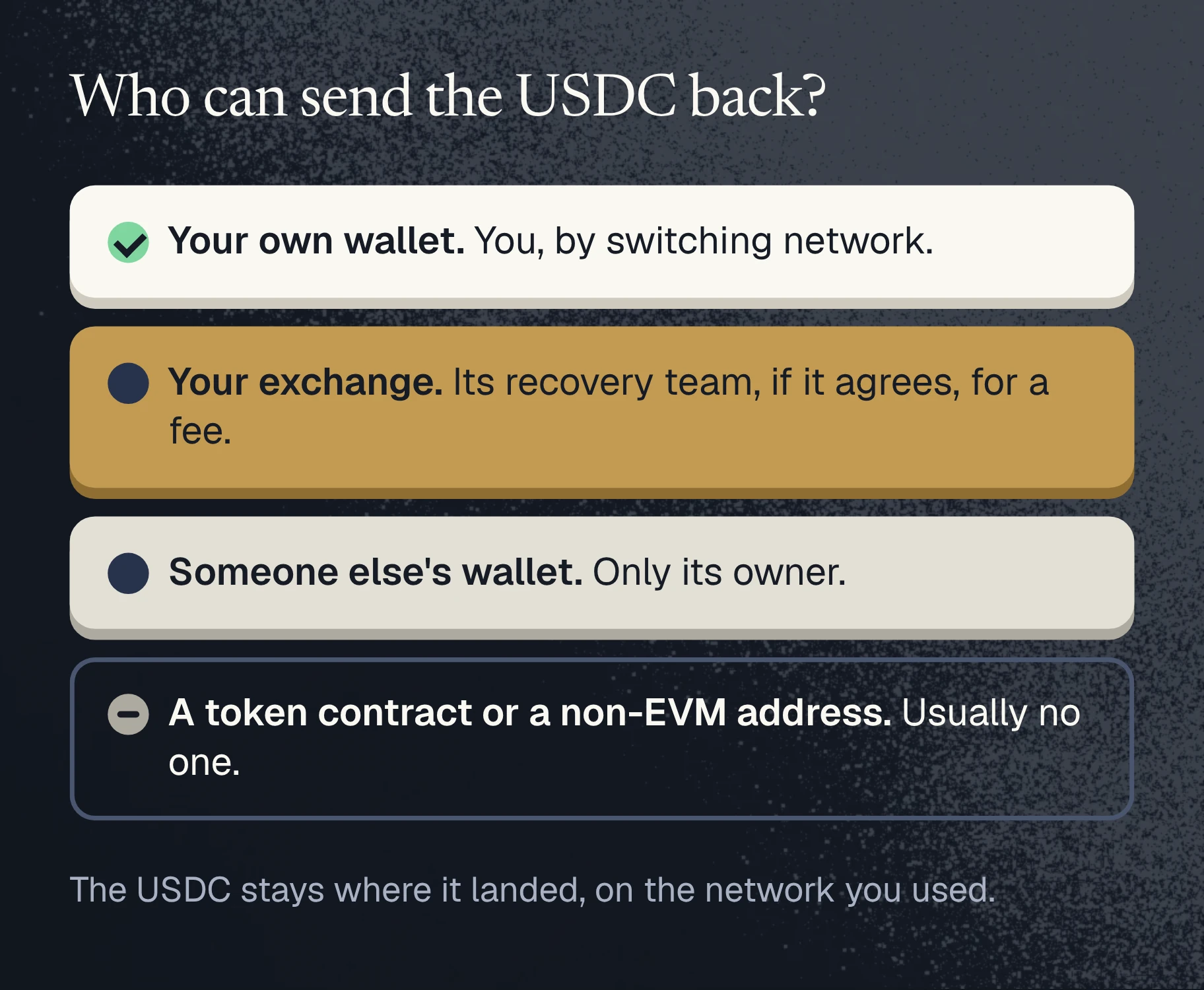
Only whoever controls the receiving address can move the USDC again, so the destination decides everything. MetaMask's wrong-network page explains that a recovery phrase "generates the same address across all EVM-compatible networks", such as Polygon, Ethereum and Arbitrum, which is why the first rows below are usually fixable and the last rows usually aren't.
| Where the USDC went | Can it come back? | Who would do it |
|---|---|---|
| Your own wallet, on a different EVM network | Yes. Switch the wallet to the network you used and the USDC is there | You. Circle's first step is "Switch your wallet to the network you used" |
| Your exchange's address, on a network it supports for USDC | Usually it is credited, sometimes after a support request | The exchange. Kraken and Binance both list "Deposit not credited" as free |
| Your exchange's address, on a network or token it doesn't support | Sometimes, for a fee, sent back to a wallet you name | The exchange's recovery team, at its discretion |
| Someone else's wallet | Only if they send it back | The owner. Circle: "If you know who controls the receiving wallet, contact them directly" |
| A smart contract, such as a token's own address | MetaMask: "there is no guarantee of recovery" | Perhaps the project team; Binance turns away contract addresses outside its BNB Pioneer Burn Program |
| An address from a network that isn't EVM | MetaMask: "it's likely your tokens are gone forever" | Usually no one |
What Coinbase, Kraken, Binance and OKX say they will do
Each exchange publishes its own rules. The short version is that Coinbase avoids the Polygon and Ethereum mix-up by design, Binance publishes the clearest fee table, Kraken publishes higher flat fees and quotes each case, and OKX's pages describe narrow recovery only.
Coinbase
Coinbase treats Polygon and Ethereum as one destination for assets it supports on both. Its page on assets on multiple networks says: "The same network must be used on both the sending end and the receiving end unless the transaction involves the Polygon and Ethereum networks," because "you will have one address that you can use for either network." The same page adds that "Support for multiple networks isn't available in New York," and that "Coinbase cannot recover funds that are lost from being sent or received using an incorrect network."
For deposits Coinbase doesn't support, it runs a separate asset recovery service. "Only certain assets and networks are eligible for recovery," and "Recoveries greater than $100 incur a 5% fee applied to the amount over $100. Network fees also apply and are deducted from your Ethereum balance." It runs only in a web browser, sends the funds to a self-custodial wallet you connect, names no timeframe, and warns that "Sending on the wrong network may affect eligibility."
Kraken
Kraken recovers some misrouted deposits for a fee and quotes each case first. Its crypto deposit recovery page, last updated September 21, 2026, opens with "Not all misrouted crypto deposits can be recovered" and prints a fee table whose relevant rows are "Deposit not credited", free; "Unsupported Tokens on Supported Networks", $200 USD; and "Deposit unlisted assets on unsupported networks", $500 USD. It adds that "Fees will be communicated upfront before proceeding with recovery" and that the time "varies depending on the complexity of the issue."
No row covers USDC, a coin Kraken lists, sent on one network to an address Kraken made for another, so ask which fee applies before agreeing. Nor does Kraken say which row covers USDC.e sent to Polygon after November 16, 2026, when it stopped accepting USDC.e.
Binance
Binance publishes the most detailed table, with a fee and an estimate for each case. Its self-service recovery page, updated May 28, 2026, lists "Deposit listed or unlisted tokens on unsupported EVM networks" at 20 USDT and 30 working days, "Deposit unlisted tokens on supported networks" at 20 USDT and 30 working days, and "Deposit not credited" free in 5 working days. "Fees are only collected if the retrieval is successful," and processing "starts after we have received the required information and fee, not at the submission date."
It turns away withdrawals sent to a wrong address, deposits into another user's account, contract addresses outside its BNB Pioneer Burn Program and requests made for someone else, may ask for "a video to prove the authenticity of the deposit", and says recovery "is not guaranteed".
OKX
OKX's US help pages describe the narrowest recovery of the four. Its page on depositing to the wrong address, updated September 8, 2026, says "Confirmed blockchain transactions generally can't be reversed, and recovery isn't guaranteed." Its deposit and withdrawal fees page says "we only support the recovery of below-minimum deposits for certain crypto" and that "additional recovery fees will apply." We found no OKX page with a wrong-network fee.
What recovery would cost on an example transfer
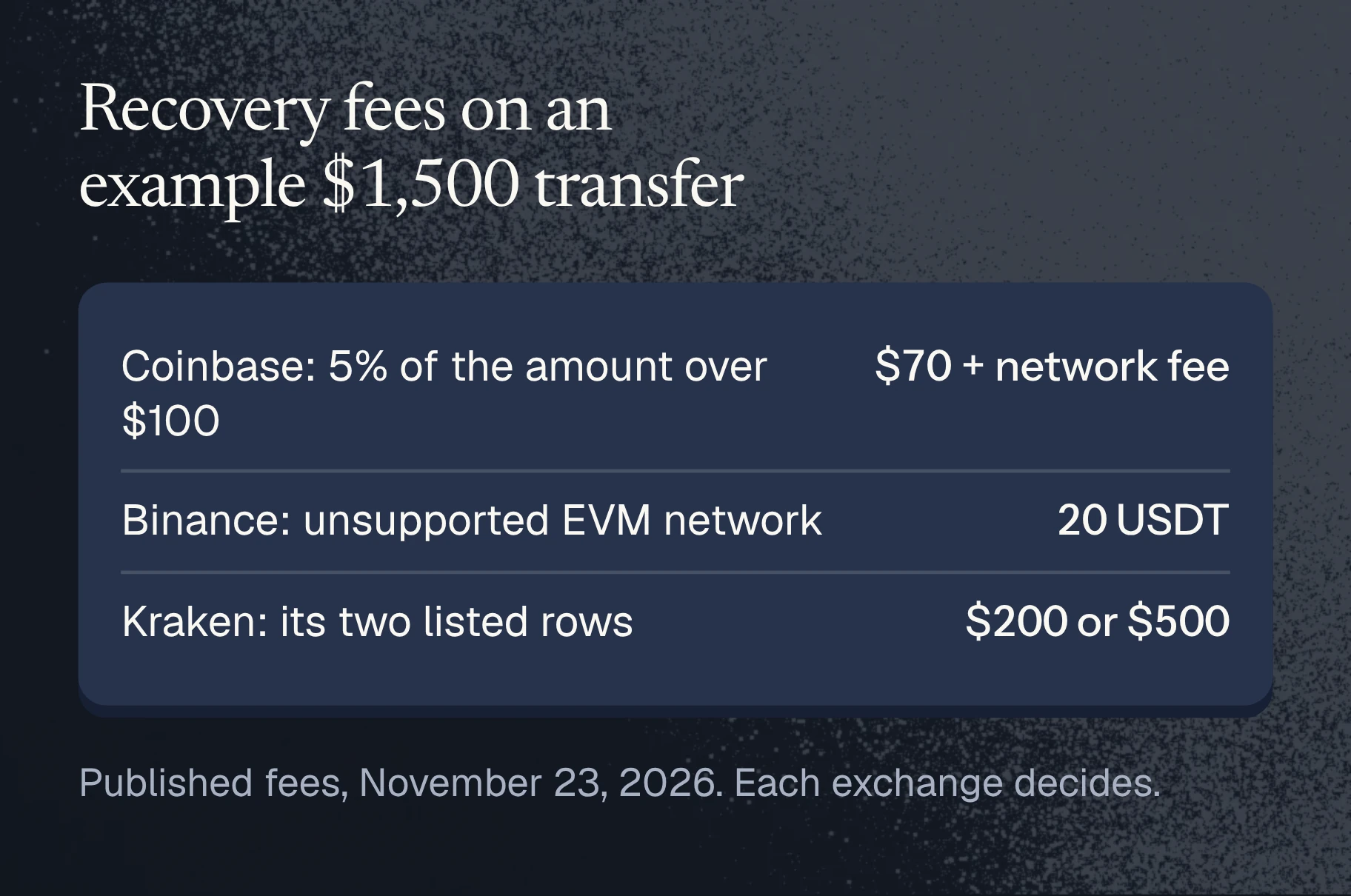
The published fees work very differently: Coinbase's grows with the amount, while Binance's and Kraken's are flat. The table applies each one to three example transfers, assuming the case is eligible at all, which none of the exchanges promises.
| Example transfer | Coinbase (5% of the amount over $100) | Binance (unsupported EVM network) | Kraken (its two listed rows) |
|---|---|---|---|
| $80 | $0, plus a network fee in ETH | 20 USDT | $200 or $500 |
| $1,500 | $70, plus a network fee in ETH | 20 USDT | $200 or $500 |
| $10,000 | $495, plus a network fee in ETH | 20 USDT | $200 or $500 |
On a small transfer, Kraken's flat fee is larger than the money itself, which is the strongest argument for a test transfer; on a large one, Coinbase's percentage costs many times Binance's flat fee. Binance and Kraken both say their fees are subject to change, so treat these as published figures, not quotes.
How to ask for it back
Every exchange asks for the same facts, so gather them before you open a request. Kraken's page lists the "transaction ID (TxID), cryptocurrency and amount, deposit address used, and date and time of the transaction"; Coinbase and Binance also need the network.
- The transaction ID, copied from the explorer, not typed.
- The network you sent on, as the explorer shows it.
- The deposit address, from the exchange's own deposit history or screen.
- A wallet you control to receive a refund. Kraken and Binance mark these recoveries "Refund", not "Credit", and Coinbase sends to a self-custodial wallet, so expect the USDC to come back out to you rather than appear in your exchange balance.
Then use the exchange's own route: Coinbase's asset recovery page, Binance's self-service form once a deposit is more than an hour late, or Kraken's support form. Be wary of anyone who offers help first. MetaMask's page says it "will never contact you directly, and will never ask for your Secret Recovery Phrase," and that someone messaging you to offer recovery is a scammer. No genuine recovery needs your recovery phrase or private key.
How to stop it happening again
The mistake happens when the network in your wallet doesn't match the network on the exchange's deposit screen. This routine makes the exchange's screen the starting point and takes about a minute.
- Start on the exchange. Choose to deposit USDC, choose the network, and only then copy the address it shows for that network. Kraken recommends taking a fresh address from your account for each deposit, so you never reuse one that has expired.
- Match the network in your wallet. On the send screen, check that both the coin and the network match what the exchange showed, before you confirm.
- Send each coin on the network it arrived on. A coin that came in on Ethereum goes out on Ethereum, to an address the exchange made for that coin on that network.
- Send a test first, above the minimum. OKX's page says a deposit "less than the minimum limit stated on the deposit page" won't be credited, so a test that is too small creates the very problem it was meant to prevent. Check the minimum on the deposit screen.
- Wait for the exchange to show the test, then send the rest. Success on the explorer only proves the transfer happened; the exchange crediting it proves the address and network were right.
Sending on any network also needs a small network fee in that network's own token; our guide on whether you need POL to move USDC on Polygon explains that step.
Where Railbed fits
Railbed can't reverse or recover a transfer, because it never holds or moves the money in your wallet. Card sales through Railbed settle to the payout wallet you control, almost always as USDC on Polygon, and the guide to moving money to your bank warns: "Money sent on the wrong network, or to an address made for another coin, can be lost."
What Railbed gives you is a record of where each sale arrived. Each Live payment's timeline opens its transaction on that network's explorer, and Verify balance on Home opens your wallet on the public Polygon explorer, as the wallet and settlement guide describes. Check it before you send, because a few payment methods pay on other networks: Apple Pay, as a provider of its own, pays USDC on Ethereum, Venmo pays PayPal USD on Ethereum and Cash App pays USDT on BNB Chain.
The same risk can reach you without your sending anything. Railbed refuses a token's own address as a payout wallet, its getting started guide says to use "a wallet you control, not an exchange deposit address", and its crypto payments guide explains why: "An exchange deposit address usually works on one network only, and money sent to it on a network the exchange doesn't support can be lost." An ordinary self-custody wallet, one a recovery phrase opens, has the same address on every EVM network, so a payment on Ethereum or BNB Chain still reaches you.
Railbed fits a business that wants its sales in a wallet it controls and is willing to own this one step. If you want someone who can undo a mistaken transfer, no payment service can offer that once the money is on-chain, Railbed included.
FAQ
How long does a wrong-network recovery take?
Only Binance gives estimates: 5 working days for a deposit that wasn't credited, and 30 working days for tokens on an unsupported EVM network, counted from when it has your information and fee. Kraken says the time "varies depending on the complexity of the issue," and Coinbase names no timeframe.
I withdrew from the exchange to my own wallet on the wrong network. Is that the same problem?
If the address is your own 0x wallet, no: switch the wallet to the network the exchange used and the USDC is there. A withdrawal to someone else's address is another matter; Binance's page says that once "your funds have already been withdrawn from your Binance account, we are unable to assist you."
{"heading": "Know which network every sale arrived on", "description": "Each Railbed payment links its transaction on the explorer, so you can check the coin and network before you move the money.", "buttons": [{"label": "Read the move-to-your-bank guide", "url": "https://railbed.com/docs/user-guide/move-money-to-your-bank/"}, {"label": "Create an account", "url": "https://app.railbed.io/signup"}]}