Two dollar coins share one name: which one were you paid in, and will your exchange take it?
Two dollar coins share one name on the network most payouts use. How to tell from the contract which one you were paid in, and what Kraken, Binance, OKX and Coinbase say about each.
Press the card to run an example sale.
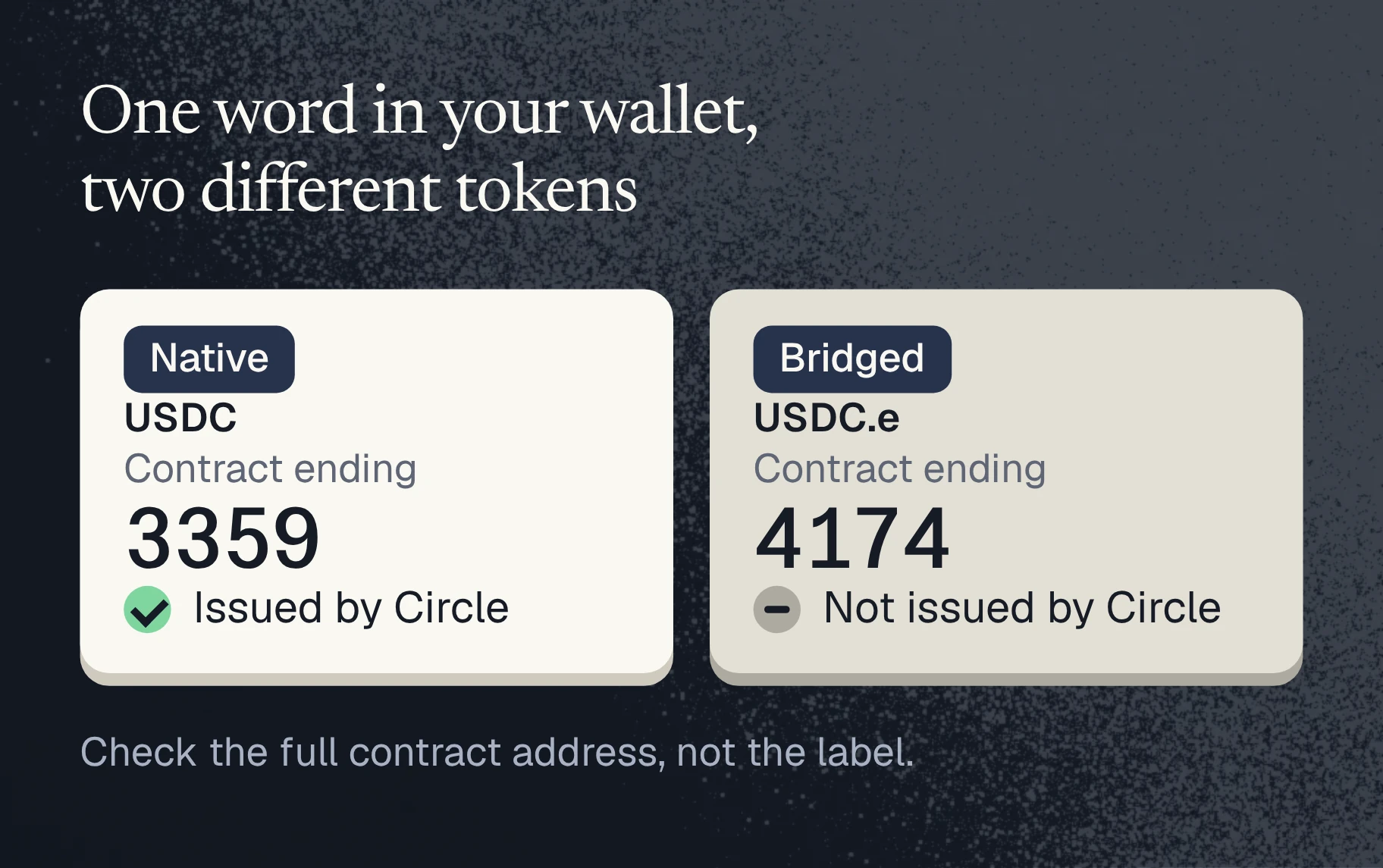
Native USDC on Polygon is Circle's own token, contract 0x3c499c…3359. USDC.e is an older copy bridged from Ethereum, contract 0x2791bc…4174, which Circle says it does not issue. Only the contract address tells them apart, and since November 16, 2026 Kraken no longer accepts USDC.e deposits on Polygon.
This page is for a business that has been paid in USDC on Polygon and needs to know which token is sitting in its wallet before it sends anything to an exchange. It gives both contract addresses from Circle's own pages, a four-step check on the block explorer, what each major exchange's own support pages say today, and what to do if what you hold turns out to be USDC.e.
What is the difference between USDC and USDC.e on Polygon?
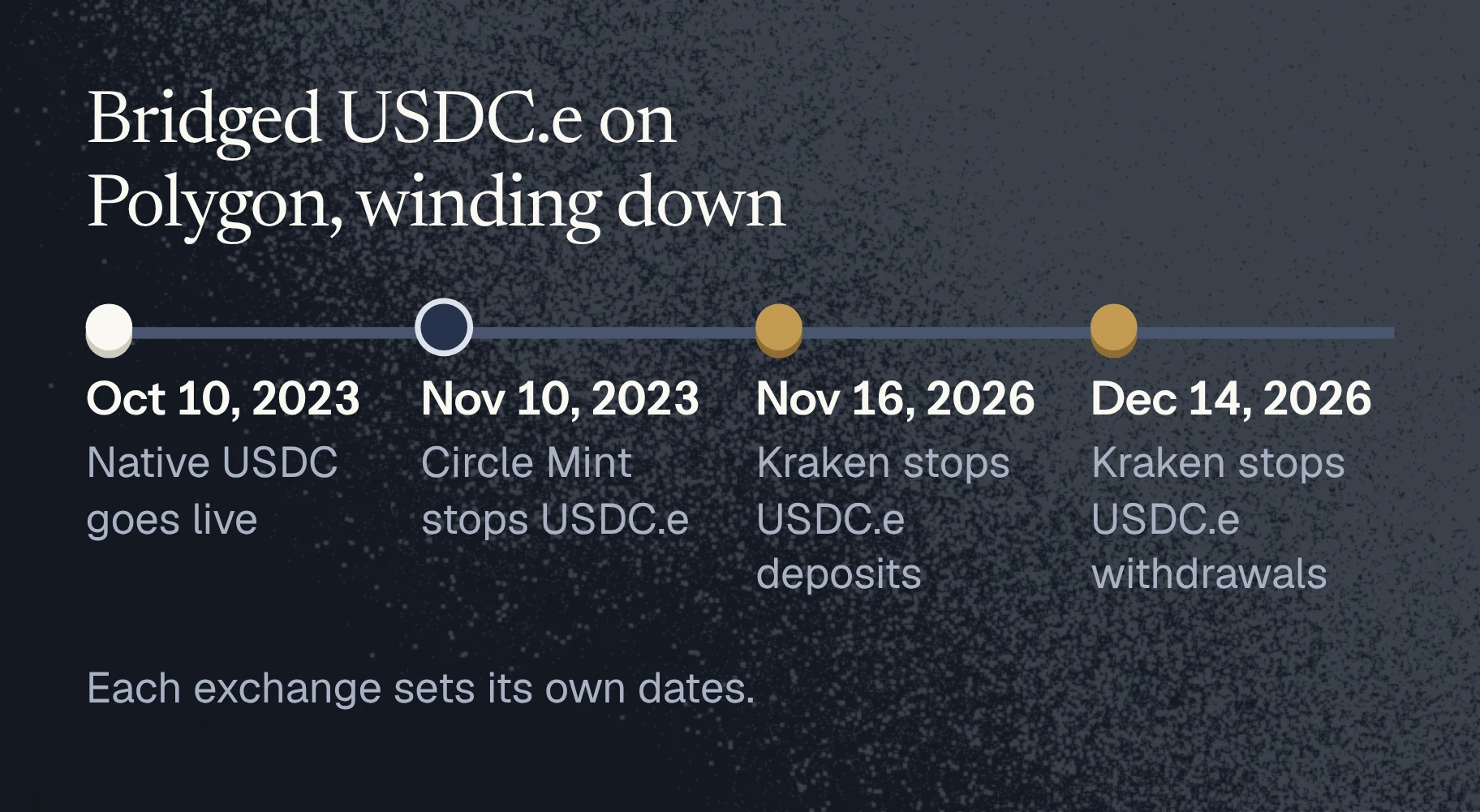
USDC is the token Circle issues directly on Polygon; USDC.e is USDC that was locked on Ethereum and represented on Polygon by a bridge contract. Circle's announcement of native USDC on Polygon PoS, dated October 10, 2023, puts it plainly: "Native USDC is officially issued by Circle and is always redeemable 1:1 for US dollars," while "Bridged USDC (USDC.e) is not issued by Circle."
Before that date the bridged token was the USDC most people used on Polygon, under the plain name USDC. Circle's end-of-life notice for bridged USDC explains that "the Ethereum-bridged form of USDC on block explorers like PolygonScan will be renamed as USDC.e". That rename is why older guides, screenshots and some wallet screens still call the bridged token plain "USDC".
The table shows the two tokens as Polygonscan described them on November 23, 2026.
| Native USDC | Bridged USDC.e | |
|---|---|---|
| Name on Polygonscan | USD Coin (USDC) | USD Coin (PoS) (USDC.e) |
| Contract | 0x3c499c…3359 |
0x2791bc…4174 |
| Issued by Circle | Yes | No |
| Supply on Polygon | About 567 million | About 1.05 billion |
The full addresses are on Circle's USDC contract list, which gives 0x3c499c542cEF5E3811e1192ce70d8cC03d5c3359 for Polygon PoS, and on the USDC.e token page and the native USDC token page on Polygonscan, where the supply figures come from. Much of the remaining USDC.e is used by the prediction market Polymarket, which The Block reported in February 2026 would move to native USDC with Circle "in coming months".
How do you tell which one you received?
You tell them apart by the contract address of the token that arrived, which you can read on Polygonscan in under a minute. A wallet's label is not enough: on the USDC.e token page, Polygonscan warns that "this token's displayed symbol does not match its contract's Symbol function", so an app that reads the name from the contract itself can show something other than "USDC.e".
- Open the transfer on polygonscan.com. Paste the transaction hash into the search box, or paste your own wallet address and pick the incoming transfer from its token transfers list.
- Find "ERC-20 Tokens Transferred". The line names the token. Native USDC reads "USD Coin (USDC)"; the bridged token reads "USD Coin (PoS) (USDC.e)".
- Click the token name and read the contract. The token page shows "Token Contract (WITH 6 Decimals)" and the full address. Native USDC ends in
3359; USDC.e ends in4174. - Compare every character with Circle's list. Lookalike tokens can copy a name and a logo but not an address. If the address matches neither, you have neither token, and you should not send it to an exchange as USDC.
Most wallet apps also show a token's contract address in its details screen, which gives the same answer without leaving the app. If you need a fuller tour of the transaction page, our walkthrough of checking a USDC payment on Polygonscan covers every field.
Which exchanges accept USDC.e on Polygon today?
Exchanges treat the two tokens as different assets, and the safe assumption is that a USDC deposit address on Polygon expects native USDC unless the exchange says otherwise. The table records what each exchange's or issuer's own pages said when read on November 23, 2026. Support changes without much warning, so check the deposit screen itself before sending.
| Where | Native USDC on Polygon | USDC.e on Polygon | Source, date shown |
|---|---|---|---|
| Kraken | Supported | Deposits off from November 16, 2026; withdrawals off from December 14, 2026 | Kraken notice, updated November 5, 2026 |
| Binance | Supported | Listed separately as MATICUSDCE, deposits "will continue to be supported" | Binance announcement, October 23, 2023 |
| OKX | Deposits from October 26, 2023 | Not stated on the page read | OKX announcement, October 24, 2023 |
| Coinbase | USDC on Polygon supported | Not stated on the pages read | Coinbase help, no date shown |
| Circle Mint | Supported | Not supported since November 10, 2023 | Circle help, updated June 2026 |
Kraken's own pages show why a dated notice beats a general help article. Its page on native USDC on Arbitrum, Optimism and Polygon, last updated October 19, 2026, still says "Kraken will continue to support deposits and withdrawals of USDC.e until further notice". The newer notice of November 5 sets the cut-off. If two pages from the same exchange disagree, follow the newer one and ask support before you send.
The Binance row rests on a 2023 announcement; it is the latest Binance statement on USDC.e we found, not proof that the deposit option still exists today.
What happens if you send USDC.e to an exchange that does not support it?
Sending USDC.e where only native USDC is accepted can mean the deposit is not credited, and recovery is at the exchange's discretion. Circle's own warning about its Circle Mint accounts is blunt: after the cut-off "you should not attempt to send bridged USDC.e to your Circle Mint, as it may not be recoverable and could result in a loss of funds."
Kraken's notice says deposits are "disabled" but does not say what happens to USDC.e that arrives after November 16. Treat that as an unsupported-asset deposit: do not send more, keep the transaction hash, and open a support ticket with the hash and the deposit address you used. What exchanges say about recovering deposits on the wrong network or in the wrong token, and what they charge, is covered in what to do if you sent USDC to an exchange on the wrong network.
You hold USDC.e: what are your options?
USDC.e in your own wallet is not lost; it is a token that fewer services accept. Both tokens were priced at about $0.9996 on Polygonscan on November 23, 2026, so the question is how to turn it into something your exchange takes, not how much it is worth.
- Swap it for native USDC in your wallet. Many wallet apps have a swap feature, and decentralized exchanges on Polygon trade the pair. A swap needs a little POL for the network fee and may lose a small amount to the price difference. Before you confirm, check that the token you will receive is the one ending
3359. - Send it to an exchange that still lists USDC.e deposits. Only do this when the exchange's deposit screen names USDC.e or shows the contract ending
4174for the Polygon network. A generic "USDC on Polygon" option is not enough. - Hold it for now. Nothing about the token changes in your own wallet, but the list of places that accept it has been getting shorter, as the dates above show.
Whatever you choose, send a small amount first and wait for it to arrive before moving the rest. Railbed's guide to moving money from your wallet to your bank gives the same advice for every transfer.
Which one do Railbed payouts arrive as?
Railbed's documentation says card payments settle "as USDC on Polygon for almost every card payment", and the API reports the coin as polygon_usdc. The public docs do not name a contract address, so the reliable check is the one above: open the payout and read its token contract.
Railbed makes that quick. In the dashboard, a Live payment's timeline opens its transaction on Polygonscan, as the wallet and settlement guide describes, and Verify balance on Home opens your wallet on the explorer. Through the API, each payment's settlement object carries txid_out, the transaction that forwarded the money to your wallet, and payout_wallet, the address it went to.
A few card providers pay on another network instead: Apple Pay as a provider of its own pays USDC on Ethereum, Alipay and WeChat Pay pay USDT there, Venmo pays PayPal USD there, Rampnow pays ETH there, and Cash App pays USDT on BNB Chain. Those arrive in the same wallet address but on a different network, so check them on that network's explorer, and send each one on the network it arrived on.
Railbed never holds the money, so it cannot swap, convert or move a token for you once it is in your wallet. That is the trade-off of settling to a wallet you control: nothing is held back from your sales, and the checks before you send are yours to make. If you would rather never handle a token at all, a processor that pays out to a bank account is the better fit; if you want card sales to land in your own wallet, start with what to know when card sales settle as USDC in your own wallet.
FAQ
Why does my wallet say USDC when Polygonscan says USDC.e?
The bridged token was called USDC on Polygon until Circle launched the native version in October 2023, and the renaming to USDC.e happened on explorers and in apps, not in every token contract. Polygonscan notes that the USDC.e symbol it displays does not match the symbol in the contract. Go by the contract address, not the label.
Is USDC.e on Arbitrum or Optimism the same token?
No. Each network has its own bridged token at its own address; Kraken's notice lists 0xff970a…5cc8 on Arbitrum and 0x7f5c76…1607 on Optimism, beside 0x2791bc…4174 on Polygon. Kraken ended USDC.e deposits on all three networks on the same date, November 16, 2026.
Can Circle redeem my USDC.e for dollars?
Circle's launch post says native USDC "is always redeemable 1:1 for US dollars" and that USDC.e "is not issued by Circle". Circle Mint, Circle's account for businesses, stopped accepting USDC.e on Polygon on November 10, 2023. To cash out USDC.e, swap it for native USDC or use a service that names USDC.e on its deposit screen.
{"heading": "See exactly what reached your wallet", "description": "Every Railbed payment links its payout transaction on the explorer, so you can check the token, the amount and the address before you move a cent.", "buttons": [{"label": "Read the wallet and settlement guide", "url": "https://railbed.com/docs/user-guide/wallet-and-settlement/"}, {"label": "Create an account", "url": "https://app.railbed.io/signup"}]}