Can you take Apple Pay and Google Pay and be paid to your own wallet?
Apple Pay and Google Pay pass a card to whoever processes it. Which routes pay to your own wallet, from what order size, and what a buyer sees.
Press the card to run an example sale.
You can take Apple Pay and Google Pay and be paid to your own wallet when the card provider that charges your buyer offers them on its checkout. Both wallets pass a card to whoever processes the payment, so that processor decides whether the button appears and where the money goes.
On a card checkout that pays to your own wallet, the sale lands there either way. That makes the real questions which processor shows the button, what arrives and from what order size. This page answers each for Railbed, with a $24.00 coffee order worked through.
Apple Pay and Google Pay are a card, not a separate way to get paid
Apple Pay and Google Pay hand the buyer's card to the seller's payment processor as a token, and the card network and the buyer's bank still move the money. Apple's page for payment platforms puts it plainly: "Neither Apple Inc. nor its affiliates are a bank. Any card used in Apple Pay is offered by the card issuer." What changes is what the seller receives. Apple's security page says "Apple sends your Device Account Number to the app or website along with the transaction-specific dynamic security code", and that "Neither Apple nor your device sends your actual payment card number to the app."
Google Pay works the same way on the web. Its developer overview says Google returns a payment token, and "the backend processes the purchase and sends the payment token to the payment service provider". Taking the token straight into your own systems is a direct integration, which Google limits to merchants that are PCI DSS compliant.
Three things follow for a seller:
- You need a processor or provider that supports the button. Apple says "Using an Apple Pay SDK or JavaScript API from a payment provider is the quickest and most reliable way to support Apple Pay in your app or on your website."
- The money goes where that processor sends it. A merchant account pays a bank account; Stripe, PayPal and Square pay out on their own terms, and Apple Pay doesn't change that.
- It is disputed like a card. Stripe's Apple Pay docs say "users can still dispute transactions after they complete payment" and "The dispute process is the same as that for card payments."
Two routes to your wallet on Railbed
On Railbed, Apple Pay and Google Pay reach you through the same independent, licensed on-ramp providers that charge every card, and the sale settles to a self-custody wallet you control, as a card checkout that pays to your own wallet explains. The buyer experience guide describes two routes and one that is paused.
The table shows each route, what the buyer taps, what arrives in your wallet and when the route is offered.
| Route | What the buyer taps | What arrives | When it's offered |
|---|---|---|---|
| A card provider's page, such as Stripe or Topper | Apple Pay or Google Pay on that provider's checkout | USDC on Polygon, like any card | Whenever that provider can take the buyer |
| Apple Pay as a provider of its own | Apple Pay in the checkout's list of providers | USDC on Ethereum, to the same wallet address | Prices in USD, EUR or GBP, an ordinary wallet, and orders large enough (next section) |
| Google Pay as a provider of its own | Nothing | Nothing | Paused "for now" |
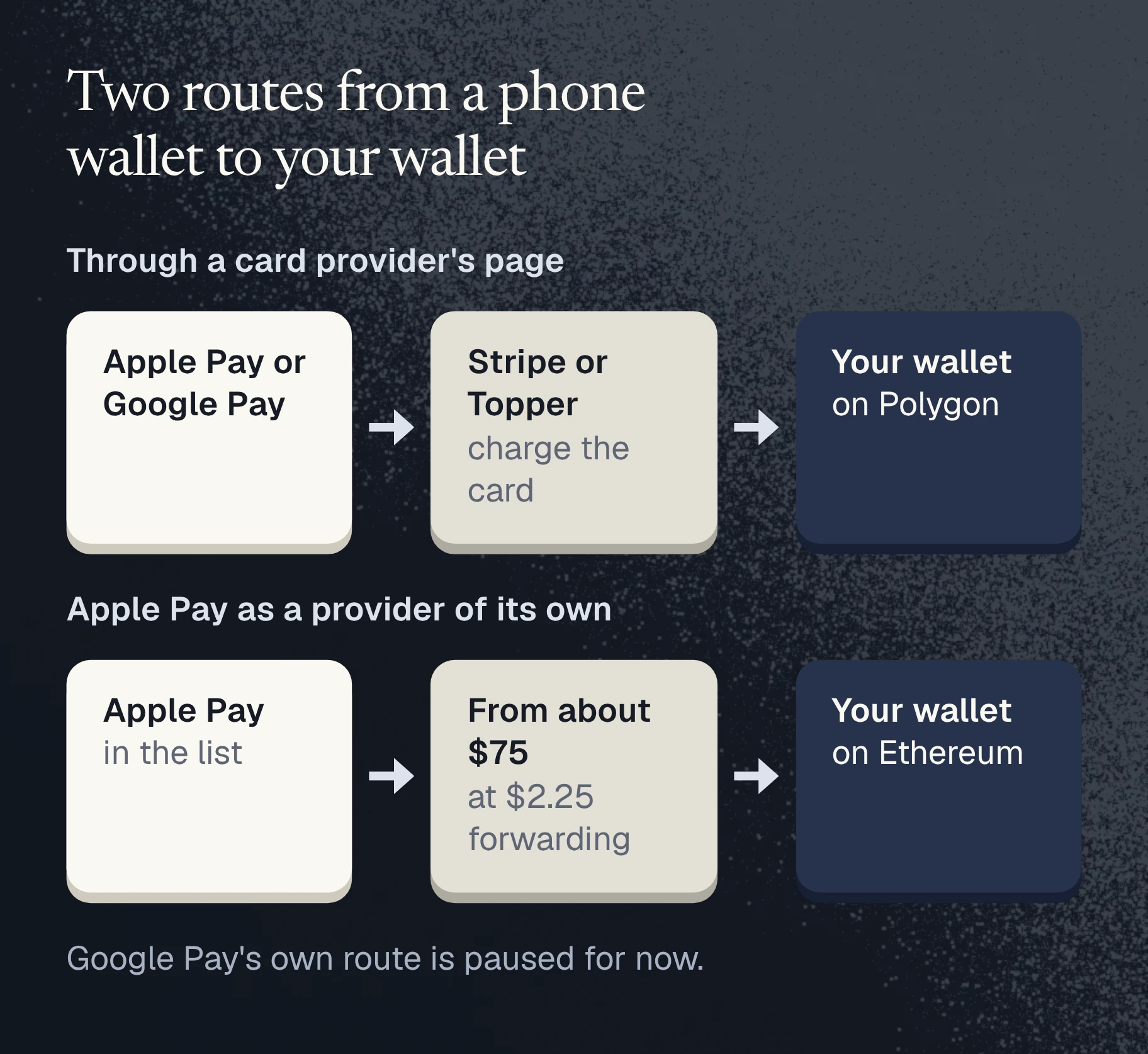
Two conditions decide whether Apple Pay's own route appears at all. In Live it is offered only with "an ordinary self-custody payout wallet, such as MetaMask, Coinbase Wallet or Rabby, where the same address receives on every network". A smart contract wallet such as a Safe can't take it, and Integrations → Card providers then lists it as Not offered and says what turns it on. On that same page Apple Pay has the Offer to buyers switch every provider has, and a checkout set to One provider can use Apple Pay only with If it can't take a buyer, use Smart Routing instead on, because its minimum changes from day to day.
Google Pay's own route is the paused one. The guide says "Google Pay as a provider of its own is paused for now. Buyers still pay with Google Pay through card providers such as Stripe."
What a buyer on a phone sees
A buyer pays with Apple Pay or Google Pay on the card provider's page, never on a form of yours. The guide's own steps run like this:
- They open your checkout page, payment link or invoice and see your business, the product and the price.
- They give an email address, answer any details you ask for, and choose Continue to pay.
- A provider is picked. With Smart Routing, the best provider for that buyer opens straight away. With Buyers choose, they see a list with a recommended Best match, and "When Apple Pay or Google Pay is on the list and the buyer's browser can pay with it, it comes right after Best match: Apple Pay on an iPhone, iPad or Mac set up for it, Google Pay on Android and in Chrome."
- The provider opens in a new tab, showing Opening secure payment until its page loads. The buyer pays there and completes any checks the provider asks for. Providers decide those checks, as whether buyers need ID to pay by card sets out provider by provider.
- Your checkout tab waits, then shows the result or follows your success address once the payment is marked paid.
Railbed's guide is careful about step 3: "Best match is a recommendation, not an approval guarantee." A wallet payment can still be declined on the provider's page for the same reasons a typed card can, covered in why card payments fail at a provider's checkout.
A $24.00 bag of coffee beans, worked through
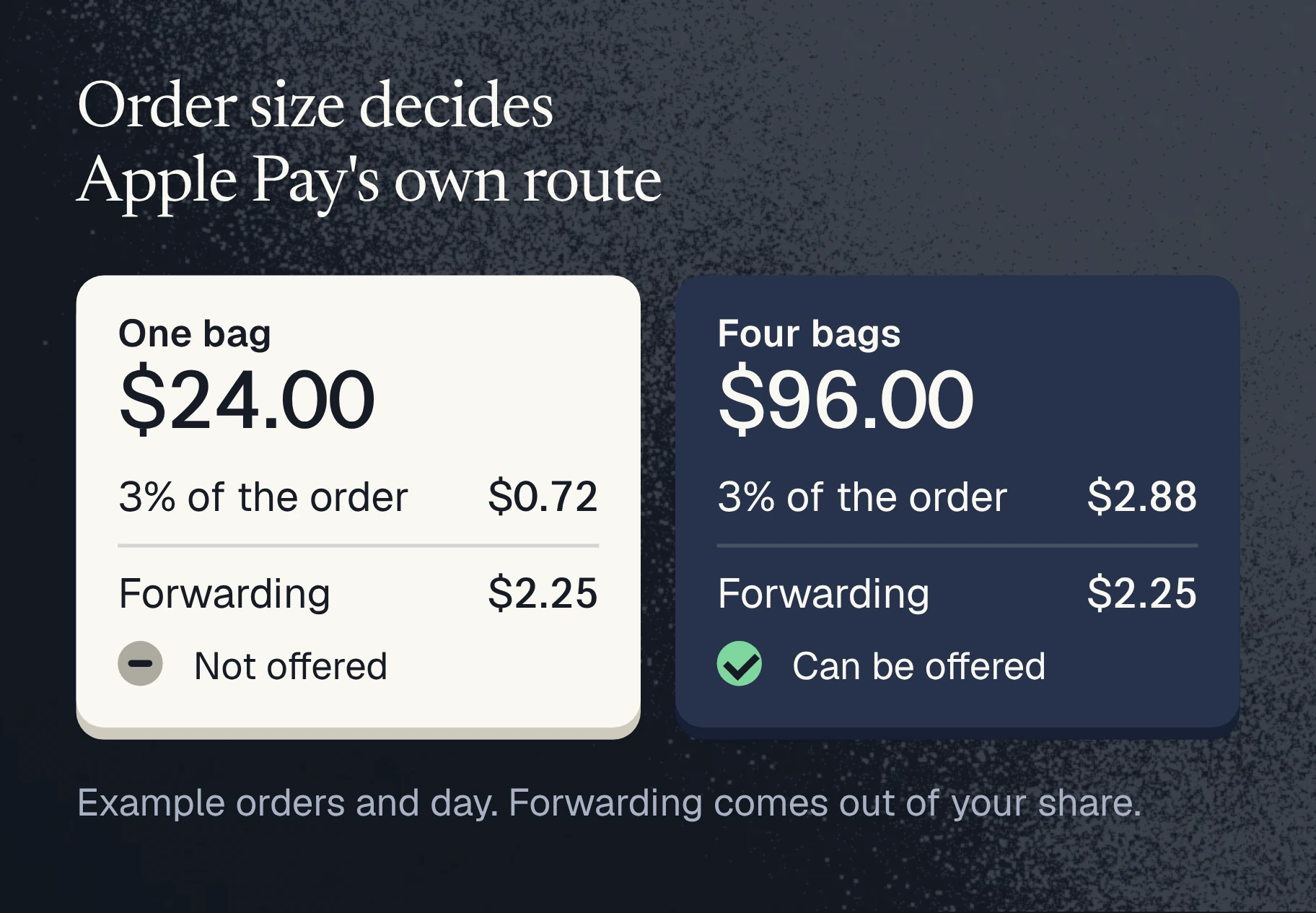
Order size decides which Apple Pay route a buyer can use, because Apple Pay's own route pays on Ethereum, where moving money costs more. The guide says those providers take an order only when the forwarding cost "stays at most 3% of it and the amount clears the network's minimum", which is "about $75 for Apple Pay when forwarding costs $2.25, a few dollars when it costs cents". That cost comes out of your share.
Take an example roaster selling a $24.00 bag of beans, on an example day when forwarding on Ethereum costs $2.25.
| Example order | 3% of the order | Forwarding cost that day | Apple Pay's own route |
|---|---|---|---|
| One bag, $24.00 | $0.72 | $2.25 | Not offered |
| Four bags, $96.00 | $2.88 | $2.25 | Can be offered |
The one-bag buyer on an iPhone can still pay with Apple Pay if the card provider they reach shows it on its page, and that sale arrives on Polygon like any card. The four-bag order clears the line, so Apple Pay can also appear as a provider of its own, priced in dollars, and that sale arrives on Ethereum with the $2.25 taken from your share. On a day forwarding costs cents, the one-bag order clears too. The figures for every provider's floor are in the minimum order for card payments.
Sales that arrive on Ethereum need their own handling
An Apple Pay sale through its own route is in the same wallet address as every other sale, but on a different network, and that affects what you see and how you move it. Home's figures stay in dollars whatever the coin. The live wallet balance, though, is read from Polygon, and the troubleshooting guide says it "leaves out money that arrived on another network", Apple Pay's Ethereum payments among them.
Moving that money has two rules from the guide on moving money to your bank: "Send each coin on the network it arrived on, to an exchange address made for that coin and network", and "Sending on Ethereum needs a little ETH in the wallet for the network fee." An exchange address made for Polygon is the wrong place for Ethereum money; what to do when money went on the wrong network covers what that costs and what can be recovered.
FAQ
Can a buyer dispute an Apple Pay payment? Yes. Stripe's documentation says the dispute process "is the same as that for card payments". On Railbed, card disputes go to the provider that charged the card, and settled sales can't be pulled back from your wallet; what friendly fraud is and what a merchant can do covers the disputes buyers file over purchases they really made.
Does the seller ever see the buyer's card number? No. With Apple Pay, the website gets a Device Account Number, not the card number, according to Apple's security page. On Railbed, card details go in on the provider's page, never on Railbed's, whether typed or from a wallet.
Is there still a Google Pay app in the US? Not the standalone one. Google said "the U.S. version of the standalone Google Pay app will no longer be available for use starting June 4, 2024", while paying with Google Pay at online checkouts and in stores "remains the same". Google Pay at a card provider's checkout is that second kind.
Who this fits
This fits a seller whose buyers shop on phones and who wants each sale paid to a wallet the seller controls, with Apple Pay and Google Pay coming from the providers rather than from an integration of its own.
Check which providers your buyers will see
Integrations, Card providers lists every provider with its minimum, and says when your wallet can't take Apple Pay's own route. Phone wallet sales settle to your wallet like any card.
Read the buyer experience guideCreate an account